.png?width=112&height=28&name=Logo%20(1).png)

 9 minute read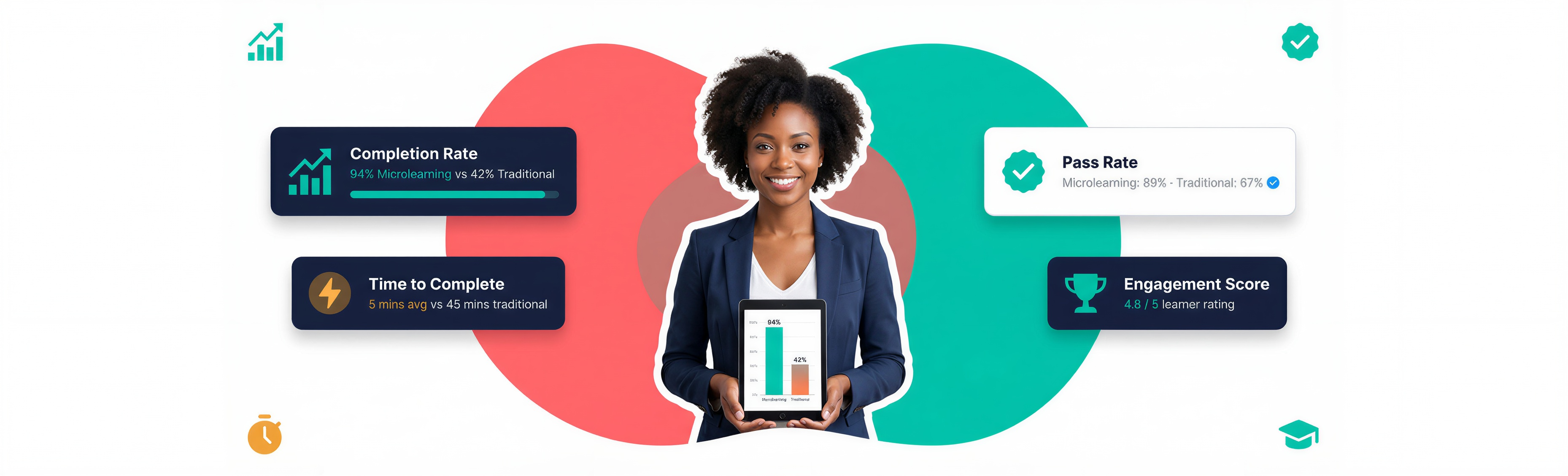
Senior L&D leaders evaluating delivery methods don't need another think-piece on whether microlearning works. The data settled that argument. The real question is which mechanisms drive completion, retention, and engagement - and which are marketing dressing on the same broken format. This article walks through 10 specific mechanisms behind bite-sized learning, each backed by peer-reviewed research or industry data, and each mapped to a real L&D use case. The headline number: traditional e-learning averages 20-30% completion. Bite-sized learning averages around 80%. The 10 reasons below explain why.

- Bite-sized learning beats traditional training on completion rates (~80% vs 20-30%) because it works with cognitive science, not against it.
- The 10 mechanisms split into three layers: cognitive foundations (1-2), delivery innovations (3-6), and program design (7-10). All three need to be present for the gains to compound.
- Gamified eLearning hits 90% completion against 25% for non-gamified. Spaced repetition reverses the Ebbinghaus forgetting curve. Manager-led nudging adds another 37%.
- The same mechanisms work across onboarding, leadership, sales enablement, role-based skills, and compliance.
- Score microlearning vendors on whether each mechanism is built into the architecture, not bolted on as a feature.
Why most training never finishes
Industry research puts the average corporate e-learning completion rate at 20-30%.1,3,16 For long mandatory modules, the real number is often single digits. That's not a learner problem - it's a format problem. Traditional e-learning was designed around the constraints of the 1990s LMS: long sessions, linear paths, desktop access, end-of-course quizzes. The brain was the constraint, then and now. The format never adapted.
Bite-sized learning - lessons of 3-12 minutes, single-objective, mobile-first, often gamified - was built around how memory actually works. The mechanisms below explain the outcomes.
The 10 mechanisms
Spaced repetition cuts the forgetting curve
Hermann Ebbinghaus showed in 1885 that we forget around 50% of new information within an hour and 80% within 30 days, unless it is reinforced. Spacing learning at increasing intervals reverses the curve - peer-reviewed research confirms an optimal cadence of 24 hours, then 3, 7, and 14 days.4
Traditional annual training fails this test by design. A learner sits through 45 minutes once and has lost most of it within a month. Bite-sized learning bakes spacing in - the same concept resurfaces multiple times across multiple lessons.
Where it shows up: anti-bribery training where employees need to recognize a red flag 18 months later; clinical protocols where memory affects outcomes.Single-objective lessons reduce cognitive load
Working memory has a hard ceiling - most studies put it at four to seven items at once. Cram a complete onboarding curriculum into a 3-hour session and most of it never makes it to long-term memory. Peer-reviewed research consistently shows microlearning sessions focused on single objectives produce superior outcomes compared to sessions covering multiple concepts.5
The difference: teaching "professional communication" in one block versus teaching "how to give written feedback that reduces defensiveness" as a single 5-minute lesson. The narrower the objective, the deeper the encoding.
Where it shows up: new manager training broken into 30+ single-skill modules; technical onboarding where each tool gets its own micro-lesson.Mobile-first delivery meets people where they are
96% of people turn to their phone in moments of need, and 70% of modern learners use smartphones to learn. About 28% use commute time.11 Yet most corporate e-learning is still designed for desktop. The mismatch is the completion gap.
Bite-sized learning that works on a phone in 30 seconds slots into the gaps that already exist - a 5-minute lesson between meetings, a refresher on the train, a frontline worker checking a procedure on the floor.
Where it shows up: retail and hospitality training for staff without a desk; sales enablement before customer calls; compliance refreshers for distributed workforces.Gamification turns voluntary engagement into a habit
This is where the data gap is largest. Gamified eLearning hits 90% completion rates against 25% for non-gamified programs.7,8 PwC research found gamified environments boost engagement by 60%.9 TalentLMS reports 83% of employees find gamified courses more motivating, leading to a 20% increase in completion.10 A 2024 ScienceDirect peer-reviewed study confirmed that points, badges, and leaderboards drive engagement, retention, and job performance.6
Used well, gamification doesn't make training feel like a game - it makes progress visible. Streaks and leaderboards expose what every learner cares about: how am I doing, and how am I doing compared to peers?
Where it shows up: large-scale role-based rollouts where you need momentum from word-of-mouth.
Gamification only works when the underlying content is good. A leaderboard on top of a 45-minute boring module is still a 45-minute boring module.
AI personalization removes irrelevance
Only 15% of employees can access learning directly related to their jobs (Towards Maturity).17 That's the irrelevance tax: people skip training because too much of it doesn't apply to them. AI-powered platforms fix this by building skill pathways per learner - a sales engineer and an account executive in the same team see different content.
Adaptive courses cut study time by 50% while improving retention. A learner who knows item 3 doesn't waste time on it; a learner weak on item 7 sees more reinforcement.
5Mins's AI-powered learning platform builds these pathways automatically across compliance, leadership, and role-based training.
Where it shows up: technical training across job families where a generic curriculum wastes 70% of learner time; leadership development where new managers and senior leaders need different paths.Just-in-time access turns training into job aids
56% of modern learners learn at a point of need.11 The average employee has 20 minutes a week for formal learning - around 1% of working time.18 That math doesn't work if training is locked in scheduled, hour-long sessions.
Bite-sized learning, indexed and searchable, becomes a job aid as much as a training program. A sales rep checks a 4-minute objection-handling lesson before a call. Training stops being an event and starts being a tool.
Where it shows up: sales enablement, onboarding, customer service - any context where training needs to be applied within hours.Retrieval practice (not just consumption) drives retention
The testing effect - documented by Roediger and Butler in 2011 and replicated since - shows that actively retrieving information produces stronger long-term retention than re-reading or re-watching the same content.13 The brain consolidates memory through retrieval, not exposure.
Long-form e-learning typically ends with one quiz. Bite-sized learning embeds retrieval into every lesson: a quick scenario, a multiple-choice check, a "what would you do here?" prompt.
Where it shows up: technical skills training where the gap between "I learned it" and "I can do it" is what matters; leadership scenarios where decision-making muscle is the goal.Short sessions match natural attention cycles
Sleep researcher Nathaniel Kleitman documented that human alertness cycles in 90-120 minute ultradian rhythms, and attention drops sharply after 20 minutes of focused work.15 The peer-reviewed sweet spot for microlearning is 8-12 minutes; the practical 5Mins benchmark is 3-5 minutes. Both fit comfortably inside a single attention window.
A 60-minute module asks the learner to do something the brain can't do well - sustain peak attention for an hour straight.
Where it shows up: any training where focus matters, which is to say, all of it.Continuous delivery beats annual campaigns
91% of organizations plan to implement continuous compliance and continuous learning approaches within five years. The annual training cycle is a Q1 fire drill that produces a spike in completion data and zero behavioral change for the rest of the year. Continuous, drip-fed bite-sized lessons spread the load and keep skills warm.
Same total training time per learner, redistributed across the year in 5-minute increments instead of one 45-minute session. Retention compounds, admin drops, audit-readiness becomes a side effect of normal operations.
Where it shows up: any program where the goal is sustained behavior change rather than a certificate.Real-time analytics surface intervention points
The final mechanism holds the other nine together. Bite-sized platforms generate per-learner, per-lesson data in real time. L&D can see which teams are completing, which lessons are dropping off, and which managers have learners falling behind - while there's still time to act.
Managers are the highest-impact lever. According to Gartner, when managers actively discuss training progress with team members, completion rates improve by an average of 37%.14 With analytics, dashboards flag at-risk learners and managers nudge with context, not generic reminders.
Where it shows up: any large-scale rollout where chasing completion manually doesn't scale - most rollouts above 100 people.What this means for your L&D evaluation
Each of these 10 mechanisms is independently evidenced. Compounded, they explain the gap between 20-30% and 95%+ completion rates. Vendor evaluation shouldn't focus on feature lists - it should focus on whether each mechanism is genuinely built in.
Five questions to ask any microlearning platform you're evaluating:
| Question | What you're checking |
|---|---|
| Show me one lesson, end to end. How long is it? | Is the format actually bite-sized (3-12 minutes), or a long course chopped into clips? |
| How does spaced reinforcement work? | Manual recurrence rules, or built-in spacing? |
| What does a learner see on their phone in 30 seconds? | Mobile-first, or desktop-first with mobile bolted on? |
| How is content personalized to the learner? | Role assignment only, or AI skill pathways? |
| What does the dashboard show me about an at-risk learner? | Periodic exports, or real-time flags I can act on this week? |
IKEN, a Bristol-based legal technology firm, is a useful benchmark. After switching from 30-page PDF handbooks to bite-sized learning with built-in gamification, IKEN saw an 84-85% engagement rate in the first week, 30+ day learning streaks, and a 95% reduction in setup time.
"The time saving has been massive - from 3 hours of setup per session to a one-time setup that lasts a full year. But what really surprised us was the engagement."
That's the pattern when the 10 mechanisms are built into the platform, not retrofitted onto a long-course architecture.
Frequently Asked Questions
Bite-sized learning, explained
What L&D leaders ask when evaluating bite-sized learning vs traditional training formats.
Why does microlearning improve completion rates so dramatically?
What completion rate should we expect from bite-sized learning?
Is bite-sized learning the same as microlearning?
Does bite-sized learning work for all training types?
How long should a bite-sized learning module be?
What's the ROI of switching to bite-sized learning?
 Sources
- eLearning Industry. Microlearning Statistics, Facts and Trends for 2025. elearningindustry.com
- eLearning Industry. Employee Training Statistics, Trends and Data in 2025. elearningindustry.com
- Continu. Corporate eLearning Statistics 2025. continu.com
- International Journal of Educational Pedagogy. The Science of Knowledge Retention in Bite-Sized Educational Experiences. 2024. eduresearchjournal.com
- ResearchGate / Gulf Journal of Advance Business Research. Investigating the effectiveness of microlearning approaches in corporate training programs for skill enhancement. 2024. researchgate.net
- ScienceDirect. Leveling up in corporate training: Unveiling the power of gamification to enhance knowledge retention, knowledge sharing, and job performance. 2024. sciencedirect.com
- BuildEmpire. Gamification Statistics for 2026. buildempire.co.uk
- AmplifAI. 50+ Gamification Statistics for 2026. amplifai.com
- PwC research, cited in Shift eLearning. Top Gamification Trends for Boosting Learning Engagement. shiftelearning.com
- TalentLMS Survey on gamification effectiveness. talentlms.com
- Elucidat. Profile of a Modern Learner. elucidat.com
- Elucidat. Bite-Sized Learning Guide. elucidat.com
- Roediger, H. L., & Butler, A. C. The critical role of retrieval practice in long-term retention. Trends in Cognitive Sciences, 2011.
- Gartner research, cited in Training Completion Rate: A Critical Metric. getmonetizely.com
- Kleitman, N. Sleep and Wakefulness. University of Chicago Press. Foundational research on ultradian rhythms.
- 360Learning. Course Completion: Boost Rates with 3 Key Insights. 360learning.com
- Towards Maturity / Bridging the Divide research, synthesized via Elucidat. elucidat.com
- Bersin & Forbes, cited in Elucidat: average employee has 20 minutes per week for learning. elucidat.com
- 5Mins. IKEN customer story. 5mins.ai
- 5Mins. AI-powered learning platform. 5mins.ai
 This article summarizes published research and industry data on bite-sized learning and microlearning effectiveness. Findings vary across contexts, audiences, and use cases. Pilot any new training format with your own teams to validate the gains before full rollout.



Saurav Chopra









_transparent%20background.png)



.png)