.png?width=112&height=28&name=Logo%20(1).png)

 14 minute read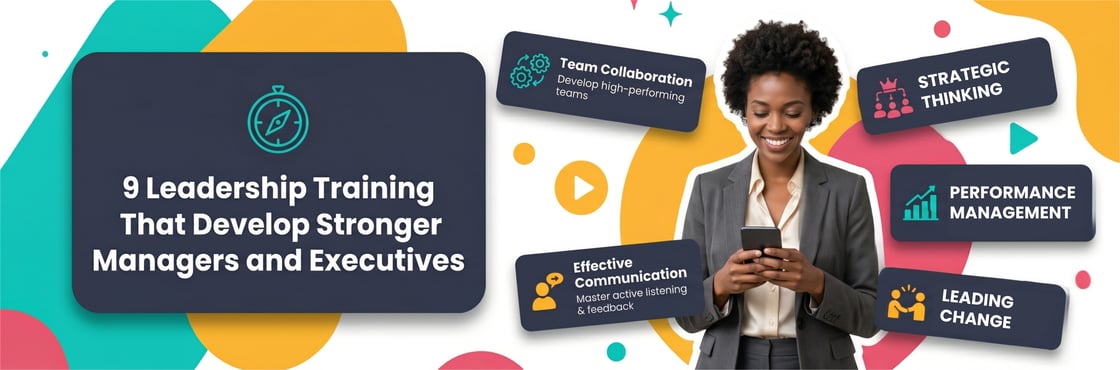
Most leadership programs do not work. McKinsey surveyed senior executives and found that only 11% believe their leadership development efforts deliver and sustain results. Around 75% rate their own programs as "not very effective." Deloitte's Global Human Capital Trends found a similar disconnect: 86% of companies say leadership development is a top priority, but only 13% feel they do it well. The gap between intent and impact in this category is wider than in almost any other area of L&D.36
The cost of weak leadership is not abstract. Gallup's State of the Global Workplace puts disengaged employees at $8.8 trillion in lost productivity globally, and managers account for at least 70% of the variance in team engagement.12 Engagement fell to 21% globally in 2024, a $438 billion productivity hit. The single biggest lever for fixing engagement, retention, and performance is the quality of the people leading teams. Yet research cited by the CIPD and Center for Creative Leadership shows 60% of first-time managers receive no leadership training, and 40% of them fail within 18 months.4
Most L&D leaders know this. The harder question is what to actually offer. This guide sets out the nine leadership training courses that belong in any modern leadership development portfolio, mapped across the leader lifecycle from first-time manager to executive. Each section names the audience, the specific behaviors to teach, the stats that justify the investment, and how to deliver each course so it changes daily behavior rather than just filling a calendar.

- Managers drive at least 70% of the variance in team engagement (Gallup), making leadership training one of the highest-impact investments in L&D.
- Only 11% of executives believe their leadership programs sustain results, and 86% of companies rate development as a priority while just 13% execute it well.
- Over 90% of organizations report a major or minor leadership skills gap (ATD, 2024); manager engagement itself fell from 30% to 27% in 2026.
- The strongest leadership portfolios cover nine course categories spanning frontline, mid-level, and executive needs, sequenced by leader stage.
- One-off workshops produce only temporary gains in over 70% of cases (HBR). Microlearning delivers leadership content with 95%+ completion rates compared with under 5% for traditional formats.
Why leadership training matters more in 2026 than ever before
Three forces have made leadership development the top-funded L&D category for 13 years running, according to Training Magazine's 2025 industry report, which found 30% of organizations expect to increase management and supervisory training budgets again in 2026.7
The first is the manager engagement crisis. Gallup's 2026 data shows manager engagement dropped from 30% to 27%, with the steepest declines among managers under 35 and female managers. Disengaged managers create disengaged teams: top-quartile engagement teams experience 81% lower absenteeism than bottom-quartile teams, and the cost cascades through productivity, retention, customer experience, and safety incidents.2
The second is the skills gap. ATD's research found more than 90% of organizations face a major or minor leadership skills gap.5 Hybrid teams, multigenerational workforces, AI-driven workflow change, and the retirement of Baby Boomer executives have collectively rewritten the manager job description. The World Economic Forum's Future of Jobs Report 2025 lists analytical thinking, resilience, flexibility, and management skills among the top fastest-growing skills to 2030, and most leaders were trained for a different decade.10
The third is the spend itself. The global corporate leadership training market is projected to grow from $98.7 billion in 2026 to $263.1 billion by 2036, a 10.3% CAGR. US companies alone spend approximately $166 billion annually on leadership development.8 Spend is not the issue. The issue is whether that spend produces measurable behavior change, and the data above is unanimous: at the moment, mostly it does not.
The 9 leadership training courses to build into your portfolio
Each course below answers a specific capability gap. Ordered roughly by leader seniority, they form a pathway: a first-time manager starts with course 1, a senior leader leans on courses 5 to 9, and high-performing organizations make all nine available continuously rather than as one-off events.
Foundations of People Management
This is the course most organizations get wrong by skipping it entirely. The CIPD and Center for Creative Leadership found 60% of first-time managers receive no leadership training, and 40% of them fail within 18 months.4 The promotion logic is well-known and broken: an organization rewards a strong individual contributor with a manager title, then hands them responsibility for people, performance, and budget without any framework for doing the job.
A foundations course teaches the basics most experienced leaders take for granted: how to run a one-to-one that produces a useful outcome rather than a status update, how to set clear expectations using something like a RACI or a written team charter, how to delegate without abandoning, how to give feedback that lands inside 48 hours of the behavior, and how to handle the first hard conversation about underperformance. Real examples beat theory: walk new managers through a difficult feedback conversation, a missed deadline, a peer they now manage, a request for a raise. Pair the course with a 30-60-90 day support cadence so new managers practice each skill in their actual role rather than only in a workshop.
What to include
Transitioning from peer to manager, running effective 1:1s, setting team goals and OKRs, basic delegation models (RACI, situational leadership), giving timely feedback, holding accountability conversations, recognizing and rewarding good work, escalating problems early.
Communication and Influence
Communication is the skill leaders use every hour and develop the least. CIPD's Good Work Index 2025 found only about two-thirds of public sector employees said their manager helps them perform well or provides useful feedback, suggesting the gap sits in everyday managerial communication rather than dramatic crisis moments.9 Strong communication training avoids vague concepts like "be a better listener" and focuses on specific behaviors and frameworks.
The five most important sub-skills: tailoring a message to different audiences (the same update lands differently with the board, your team, and a peer in finance); influencing without authority, which becomes the dominant mode of getting things done above middle management; chairing a meeting that actually decides something rather than ending in a "let's circle back"; writing the kind of update that earns time back rather than burning it; and handling pushback without going defensive. Use frameworks people can apply on Tuesday morning: the Pyramid Principle for written communication, BLUF (Bottom Line Up Front) for executive updates, SBI (Situation-Behavior-Impact) for feedback.
What to include
Active listening, structured messaging frameworks (Pyramid Principle, BLUF, SBI), executive presence in writing and email, influencing without authority, difficult conversations, presenting to senior stakeholders, chairing decision-making meetings, communicating across cultures and seniority levels.
Coaching and Performance Conversations
Telling people what to do gets you compliance. Coaching them to figure it out gets you capability. The shift from directive management to coaching management is the single biggest behavior change most mid-level leaders need to make, and it is the one most leadership programs treat as a soft topic. International Coaching Federation research links coaching directly to improvements in self-awareness, communication, goal attainment, and business performance.
A good coaching course teaches managers to ask better questions, hold the silence after asking, and resist the urge to solve problems for their team. The GROW model (Goal, Reality, Options, Will) gives a simple structure; tools like Marshall Goldsmith's "feedforward" or the Karpman Drama Triangle help managers spot patterns that derail conversations. The harder edge is the performance conversation: honest, specific, timely. Most managers either avoid these conversations until annual reviews force them, or deliver feedback so vague the recipient leaves more confused than before. Train managers to use SBI for daily feedback and a structured PIP framework when performance has genuinely slipped.
What to include
The GROW model, powerful questions, holding silence, distinguishing coaching from mentoring, giving developmental feedback (SBI), performance improvement conversations, recognition that motivates beyond cash, calibrating challenge and support, conducting effective performance reviews, addressing underperformance early.
"The leadership programs that fail are the ones that treat development as a 2-day workshop. Behavior change is daily, not annual. The managers who actually grow are the ones who get small, useful inputs every day in the flow of work, not a binder once a quarter."

Emotional Intelligence and Self-Awareness
Emotional intelligence is the leadership skill most consistently linked to performance, and the one hardest to build in a classroom. Research from the Center for Creative Leadership identifies self-awareness, self-regulation, and empathy as foundational competencies for mid- to upper-level leaders, and CCL's own 16-competency framework includes resourcefulness, decisiveness, and the ability to "lead employees" as direct outputs of emotional self-management.12
The most effective EI training pairs assessment with reflection. A 360-degree review or a tool like Hogan, DiSC, MBTI, or the EQ-i 2.0 gives leaders honest data about how they are perceived, then the training focuses on the gap between intent and impact: what you mean to communicate versus what your team actually experiences. Most leaders who think they are direct are actually blunt. Most who think they are warm are read as conflict-avoidant. Most who think they are calm under pressure are read as disengaged. Closing those gaps is where the real work happens. McKinsey recommends 360-feedback at the start of a development program and again 6 to 12 months later as the most reliable measure of behavior change.3
What to include
360-feedback debriefs, identifying personal triggers and stress responses, regulating emotional responses under pressure, reading team dynamics and group emotion, building psychological safety (Edmondson's four-stage model), leading with empathy without losing edge, managing your own energy and burnout risk.
Strategic Thinking and Decision-Making
Most strategic thinking training is too abstract to be useful. It covers Porter's Five Forces and SWOT analysis, then sends leaders back to a Tuesday inbox where the actual challenge is choosing between three competing priorities with incomplete information and a budget constraint. McKinsey's research on leadership development failure singles out "one size fits all" thinking and disconnect from real business context as the most common reasons strategy training does not transfer to behavior.3
A useful version of this course teaches three things. First, problem framing: most poor decisions are well-executed answers to the wrong question. Tools like the "5 Whys", premortems, and Issue Trees help leaders interrogate the question before they answer it. Second, weighing options under uncertainty: expected-value thinking, base rates, and recognizing cognitive biases like anchoring, sunk-cost fallacy, and overconfidence. Daniel Kahneman's work on System 1 and System 2 thinking is now standard in executive curricula. Third, committing to a direction without endless analysis: Jeff Bezos's "two-way door" framework for distinguishing reversible from irreversible decisions, and disagree-and-commit norms for closing out debate.
What to include
Problem framing and reframing, scenario planning, decision-making under uncertainty, identifying and counteracting cognitive biases, prioritization frameworks (RICE, ICE, Eisenhower Matrix), communicating strategic choices to operational teams, building a strategic narrative the organization can act on.

Resist the urge to put every leader through every course. The strongest portfolios run Courses 1-2 in the first 90 days of management, layer Courses 3, 4, 7, and 8 across years one and two, and reserve Courses 5, 6, and 9 for senior leaders. This is covered in the framework section below.
Change Leadership
McKinsey research suggests around 30% of US companies admit they have failed to fully exploit international business opportunities because they lack enough leaders with the right capabilities, and the same body of work repeatedly cites change execution as the weak point.3 Strategy is comparatively easy to write. Getting an organization of 500, 5,000, or 50,000 people to actually adopt it is the hard part, and most senior leaders have never been formally trained in how to do it.
Change leadership training equips senior leaders to do the work most strategy decks ignore. Building a stakeholder map and understanding which coalitions are needed before the launch announcement. Surfacing resistance early rather than letting it surface during execution. Communicating the case for change in a way that connects with people's day-to-day reality, not the boardroom rationale. Pacing change so the organization can absorb it; Kotter's research suggests the failure rate of change programs is roughly 70% precisely because leaders push too hard, too fast, or with too little communication. The best programs combine frameworks like Kotter's 8-Step, ADKAR, and Bridges' Transitions Model with case studies of transformations that worked (and ones that quietly failed).
What to include
Building the case for change, stakeholder mapping and coalition-building, managing resistance and skepticism, sustaining momentum past the launch phase, leading through ambiguity, communicating during uncertainty, integrating cultures after M&A or restructure, leading AI and digital transformation specifically.
Inclusive Leadership
Inclusive leadership has moved from a DEI compliance topic to a core management capability. Research consistently links inclusive teams to better decision-making, higher innovation, and stronger retention. CIPD found 60% of organizations in Ireland were planning comprehensive EDI training for managers and staff in 2025, alongside 73% planning pay equity reviews.10 Multigenerational, multicultural, and neurodivergent teams now make up the majority of most workplaces, and leaders who default to a single management style limit the performance of everyone who does not fit it.
A practical inclusive leadership course goes well beyond awareness training. It covers behaviors. How to run a meeting where everyone contributes, including the introvert, the remote attendee, and the most junior person in the room. How to recognize where bias enters performance reviews, hiring decisions, and promotion calibration; tools like structured interviews, blind CV review, and calibration sessions reduce bias measurably. How to give feedback across cultural and generational differences, where directness and the meaning of silence vary widely. How to build psychological safety that holds when the team disagrees, not just when things are easy. How to support neurodivergent team members without making it weird. The Training Magazine 2025 report noted DEI training spending has been volatile due to government policy changes; serious organizations have responded by reframing the work as "inclusive leadership" tied to performance outcomes rather than as standalone DEI.7
What to include
Unconscious bias and how it affects daily decisions, inclusive meeting facilitation, equitable performance reviews and calibration, managing across generations and cultures, building psychological safety (Edmondson), neurodivergence at work, allyship as a practice not an identity, addressing microaggressions constructively.
Leading Hybrid and Remote Teams
The leadership skills that worked when everyone was in the office do not transfer directly to a hybrid context. Visibility is harder to read. Trust takes longer to build. Coordination costs more, and the cost of unclear expectations is higher because there are fewer ambient corrections. Most leaders adapted to remote work after 2020 without ever being trained for it, and the result shows in surveys reporting hybrid teams with weaker engagement, slower decision-making, and higher voluntary attrition than either fully remote or fully in-office teams.
A hybrid leadership course covers the practical mechanics rather than philosophy. Async-first communication standards: when to use email vs. chat vs. video vs. document, and norms about response times and "no-meeting" blocks. Hybrid meeting design: how to run a meeting where in-person and remote attendees actually have equal voice, including the basics of camera, audio, and shared-document discipline. Building team culture without relying on incidental office moments; rituals like virtual coffee, async show-and-tell, and team "working agreements" do measurable work. Managing performance based on outcomes rather than visible activity, which requires clear goal-setting (often quarterly OKRs) and trust in the data. Supporting wellbeing and managing burnout risk, which is higher in hybrid teams because boundaries blur. Time zone and working pattern fairness, especially for global teams.
What to include
Async communication standards and channel etiquette, hybrid meeting design, building trust at distance, outcome-based performance management, supporting wellbeing in distributed teams, managing across time zones and working patterns, running a high-trust 1:1 by video, designing onboarding for remote hires.
Executive Presence and Boardroom Communication
Executive presence is the skill that separates strong operators from strong leaders, and it is rarely taught directly. The Center for Creative Leadership's research notes that 38% of new chief executives fail in their first 18 months on the job, and the failures cluster around communication, presence, and stakeholder management rather than technical knowledge. The cost of getting this wrong is significant: a single underprepared board appearance can permanently shift how a leader is perceived.
The skill covers how a leader shows up in high-stakes settings: presenting to a board, fielding tough questions from investors, communicating during a crisis, or representing the organization to the press, regulators, or major customers. The best executive presence training is part-coaching, part-rehearsal. Leaders work on the substance (structuring a board paper using something like the McKinsey "answer-first" structure, anticipating likely questions and preparing the underlying analysis, learning what level of detail a board actually wants) and the delivery. Pacing, gravitas, eye contact, handling interruption gracefully, managing nerves under camera, and the difficult skill of saying "I do not know, I will follow up by Friday" without losing authority. Specialist coaches and former journalists are often the best instructors here. For executives moving from functional roles to enterprise leadership, this is often the difference between being seen as a high-performing director and being seen as ready for the next role.
What to include
Structuring board-level communications (answer-first, exec summary), fielding hard and hostile questions, presenting financial and strategic information without losing the room, crisis communication and media training basics, gravitas and composure under pressure, building executive narrative and personal brand, navigating board dynamics.
How to choose the right leadership training mix
Not every leader needs every course. The strongest L&D portfolios sequence courses by leader stage and pull the right ones forward when business conditions demand them. A simple framework:
- First 90 days as a manager: Course 1 (Foundations) plus the basics of Course 2 (Communication).
- First two years as a manager: Add Course 3 (Coaching), Course 4 (Emotional Intelligence), Course 7 (Inclusive Leadership), and Course 8 (Hybrid).
- Senior manager and director level: Layer Course 5 (Strategic Thinking) and Course 6 (Change Leadership), with Courses 3 and 4 deepened.
- Executive and board-facing: Course 9 (Executive Presence), with refreshers on Courses 5 and 6 as the scope expands.
Three warnings worth flagging.
First, do not buy a single multi-day workshop and call it done. McKinsey's research found one-size-fits-all programs are the most common cause of leadership development failure, and Harvard Business Review studies have shown more than 70% of leadership development efforts produce only temporary gains.3 The reason is mechanical: leadership is a daily practice, and a 2-day off-site cannot install daily habits. Ebbinghaus's forgetting curve research shows learners lose roughly 70% of new information within 24 hours and 90% within a week without reinforcement.
Second, do not skip measurement. Set behavior-based goals at the start of each program, measure them through 360 feedback and team-engagement pulse surveys at 6 and 12 months, and adjust. Programs evaluated only on participant satisfaction tend to optimize for entertainment, not behavior change. McKinsey's published guidance specifically warns that participant feedback alone allows trainers to "game the system" by delivering syllabi that are pleasant rather than challenging.3
Third, do not under-invest in frontline managers. Research suggests frontline managers receive the least training investment despite managing the most people, and the cost of that decision shows up directly in engagement and retention numbers. The 60% of new managers who get no training are leading the majority of your workforce.4

Harvard Business Review research has shown that more than 70% of leadership development efforts produce only temporary gains, and McKinsey found just 11% of executives believe their programs sustain results. The biggest single cause is delivery, not content. A two-day workshop teaches the framework; a daily habit changes the behavior.
Delivering leadership training that actually changes behavior
The biggest reason leadership programs fail is not content. It is delivery. A 2-day workshop teaches the framework, then real life resumes and the new behavior fades inside a fortnight, a pattern documented in Ebbinghaus's forgetting curve and confirmed by every modern study of training transfer. A McKinsey study summarized by industry researchers found only 25% of managers surveyed felt training programs measurably improved business results.3
The format that consistently produces behavior change is short, frequent, and embedded in the flow of work. Five to ten minutes a day, on the device leaders already carry, on a topic relevant to the situation they are in this week. A first-time manager preparing for a difficult conversation watches a 5-minute lesson on the morning of it. A senior leader preparing for a board meeting brushes up on framing and pacing the night before. The training stops being an event and becomes a habit. ATD's State of the Industry found average organizational training spend at $1,283 per employee, and the highest-impact place to deploy that spend is in formats that compound daily rather than peak once a quarter.5
This is the case for microlearning. Traditional leadership programs see completion rates under 5% in workplace settings, while platforms designed around 5-minute daily lessons routinely hit 95%+. The 5Mins.ai library covers all nine course categories above with over 5,000 leadership micro-lessons from more than 200 expert instructors, delivered in a TikTok-style mobile experience that managers actually open. The platform uses AI conversations and a flipped classroom model so learning is reinforced rather than forgotten, and engagement consistently runs 6 to 10 times higher than traditional LMS platforms.
| Dimension | Microlearning-led delivery | Traditional workshop |
|---|---|---|
| Format | 5-min daily lessons, daily for 6-12 months | 1-3 day off-site, annual or semi-annual |
| Completion rate | 95%+ with 5Mins | Under 5% in workplace deployment |
| Engagement | Daily habit, 6-10x higher than LMS | One-off, room-energy dependent |
| Behavior change | Continuous reinforcement, measured monthly | High intent, low transfer (HBR: >70% temporary) |
| Cost per learner | A small fraction of workshop cost | $1,500 to $5,000+ per leader |
| Reach | Whole population of people managers | Selected cohort (10-50 leaders) |
| Manager time required | 5 minutes a day | 2-3 days out of role plus travel |
| Measurement | Completion, behavior 360s, engagement | Participant satisfaction surveys |
Most organizations get the best results from a hybrid approach: a single in-person kickoff for cohort bonding and high-stakes practice, then microlearning to sustain the daily reinforcement that makes the behaviors stick, with quarterly cohort check-ins to share what is working. The mistake is doing the workshop alone and assuming the learning will hold, or running pure online learning without any peer connection. The behavior change happens in the daily practice, but the motivation and accountability often come from the cohort.
Frequently Asked Questions
Leadership Training FAQs
Answers to the most common questions L&D leaders ask when designing a leadership development portfolio.
What are the most important leadership training courses for new managers?
How long should a leadership training program be?
What is the difference between leadership training and management training?
How do I measure the ROI of leadership training?
Can leadership training be delivered fully online?
How much should an organization spend on leadership training per leader?
What leadership skills will matter most by 2030?
 Sources
- State of the American Manager: Analytics and Advice for Leaders, Gallup. View source
- State of the Global Workplace 2025, Gallup. View source
- Why leadership-development programs fail, McKinsey & Company. View source
- Leadership Skills for People Managers partnership, CCL & CIPD. View source
- 2024 State of the Industry, ATD. View source
- Global Human Capital Trends, Deloitte. View source
- 2025 Training Industry Report, Training Magazine. View source
- Leadership Development Program Market 2026-2036, Future Market Insights. View source
- Good Work Index 2025 and public sector productivity briefing, CIPD. View source
- Future of Jobs Report 2025, WEF (via CIPD). View source
- How Organizations Can Address Manager Skill Gaps Early (2026), SHRM. View source
- The Leadership Skills Gap (citing Gallup, SHRM, OPM, CCL), Aden Leadership. View source
 This article is for informational purposes only and is not professional L&D, HR, or legal advice. Statistics cited are from publicly available research as of publication; figures may evolve over time. Organizations should adapt the framework to their own size, sector, and leadership maturity.
All content is researched and written by the 5Mins team.


Saurav Chopra










_transparent%20background.png)



.png)