.png?width=112&height=28&name=Logo%20(1).png)

 8 minute read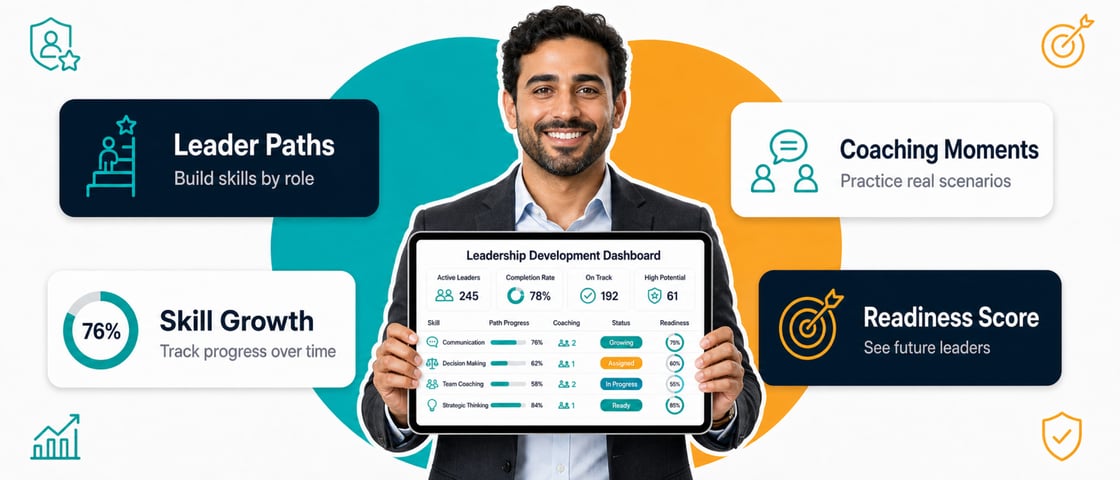
Leader and manager development has been the number one HR priority for three consecutive years, according to Gartner's annual survey of HR leaders.1 It is also, by most honest measures, failing. McLean & Company's 2026 research rates leaders as highly effective at employee engagement just 19% of the time.2 Three years of top billing, and the basics still aren't landing.
AI is where most L&D teams are now looking for the fix, and adoption is running far ahead of strategy: a lot of programs now have the tool before they've decided what it's for. So this article does two things. It lays out specifically where AI improves leadership development, with a real customer result attached. And it's equally specific about what AI doesn't fix, because a badly designed program with AI bolted on is still a badly designed program.

- Leadership development is the top priority and the biggest gap at the same time. It has been HR's #1 priority for three straight years, yet leaders rate as highly effective at employee engagement only 19% of the time.1,2
- Managers drive most of what L&D is measured on. Gallup attributes 70% of the variance in team engagement to the manager, which is why leadership programs carry so much weight.3
- AI adoption in L&D is mainstream; AI strategy is not. Most teams already use or pilot AI; far fewer have decided which behaviors it exists to change.
- AI's real contribution is personalization and practice, not magic. Skill-gap-matched learning paths, AI coaching with feedback, and adaptive content are where the measurable gains sit.
- It works in practice when the design is right. Channable paired AI-driven personalization with a flipped-classroom structure and cut training time 83% (24 hours to 4 per quarter) with zero voluntary drop-offs.4
- AI can't replace the human half. 77% of HR and L&D leaders say formal mentorship will be critical to development in 2026; AI supports that relationship, it doesn't substitute for it.5
Why Leadership Development Keeps Failing
The standard leadership program has a design problem before AI enters the picture. A cohort gets nominated, sits through the same content regardless of individual gaps, collects a certificate, and nobody checks six months later whether anything changed. McLean & Company's effectiveness numbers above are what that pattern produces at scale.2
The stakes explain why this keeps getting priority billing anyway. Gallup's research attributes 70% of the variance in team engagement to the manager.3 When a leadership program fails, the cost doesn't stay contained to the program. It shows up in every team those managers run.
The recurring failure mode is uniformity. One curriculum, one pace, one format, applied to a group of people with completely different gaps. The manager who needs help delegating sits through the same conflict-resolution module as the manager who delegates fine but avoids hard conversations. Neither gets what they came for, and both learn to treat the program as a calendar obligation.
What AI Actually Changes in Leadership Development
Strip away the vendor language and AI makes three concrete differences to how leadership training works. Each one attacks the uniformity problem from a different side.
Learning paths matched to individual skill gaps
AI-powered platforms assess where each manager actually stands (through skills diagnostics, manager input, and performance signals) and sequence content against those specific gaps. The delegation-avoider gets delegation content first; the conflict-avoider gets feedback and difficult-conversation modules. This is adaptive learning applied to leadership: the difficulty and topic adjust as the learner progresses, rather than following a fixed syllabus. Paired with bite-sized lesson formats, it means a manager works on their actual weakest skill for ten minutes a day instead of everyone's average weakness for a full afternoon per quarter.
An AI coach for practice, not just content
Leadership skills are behavioral, and behavior needs rehearsal. AI coaching tools now let a manager practice a difficult feedback conversation, a negotiation, or a performance review against a responsive simulation, and get immediate feedback on what worked. The practice happens in private, repeats as many times as needed, and costs nothing per attempt. That last part matters: role-play with a human facilitator is valuable but scarce, so most managers historically got one or two practice reps a year. An AI coach makes rehearsal routine instead of rationed.
Data on what's landing and what isn't
Traditional programs measure attendance. AI-powered platforms measure skill progression: which competencies are moving, where individual managers stall, and which content produces application rather than just completion. For L&D teams under pressure to prove impact, that visibility is the difference between reporting activity and reporting change.
What AI Doesn't Fix
Two limits worth stating plainly, because the current research says most organizations are skipping this step. First, AI doesn't supply the human relationship that development runs on. 77% of HR and L&D leaders say formal mentorship will be critical to employee development in 20265, and a mentor's job (context, judgment, confidence-building, institutional memory) is exactly the part a model can't do. The strongest programs use AI for personalization and practice, then spend the human time it frees up on mentoring and live discussion.
Second, AI doesn't rescue a program nobody wanted. If the underlying design is a box-checking exercise, AI makes the box-checking more efficient. Most organizations bought the tool before deciding what it was for. Decide first what behavior you want to change, then apply AI to the delivery.

Only 14% of organizations have a formal AI strategy, even though most have already moved past exploration into implementation.2 If your leadership program can't name the behaviors it exists to change, adding AI speeds up the wrong thing.
What This Looks Like in Practice: Channable
Channable's rollout is the one I point people to when they ask what AI-plus-human design looks like. The Utrecht-based SaaS company, 200+ employees, was running 24 hours of quarterly classroom training in half-day blocks, with the scheduling headaches that implies. They rebuilt it as a flipped classroom on 5Mins: 15-minute AI-personalized modules as pre-work, then a 60-minute live discussion every six weeks.4
Training time fell 83%, from 24 hours to 4 per quarter. Voluntary retention in the program was 100%; nobody dropped out.4
“Switching to 5Mins cut our online training time from 24 hours to just 4 per quarter, and the live sessions got better.”
That last clause is the point. The AI didn't replace the live sessions. It did the content-delivery work so the live time could go entirely to discussion, which is the part people actually stayed for.
How to Implement AI-Powered Leadership Development
Define the behavior change first
Pick two or three specific leadership behaviors you need more of (running effective 1:1s, delegating outcomes rather than tasks, giving corrective feedback within a week). A program aimed at “better leaders” can't be measured; one aimed at named behaviors can.
Diagnose individual gaps before assigning content
Use a skills assessment or structured manager input to establish each participant's starting point. This is the input that makes AI personalization work; without it, the platform is guessing.
Deliver content as short, sequenced modules
5-15 minute lessons, ordered so each builds on the last, available on mobile. The Netflix-style sequencing approach covers why this structure gets finished when longer formats don't.
Protect human time for discussion and mentorship
Follow Channable's pattern: let AI handle content and practice, and put the recovered hours into live group sessions or mentor pairings. This is the half most implementations cut, and it's the half the research says matters most.
Measure skill movement, not completions
Track the behaviors from step one at 3 and 6 months: are 1:1s happening, is feedback landing, do skip-level reports notice a difference. Completion rates tell you the content was consumed. These tell you it worked.
Frequently Asked Questions
AI for Leadership Development FAQs
Answers to the most common questions about using AI in leadership development.
What is AI-powered leadership development?
What is a leadership development framework?
How do you write a leadership development plan?
Can an AI coach replace a human leadership coach?
What is adaptive learning in leadership training?
How do you measure the ROI of AI leadership development?
Where to Start
Leadership development doesn't need another year at the top of the priority list. It needs the uniformity problem fixed, and that's the specific thing AI is good at: matching content to individual gaps, making practice cheap and private, and showing you which skills are moving. Keep the human relationships at the center, put AI underneath them, and the program stops being a calendar obligation.
If you want to see what that looks like against your own leadership framework, 5Mins' leadership development solution combines AI-personalized bite-sized lessons with the flipped-classroom structure Channable used. You can start a free trial or browse the course collection to see the leadership content first.
 Sources
- Top 5 Priorities for HR Leaders annual survey (leader and manager development ranked #1 for the third consecutive year), Gartner, 2025.
- HR Trends Report 2026, McLean & Company, 2026.
- State of the Global Workplace research on manager impact (managers account for 70% of the variance in team engagement), Gallup.
- Channable Customer Story, 5Mins.ai. View source
- Enterprise L&D in 2026: Trends and Predictions, Absorb Software & Together, 2025. View source
 This article shares general guidance on leadership development design and is not a substitute for professional HR or organizational development advice specific to your business.
All content is researched and written by the 5Mins team.



Madlena (Maddie) Pozlevic







_transparent%20background.png)



.png)