.png?width=112&height=28&name=Logo%20(1).png)

 8 minute read
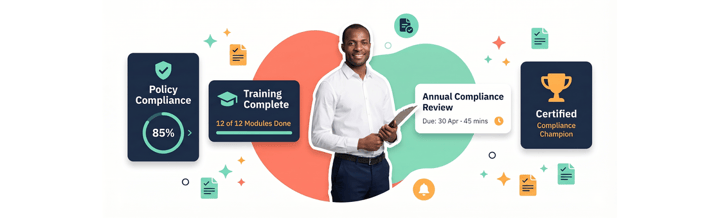
.png?width=1120&height=490&name=Soft%20Skills%20Training%20with%20Microlearning%20hero%20(2).png)
US businesses lose an estimated $1.2 trillion a year to poor workplace communication - about $12,506 per employee.1 That statistic alone should retire the idea that soft skills training is a nice-to-have.
It usually doesn't retire it, because most soft skills training still gets treated as a line item instead of a lever. Here's what's changed: LinkedIn's 2026 Skills on the Rise report found soft skills now fill seven of the ten fastest-growing skills globally, and conflict mitigation - not AI, not coding - tops the list.2 The skills gap employers are worried about this year isn't a technical one. It's a human one.
The real problem isn't whether soft skills training matters. It's that most of it doesn't survive the first Monday back at work. Here's why the classroom model keeps failing communication, emotional intelligence, and leadership training specifically, and what HR and L&D teams are doing about it instead.

- Soft skills training has a structural failure point, not a content one: people forget roughly 70% of new information within a day without reinforcement.3 A one-off workshop provides none.
- LinkedIn's 2026 data puts soft skills in 7 of the 10 fastest-growing workplace skills, led by conflict mitigation, stakeholder communication, and people management.2
- Microlearning delivers soft skills training in short, spaced, scenario-based lessons instead of a single classroom event - the format spaced-repetition research says actually builds behavior change.
- Gallup's finding that managers account for at least 70% of the variance in team engagement4 is really an argument for training feedback and communication skills continuously, not once a year.
- Teams running bite-sized leadership and manager-development pathways have cut classroom training time by 20+ days per cohort while improving completion.
What Is Soft Skills Training, and Why Is It Different in 2026?
Soft skills training teaches the interpersonal and behavioral skills - communication, emotional intelligence, conflict resolution, adaptability, and leadership influence - that determine how well someone works with other people. Unlike technical training, it's judged by changed behavior, not a test score. That's exactly why it's harder to deliver well.
What's changed isn't the definition. It's the stakes. The World Economic Forum's Future of Jobs Report 2025 projects that 39% of core workplace skills will change by 2030, and places leadership and social influence in the top 10 skills on the rise globally.5 Employers aren't debating whether to invest in soft skills training anymore. Most are trying to work out why last year's workshop didn't stick.
Why Traditional Soft Skills Training Keeps Failing
Put 20 people in a room for a half-day workshop on "difficult conversations," and here's what tends to happen. They role-play a scenario that doesn't resemble their actual job. They nod along to a facilitator's slides, then head back to their desks.
Within 24 hours, they've forgotten roughly 70% of what was covered. Within a week, it's closer to 90%.3

People forget roughly 50% of new information within an hour, 70% within a day, and 90% within a week without reinforcement. Hermann Ebbinghaus documented this in the 1880s, and it still explains why one soft skills session a quarter doesn't count as development.
There's a second problem sitting on top of the first: generic content. A workshop on "communication skills" that never touches the specific conversations your managers actually have - performance feedback, an escalation, pushback from a difficult stakeholder - asks people to bridge the gap from theory to practice alone. Most don't.
| Traditional soft skills workshop | Microlearning approach | |
|---|---|---|
| Format | Half-day or full-day session, a few times a year | 5-minute lessons, several times a week |
| Reinforcement | None after the event | Automated, spaced repetition |
| Practice | One role-play, in a room | Repeated scenario practice, in the flow of work |
| How it's tracked | Attendance | Completion and skill data |
| Typical completion rate | Under 20% for optional or refresher sessions | 95%+ on platforms like 5Mins |
Why Microlearning Actually Works for Soft Skills, Not Just Knowledge
Microlearning didn't start as a soft skills tool. It started as a way to shrink compliance training. But the mechanics that make it work for compliance work even better for behavior change.
Spaced repetition beats cramming. Reviewing a concept in short sessions spread over days or weeks builds retention that a single long session can't match, because each repetition catches the information right before it would otherwise fade.3 For a skill like active listening or giving feedback, that repetition is the difference between "I understood it in the room" and "I actually do it differently now."
Scenario practice beats lecture. Soft skills are behaviors, not facts. Watching a slide about conflict resolution doesn't build the skill; practicing a specific, realistic version of that conflict does. This is where microlearning breaks from video-based e-learning - the better role-based training platforms let employees rehearse a real conversation, get feedback, and try again, all inside a five-minute session.
Personalization beats one-size-fits-all. A first-time manager and a senior director don't need identical feedback training. Skills-based learning routes the right scenario to the right person instead of running everyone through the same generic module.
The Soft Skills That Matter Most Right Now
Five behaviors are showing up again and again in 2026's skills data - and each one responds differently to bite-sized, repeated practice.
Communication and Difficult Conversations
Communication remains the most cited soft skill in every workplace survey, and 2026 is no exception - executive and stakeholder communication, including public speaking, is one of LinkedIn's fastest-growing skill categories.2 Microlearning builds this through short scenario drills: delivering feedback in under two minutes, structuring a hard message, adjusting tone for a specific audience.
Emotional Intelligence and Self-Management
LinkedIn's 2026 data shows a cluster of self-management skills rising fast, including emotional maturity and frustration tolerance - the ability to respond to a stressful moment based on context, not impulse. These are hard to teach in a classroom because they only show up under real pressure. Bite-sized scenario training can put someone in that pressure, safely, more than once.
Conflict Mitigation
Conflict mitigation topped LinkedIn's 2026 list of fastest-growing skills, ahead of every technical category.2 It's also one of the least trained. Most managers have never practiced de-escalating a specific disagreement; they've been told to "communicate openly" and left to work out the mechanics themselves.
Adaptability and Resilience
The World Economic Forum ranks resilience, flexibility, and agility among the fastest-growing skills through 2030.5 Adaptability training benefits from repetition for a simple reason: change doesn't happen once. A single session on "managing change" ages badly. Short refreshers tied to what's actually changing that quarter age much better.
Feedback and Leadership Influence
Gallup has found that managers account for at least 70% of the variance in team engagement scores.4 That number gets quoted often and acted on rarely - most companies still train leadership skills in an annual program instead of the weekly habit of giving feedback, running one-on-ones, and coaching in the moment. Bite-sized leadership development fits that cadence in a way an annual leadership offsite never will.
How to Build a Soft Skills Microlearning Program That Sticks
Five steps, in the order most L&D teams actually have room to execute them.
Start with the skill that's costing you something specific
Don't try to microlearn "all soft skills" at once. Pick the one tied to a real business number - manager turnover, escalation volume, engagement scores - and build the pathway for that first.
Convert one existing workshop before building anything new
Most L&D teams already have a communication or leadership workshop that works. Learn what microlearning is and how it works, then break the workshop into 5-minute modules instead of writing from scratch.
Build in practice, not just video
A lesson that only explains a concept teaches knowledge. A lesson that asks the learner to respond to a scenario and gets feedback teaches behavior. Soft skills training needs the second kind.
Automate the reinforcement
Spaced repetition only works if someone, or something, schedules the repeats. Manual reassignment doesn't survive a busy quarter; automated recurrence does. Bite-sized learning is already reshaping how corporate training gets scheduled for exactly this reason.
Pair it with a human check-in
Bite-sized doesn't mean unsupervised. The strongest programs combine self-paced micro-lessons with a short manager or peer discussion, which is where a lot of real behavior change actually gets confirmed - see how this works in practice for personalizing corporate training programs.
What This Looks Like in Practice
Ivy Farm, a 50-60 person food technology company in Oxford, ran leadership development for first-time managers the traditional way: three-hour classroom sessions that needed the whole team in one room at once. Learning happened in isolation between sessions, and new managers waited two months or more for the next available course.
They switched to a flipped model: self-paced bite-sized modules for the theory, with one hour every fortnight for group discussion instead of a half-day session.
"In total, we've probably saved about 20 training days. Having it readymade saved hours. Invaluable in a startup where there's just not enough hours in the day."
The result was 20 training days saved across the cohort and 13 first-time managers trained without pulling the business to a stop to do it. More stories like this are on 5Mins' customer success stories page, including how HR teams are using bite-sized lessons to close skill gaps more broadly.
Frequently Asked Questions
Soft skills training FAQs
Answers to the most common questions HR and L&D leaders are asking in 2026.
What are the most important soft skills for the workplace in 2026?
How is microlearning different from traditional soft skills training?
Can soft skills actually be taught, or are they mostly innate?
How long does it take to see results from soft skills microlearning?
Do employees actually complete soft skills microlearning, or does it get skipped like other online training?
What's the best way to measure soft skills training ROI?
 Sources
- State of Business Communication: The Backbone of Business Is Broken, Grammarly & The Harris Poll. View source
- These are the fastest-growing skills in the U.S., according to LinkedIn, CNBC, February 24, 2026, citing LinkedIn's Skills on the Rise 2026 report. View source
- Overcome the Forgetting Curve in Corporate Training, Go1, 2025. View source
- How to Engage Frontline Managers, Gallup. View source
- Future of Jobs Report 2025, World Economic Forum, January 2025. View source
- 5Mins.ai platform completion-rate and content-library data, 5Mins.ai, 2026 (internal benchmark).
 This article is for informational purposes only. Third-party statistics and research are cited from public sources at the time of publication and may change as newer studies are released.
All content is researched and written by the 5Mins team.



Saurav Chopra







_transparent%20background.png)



.png)