.png?width=112&height=28&name=Logo%20(1).png)

 12 minute read
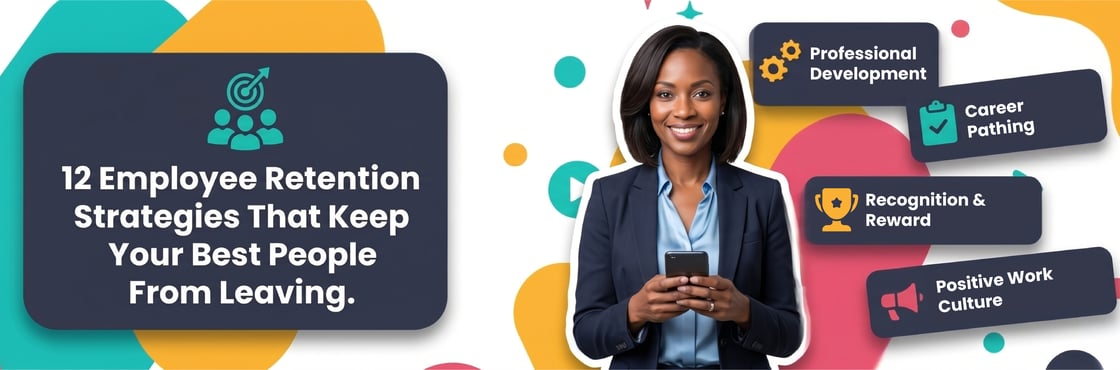
Half your workforce is watching job boards right now. Mercer's 2025 data puts voluntary turnover at 13% across US industries - but the scarier number is this: 56% of workers say they're planning to look for a new job this year.1 That's not a retention problem. That's a slow bleed.
And the people planning to leave? They're rarely your worst performers.
Replacing a manager costs around 200% of their annual salary. A frontline worker, 40% of theirs.2 Globally, voluntary attrition runs to $2.9 trillion a year.3 What stings most: Gallup found 63% of those exits were preventable.4 Not bad luck. Not personal circumstances. Organizational decisions that could have gone differently.
These 12 employee retention strategies are the ones that actually move the needle. Not because they sound good in a board deck - because the data says they work.

- Most exits are preventable: 63% of voluntary departures in 2024 came down to career stagnation and weak management - both things organizations control.4
- L&D is the #1 retention lever: 94% of employees say they'd stay longer if their company invested in their learning. Fewer than half participated in any skills training last year.5
- Recognition has a measurable impact: Strong, consistent recognition cuts the likelihood of leaving within two years by 45%.6
- Flexibility is no longer a perk: 83% of employees globally prefer hybrid work, and companies offering it see 25% lower turnover.7
- Pay is the final straw, not the root cause: 71% of voluntary exits trace back to poor management. Fix that first.3
- The gap between retention leaders and laggards is wide: Organizations with comprehensive retention strategies report 87% higher retention and 67% lower recruitment costs.3
Why retention deserves a serious budget allocation
Here's a telling detail: only 17% of employers have ever calculated what turnover actually costs them, according to CIPD.8 Most HR teams know it's expensive in a vague, theoretical way. Almost none have sat down with the real numbers.
Run it once and the conversation changes. A 200-person business with 15% annual turnover is losing 30 people a year. At a conservative £40,000 average salary and 50% replacement cost, that's £600,000 per year in recruitment, induction, and lost productivity. Cut turnover by 5 percentage points and you save £200,000 - which funds a serious L&D program several times over.
The other thing the data challenges is why people leave. Most leaders assume pay. Gallup's analysis tells a different story: engagement and culture issues, plus wellbeing concerns, account for 69% of voluntary exits.9 Pay is a factor, sure. But no salary increase repairs a broken manager relationship or opens a career ceiling that doesn't exist.

Work Institute's 2025 Retention Report found that 63% of all voluntary exits were preventable - driven by career stagnation, weak management, and poor work-life balance. These are decisions organizations made, whether they realized it or not. Every one of the 12 strategies below addresses at least one of those drivers directly.
1. Invest in continuous learning and development
94% of employees say they'd stay longer at a company that invests in their learning.5 That stat gets cited constantly, and rightfully - it's one of the most consistent findings in workforce research. LinkedIn's Workplace Learning Reports have shown similar numbers for years running.
So why does it keep not happening?
88% of organizations say L&D is their top retention strategy.10 But fewer than half of US employees actually participated in skills training in 2024.10 The gap between what HR teams think they're providing and what employees actually experience is where retention quietly falls apart.
The organizations that close this gap do something specific: they treat learning as infrastructure, not a perk. It's built into the working day - not offered as an optional lunchtime webinar or a weekend e-learning module nobody will finish. Gallup's research shows doubling the proportion of employees who feel they have growth opportunities could deliver an 18% increase in profit and 14% increase in productivity.10 That's not a soft benefit. That's a budget conversation.

Traditional L&D approaches see fewer than 5% of employees finish assigned courses. The barrier is almost always time, not willingness. AI-powered microlearning platforms like 5Mins.ai hit 95%+ completion by delivering TikTok-style lessons in 5 minutes a day - removing the "I'll get to it later" problem entirely.
2. Build visible, structured career paths
Better career advancement prospects elsewhere. That's the single biggest reason people leave - cited by 66% of departing employees.11 They're not leaving because they dislike the company. They're leaving because they've done the math on their ceiling.
Organizations with structured mentorship programs, cross-functional assignments, and clear promotion pathways perform 30% better on retention than those without.13 The operative word is "structured." A manager saying "there are definitely opportunities here for the right people" is not a career path. A written Individual Development Plan with specific milestones, reviewed quarterly, is.
Only 15% of employees say their manager helped them build a career plan in the past six months.10 That number is so low it's almost an opportunity. An organization that makes IDPs standard practice isn't doing anything radical - it's just clearing a very low bar that most competitors haven't cleared yet.
One caveat worth naming: career paths only work if promotions are real. If you build a framework that looks like a ladder but the rungs don't go anywhere, employees notice within six months and the trust cost is worse than having no framework at all.
3. Fix manager relationships before they break
The data here is blunt. 71% of voluntary exits trace back to poor management, not pay.3 The manager is the employee's daily experience of the company. Every claim the company makes about its culture - the values, the trust, the support - gets tested and either validated or contradicted in that relationship, every week.
Manager quality got worse in 2025. Gallup's 2026 State of the Global Workplace report found manager engagement dropped five points - from 27% to 22% - the largest single-year decline ever recorded.12 Disengaged managers create disengaged teams. Disengaged teams leave.
The fix isn't complicated, but it does require treating manager development as retention infrastructure rather than a nice-to-have training program. Managers need practical coaching in feedback, performance conversations, and recognition. They also need to be held accountable for team engagement - not just output metrics. A manager who consistently loses people within 18 months is a retention liability whether their numbers look good or not.

When multiple people from the same team leave within a short window, the problem is almost always the manager - not coincidence, not the job market, not bad luck. Run skip-level conversations at least quarterly. They surface management problems before they show up in exit data.
4. Pay competitively and communicate transparently
Pay is rarely why someone decides to leave. It's usually why they decide to take the call from the recruiter.
There's a specific pattern here: an employee is already disengaged - career stalled, unrecognized, stuck under a difficult manager - and a competitor's offer arrives. The offer doesn't create the dissatisfaction. It just removes the inertia. Fix the underlying problems and pay becomes far less decisive. Leave the problems unaddressed and even above-market salaries won't hold your best people indefinitely.
That said, below-market pay is a genuine risk, particularly for mid and senior roles where employees benchmark easily via LinkedIn and Glassdoor. Annual market reviews aren't optional. If you discover your highest performers are 15-20% below market, no amount of culture investment will hold them - and they'll know they're underpaid before you do.
Pay transparency matters too. Employees who don't understand their compensation structure - or who suspect inequity across teams - disengage faster than those who are simply underpaid. Publishing salary bands internally, explaining how pay decisions work, and running equity reviews are the foundation of a compensation culture that people trust.
| Role type | Replacement cost | Top exit driver | Primary retention lever |
|---|---|---|---|
| Senior leader / manager | ~200% of annual salary | Poor culture fit / lack of autonomy | Career path + culture |
| Technical professional | ~80% of annual salary | Limited growth opportunities | L&D + internal mobility |
| Mid-level individual contributor | ~50% of annual salary | Below-market pay / poor management | Pay benchmarking + manager quality |
| Frontline / entry-level | ~40% of annual salary | Lack of recognition / flexibility | Recognition + flexible scheduling |
| New hire (first 12 months) | Near-equivalent to full replacement | Poor onboarding experience | Structured onboarding + early L&D |
5. Recognize work consistently, not just at review time
Employees who receive strong, consistent recognition are 45% less likely to leave within two years.6 Companies with formal recognition programs see 31% lower voluntary turnover.14 And yet only 22% of employees say they get the right amount of recognition - a figure that hasn't shifted since 2022.15
So the problem isn't awareness. Everyone in HR knows recognition matters. The problem is execution. A quarterly "kudos" Slack message, a generic shout-out in the all-hands, a performance review that happens once a year - none of these move the dial because they aren't recognition, really. They're the appearance of it.
Recognition that actually works has five qualities: it's specific, timely, personal, equitable, and tied to something the individual actually values. A manager who notices that a team member stayed late to fix a client problem and mentions it to them directly the next morning - that's recognition. A manager who waits until the annual review to mention it has mostly lost the moment.
Peer recognition compounds the effect. When acknowledgment flows sideways across teams - not just from managers - it builds the kind of collegial culture where leaving feels like a genuine loss, not a clean break.
6. Offer flexibility that works in practice
83% of employees globally prefer hybrid arrangements.7 55% of job seekers rank it as their top priority. Nearly two-thirds of remote workers say they'd immediately start looking if their employer pulled the option entirely. This isn't a generational preference or a post-pandemic hangover. It's a settled expectation.
The retention data is direct: companies offering hybrid options see 25% lower turnover than full-office setups.13 Remote teams retain at 94.2% versus 81.6% for fully in-office staff.3 Organizations enforcing rigid return-to-office mandates aren't failing to convince employees - they're selectively retaining the people with the fewest other options while losing the ones with the most.
Flexibility doesn't mean unlimited remote work or no structure. The most common hybrid model in 2025 - three days in, two out - works for most roles and most organizations. What matters more than the specific arrangement is the underlying signal: that the organization trusts its people to do the work without monitoring their location.
Temporal flexibility matters too, and it's underrated. Condensed weeks, flexible start times, and leave policies that accommodate caring responsibilities often matter more to long-tenured employees than location flexibility does.
7. Nail the onboarding experience
Most voluntary exits happen in the first year. SecondTalent's 2025 breakdown found 76% of departures are voluntary, with the majority occurring within the first 12 months.4 You spend weeks recruiting someone, then lose them before they've had a real chance to contribute. The cost is nearly as high as losing a two-year employee, for a fraction of the value.
Poor onboarding is the common thread. Not poor in the sense of disorganized paperwork - poor in the sense of failing to answer the question every new hire is privately asking: "Did I make the right decision?"
Effective onboarding covers three phases. Pre-boarding - before day one - builds relationship and sets expectations before the first morning anxiety kicks in. Structured ramp-up over the first eight weeks delivers role-specific knowledge and social integration at a pace that doesn't overwhelm. Extended integration through months two to six connects the new hire to career paths and the wider organization before the initial honeymoon period ends and reality sets in. Most organizations do the first two phases acceptably. Almost none do the third.
The best onboarding programs introduce learning culture from day one - signaling that development is ongoing, not a one-time induction. 5Mins.ai enables 3-5x faster ramp-up by delivering role-specific bite-sized pathways from week one, building the daily learning habit while cutting time-to-productivity.
8. Take wellbeing seriously, not just symbolically
There's a version of wellbeing that is really just marketing. Free fruit. Meditation app subscriptions. An "employee assistance program" that nobody uses because nobody knows about it. 75% of businesses with formal wellness programs report measurable retention improvements3 - but the word "formal" is doing a lot of work in that stat. A wellness committee and a ping-pong table don't constitute a formal program.
Structural wellbeing - the kind that actually retains people - means manageable workloads, psychological safety, real parental leave, and access to mental health support that doesn't require navigating three layers of HR process to reach. It means managers having visibility into team capacity, not just output. It means organizations that respond to demand spikes by adjusting workloads rather than silently expecting people to absorb them.
Burnout is the single biggest predictor of departure among high performers. These are the people most likely to absorb overload without complaint, right up until the point they hand in their notice with three weeks left on their notice period and a job already lined up.
9. Build a strong organizational culture
Culture is hard to define and easy to feel. Employees experience it in how meetings are run, how failures are handled, how people talk about leadership when leadership isn't in the room. Strong culture is one of the most durable retention advantages available - and one of the hardest things a competitor can replicate.
Highly engaged teams have 40% lower turnover than disengaged ones.16 Culture doesn't directly equal engagement - but culture creates the conditions in which engagement either builds or collapses.
The patterns that erode culture are specific: a stated value that senior leaders visibly ignore, a promotion process that rewards behavior the organization claims to discourage, a town hall where only pre-approved questions get asked. These things don't announce themselves as culture problems. They register quietly as a creeping sense that the organization doesn't mean what it says. Once that feeling takes hold, it spreads fast.
Culture programs that sit outside of real decision-making change nothing. The ones that stick are embedded in how people get hired, promoted, and held accountable - not in the values poster on the break room wall.

| Retention Impact |  |
Traditional LMS |
|---|---|---|
| Training completion rate | 95%+ | <5% |
| Daily learning habit |  | ✕ |
| Personalized learning paths | | ✕ |
| Time to complete | 5 mins/day | 45-60 min modules |
| Employee engagement | 6-10x higher | Low |
| Visible career pathway support | | ✕ |
| Onboarding acceleration | 3-5x faster | Standard pace |
10. Create internal mobility pathways
One of the most reliable ways to lose ambitious employees is to make them go somewhere else to find their next challenge. 63% of companies offering tuition assistance report lower turnover.3 The principle is the same with internal mobility: when employees can see a path forward inside the organization, the grass looks considerably less green elsewhere.
The blocker is usually hiring culture. Many organizations default to external recruitment even when qualified internal candidates exist - because it's faster, because hiring managers have relationships with agencies, because internal talent is "too valuable where they are." This sends a message employees read clearly: we don't actually invest in you.
A practical starting point: require every open role to be posted internally for at least two weeks before external recruitment begins. It costs nothing. It signals a lot.
Secondments, cross-functional project assignments, and deliberate lateral moves for employees who want breadth rather than height - these build the kind of organizational depth that also happens to keep people engaged and loyal. Organizations that measure managers on "how many people did you develop and move forward?" rather than just "did you retain your headcount?" are building a fundamentally different retention culture.
11. Use data to predict and prevent exits
Most retention conversations happen too late. Someone hands in their notice, there's a counteroffer conversation, and the organization scrambles to understand what went wrong. The data that would have predicted this was available weeks or months earlier - it just wasn't being looked at.
52% of organizations using regular pulse surveys proactively address retention risks before they escalate.3 The signals are there if you look: attendance patterns, learning platform engagement dropping off, 1:1 frequency declining, survey scores trending downward, a previously active employee going quiet in team meetings.
No single signal is definitive. But when two or three appear together in the same person's pattern, it's worth a direct conversation - not a formal HR process, just a manager asking genuinely: "Are you getting what you need from this role? What would make it better?"
Sophisticated analytics platforms can automate this monitoring at scale. But a manager who runs honest fortnightly 1:1s and actually listens to the answers will catch problems earlier than most dashboards will. The data tells you where to look. The conversation tells you what's happening.
Exit interviews tell you why people left. Stay interviews tell you why they're staying - and what might tip that balance. A structured annual conversation with your highest performers, asking specifically what would cause them to leave, surfaces retention risks before they become departures. It's one of the cheapest retention tools available. Almost nobody does it consistently.
12. Act on exit interview findings - systematically
Exit interviews are standard practice everywhere. Acting on what they reveal is rare.
The usual pattern: data gets collected, compiled into a quarterly report, presented to HR leadership, and filed. The themes that caused the exits continue unchanged. Six months later, the next cohort of leavers cites the same reasons.
Useful exit interview programs have three components that most organizations skip. First, consistent data collection using a structured format - so you're comparing like with like over time, not comparing qualitative impressions quarter to quarter. Second, root cause analysis: is this issue specific to one manager, one team, one role type, or is it organizational? Third - and most importantly - visible action. When remaining employees see that exit feedback led to a real change, they become significantly more willing to raise issues while they're still employed, rather than saving them for their own exit conversation.
Cross-reference exit data with stay interviews and pulse survey results. When the same theme appears across all three, it's systemic. That requires a structural fix - policy, process, or accountability change - not a communication campaign about how things are actually better than people think.
How to prioritize your retention investments
Twelve strategies is a lot. No organization fixes all of them at once - and trying to often produces an overengineered program that runs out of energy before it produces results. The organizations that win on retention do three or four things consistently, measure the impact, and build from there.
Here's a practical sequence for working out where to start.
A practical prioritization process
Benchmark turnover by department and manager
Turnover is rarely evenly distributed. High rates in specific teams point to management or culture. High rates in specific roles point to career ceilings or pay. Map the distribution before you map the solutions.
Run stay interviews with your top performers
Ask directly: what would make you leave? What keeps you here? What would make you recommend this place to a friend? The answers tell you what's worth protecting - and what's quietly already at risk.
Match your exit themes to the 12 strategies
"Limited growth" appearing in exit data points to strategies 1, 2, and 10. "Management quality" points to strategy 3. "Work-life balance" points to strategies 6 and 8. Let the data choose the priority, not gut feel.
Build the business case with your actual turnover cost
If you've never run the numbers, start with average salary x 50% as a conservative base. Present the retention investment alongside the cost of inaction. This is the conversation that unlocks budget from leadership who think retention is "an HR thing."
Set 90-day milestones, measure, and iterate
Retention initiatives without measurement don't improve. Pick two or three leading indicators - engagement scores, 1:1 frequency, internal mobility rate - and track them quarterly. If something isn't moving, find out why before doubling down.
If L&D is where your gap is biggest, 5Mins.ai's employee training platform delivers 95%+ completion through TikTok-style lessons that take 5 minutes a day. It's the infrastructure that makes the learning retention lever actually function - rather than remaining a well-intentioned slide in next year's people strategy.
"Development budgets stop being 'learning spend' and start being framed as 'turnover prevention spend.' The ROI calculation changes everything."
Frequently Asked Questions
Employee retention strategies: your questions answered
Common questions from HR leaders, L&D managers, and business leaders on building effective retention strategies.
What are the most effective employee retention strategies?
How much does employee turnover cost?
What is a good employee retention rate?
Why do employees leave their jobs?
How does learning and development impact employee retention?
What is the difference between employee retention and employee engagement?
 Sources
- Employee Retention in 2025: Strategies for 2026 and Beyond, The HR Source, October 2025
- 28 Employee Retention Statistics Employers Need to Know [2026], Paycor, March 2026 - citing Gallup data on replacement cost by seniority level
- Top 100+ Employee Retention Statistics for 2026, SecondTalent, April 2026
- 20+ Employee Retention Statistics to Know in 2026, Emapta, March 2026 - citing Work Institute 2025 Retention Report
- LinkedIn Workplace Learning Report 2025, LinkedIn
- Employee Recognition Statistics in the US (2024-2025), High5Test, January 2026 - citing Gallup tracking study of 3,500 employees
- Employee Retention Statistics 2026: Turnover Costs, Quiet Quitting, and What Makes People Stay, Speakwise, March 2026 - citing Gallup and FlexJobs data
- 40 Must-Know Employee Retention Statistics for 2026, Thirst, December 2025 - citing CIPD data on turnover cost calculation
- 28 Employee Retention Statistics Employers Need to Know [2026], Paycor, March 2026 - citing Gallup on engagement and culture as exit drivers
- Employee Retention Solutions in 2026: Proven Strategies for Success, D2L / Brightspace, May 2026 - citing LinkedIn Workplace Learning Report 2025
- HR.com's State of Employee Retention 2025-26, HR.com, October 2025
- State of the Global Workplace 2026, Gallup, May 2026
- The Ultimate Guide to Workforce Retention Strategies for 2025, Synectics, July 2025
- Employee Recognition Statistics for 2026, TerryBerry, March 2026 - citing SHRM and Achievers data
- 30 Employee Recognition Statistics You Must Know in 2025, TeamOut, August 2025 - citing Gallup
- Employee Recognition Statistics: What HR Professionals Need to Know in 2026, TerryBerry - citing Gallup engagement and turnover data
 Statistics in this article come from publicly available research published between 2025 and 2026. Figures vary by industry, organization size, and geography. Benchmark against your own data and involve qualified HR professionals when designing retention programs for your specific context.
All content is researched and written by the 5Mins team.



James Francis









_transparent%20background.png)



.png)