.png?width=112&height=28&name=Logo%20(1).png)

 10 minute read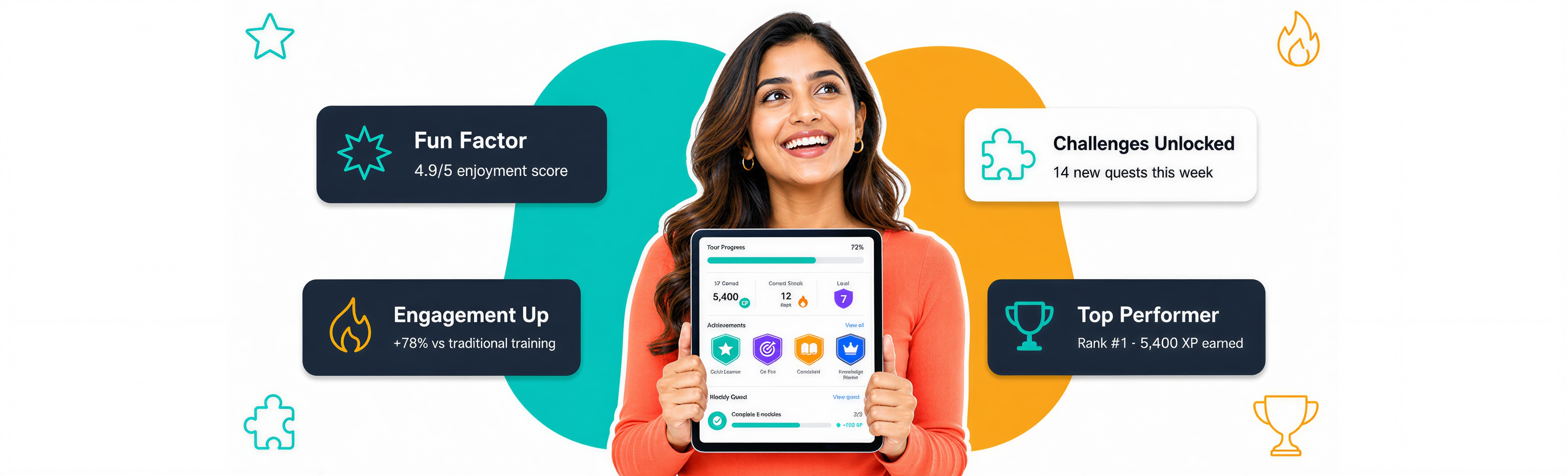
Here is a stat that should worry anyone running a training program: only 28% of employees say they actually feel motivated to learn when training has no game elements.1 The other 72%? They are clicking through slides, waiting for it to end, and forgetting everything by Friday.
The good news is the fix is surprisingly straightforward. Add game mechanics - points, leaderboards, streaks, challenges - and motivation jumps to 83%. Boredom drops to just 10%.1 Now combine that with bite-sized microlearning content, and completion rates climb above 80%, compared to the single digits that most legacy LMS platforms deliver.2
In this guide, we will walk through how gamified learning actually works, what the research says about why it sticks, and seven practical strategies that HR and L&D teams are using right now to make training something employees want to do rather than something they have to survive.

- Gamified training produces motivated learners at a rate 36% higher than traditional formats, according to TalentLMS research.1
- The global gamification market hit $36.46 billion in 2026 and is projected to reach $112 billion by 2031, showing mainstream enterprise adoption.3
- Microlearning modules achieve 70-82% completion rates, compared to rapid drop-off after the first session in traditional e-learning.2
- Seven proven gamification strategies - from instant rewards and leaderboards to adaptive pacing - can transform your training program without a full platform overhaul.
- Combining gamification with bite-sized content improves knowledge retention by up to 60% compared to traditional formats.2
- Measuring ROI matters: track completion rates, knowledge retention scores, time-to-competency, and voluntary participation to prove gamification's impact to leadership.
Why Traditional Training Fails (and Why Gamification Fixes It)
Let us be honest about the state of most corporate training: it is built to tick a compliance box, not to help anyone learn anything. Hour-long modules, dense slide decks, annual refreshers - all of it produces completion rates below 5% on many legacy LMS platforms.4 And the people who do make it through? Most of them forget the bulk of what they learned within a week.
The problem is not the content. It is the design. Traditional training ignores decades of research on how adults actually learn and retain information. The Ebbinghaus forgetting curve, first documented back in 1885, shows that people forget roughly 70% of new information within 24 hours - unless that content gets reinforced through repetition and active recall.5
This is exactly where gamification comes in. Feedback loops, progress tracking, and a bit of social competition tap into the same psychological drivers that keep people hooked on consumer apps. And the numbers back it up: 89% of employees say gamification makes them more productive at work, and 88% say they feel happier when game elements are woven into their daily workflow.6
What Is Gamified Learning?
Let us clear up a common misconception first: gamified learning does not mean turning your compliance modules into a video game. Nobody is building World of Warcraft for onboarding. What it does mean is borrowing the mechanics that make games engaging - points, progress bars, streaks, rewards - and layering them onto training content. Think Duolingo or Strava, not Call of Duty.
Here are the core game mechanics that work well in employee training:
- Points and XP: Learners earn points for completing lessons, passing quizzes, and maintaining daily activity. Points create a visible measure of progress.
- Badges and certificates: Visual achievements for reaching milestones - completing a course track, mastering a skill, or finishing a compliance module.
- Leaderboards: Team and company-wide rankings that drive friendly competition. Learners can see how they stack up against peers.
- Streaks: Consecutive-day learning streaks build daily habits, similar to the streak system that helped Duolingo grow to over 500 million users.
- Challenges and quests: Team-based or individual challenges that frame learning as a mission to complete rather than a task to endure.
- Instant feedback: Real-time scores, corrections, and encouragement after each lesson or quiz keep learners on track.
The trick is in the combination. Research shows that using 3-4 of these elements together hits the sweet spot - enough to create momentum without overwhelming people.7 A leaderboard on its own does not do much. But a leaderboard paired with points, streaks, and badges? That creates a system where people naturally keep coming back.
The Science Behind Gamification and Retention
Gamification is not just window dressing. There is real science behind why it works - and it comes down to how our brains process and hang onto new information.
Dopamine and Feedback Loops
There is a reason it feels good to see a streak counter tick up or your name climb a leaderboard. Earning points and rewards triggers dopamine - the same brain chemical behind habit formation. Every small win after a completed lesson nudges the learner to do another one. And another. That is the feedback loop in action.
Spaced Repetition
When a platform delivers content in daily bite-sized chunks, it naturally creates spaced repetition - hands down the most effective technique for moving knowledge from short-term to long-term memory. Studies show this can improve retention by 25-60% compared to the traditional "cram it all into one sitting" approach.2
Active Recall
Quizzes and scenario-based challenges built into gamified lessons force learners to pull information from memory rather than passively re-read it. That retrieval effort is what actually locks knowledge in. Research from the Journal of Applied Psychology found that breaking learning into smaller segments improves retention and on-the-job performance by up to 17%.8
Social Motivation
Leaderboards and team challenges add a layer of social accountability that solo training simply cannot match. When your learning activity is visible to peers and managers, you are more likely to show up consistently. And the data bears this out: 74% of employees in gamified workplaces report higher job satisfaction.9
7 Gamification Strategies That Drive Results
1. Instant Rewards - Create Motivation with Points and Badges
Short, focused lessons paired with immediate rewards create a "just one more" effect. When learners earn points for each completed lesson and collect badges for finishing course tracks, they experience a sense of accomplishment that builds momentum. The key is making rewards visible and frequent - not saving recognition for the end of a 20-module program.
2. Leaderboards and Streaks - Build Consistency Through Friendly Competition
Daily learning streaks and leaderboards are two of the most effective gamification tools for building habits. Streaks reward consecutive days of engagement, creating a psychological investment that learners do not want to break. Leaderboards add social competition - team rankings where departments compete for top spots drive both individual effort and group accountability.
Platforms like 5Mins.ai use TikTok-style gamified learning with daily streaks, skill points (called Jewels), and team leaderboards to drive 6-10x higher engagement than traditional LMS platforms and 95%+ completion rates.4
3. Micro-Challenges - Encourage Real-Time Application
Adding quizzes, scenario-based assessments, and quick challenges to bite-sized lessons pushes learners to apply knowledge immediately. These micro-challenges act as checkpoints that reinforce learning through active recall. Bite-sized learning delivers training aligned with individual roles and skills, making each challenge directly relevant to the learner's day-to-day responsibilities.
4. Real-Time Feedback - Keep Learners on Track
Immediate feedback after each quiz or lesson - whether a score, a correction, or a congratulatory message - keeps the learning loop tight. Learners know instantly whether they have understood the material or need another pass. This rapid feedback cycle is especially effective in microlearning, where lessons are short enough to allow immediate correction and retry without losing the learner's attention.
5. Team Challenges - Build a Learning Culture
Gamification is not just about individual performance. Team-based challenges, where departments compete on completion rates or knowledge scores, create a shared learning culture. When training becomes a collaborative effort, employees are more likely to encourage each other and hold one another accountable. For remote teams, gamified training programs that foster collaboration help team members feel connected and contribute to team building.
6. Adaptive Pacing - Match Content to Attention Spans
Attention spans in workplace learning are shorter than ever. Gamified microlearning solves this by delivering content in focused, 3-5 minute bursts that match how people naturally consume information on their phones. Learners swipe through video-based lessons the same way they scroll through social media - except each swipe builds a real skill. This format keeps engagement high because it works with modern attention patterns instead of fighting against them.
7. Progress Visualization - Make Growth Visible
Progress bars, skill maps, and completion dashboards give learners a clear picture of where they stand and what is ahead. Visible progress is a powerful motivator - it transforms abstract "learning" into a concrete journey with milestones. For managers, this visibility also means they can identify skill gaps and nudge team members who are falling behind, without waiting for a quarterly review.
Gamified Microlearning vs. Traditional Training
| Metric | Traditional Training | Gamified Microlearning |
|---|---|---|
| Completion rate | Less than 20% | 70-95%+ |
| Learner motivation | 28% feel motivated | 83% feel motivated |
| Knowledge retention | Drops 70% within 24hrs | 25-60% higher retention |
| Session length | 30-60+ minutes | 3-5 minutes |
| Learner experience | 49% report boredom | 89% feel more productive |
| Habit formation | Annual/quarterly events | Daily streaks and rewards |
| Onboarding speed | Standard pace | Up to 50% faster |
Measuring the ROI of Gamified Training
Rolling out gamification without tracking whether it is actually working? That is leaving money on the table. You need hard numbers to show leadership this is more than a novelty - and to keep improving the program over time.
Here are the metrics that actually matter:
- Completion rates: The most immediate indicator. Are more people finishing training? Gamified microlearning platforms routinely achieve 70-95%+ completion rates compared to the sub-20% common with traditional e-learning.
- Knowledge retention scores: Pre- and post-training assessments show whether learners are actually absorbing and retaining information, not just clicking through slides.
- Time-to-competency: How quickly are new hires or reskilled employees reaching proficiency? Gamified onboarding programs have shown reductions of up to 50% in ramp-up time.9
- Voluntary participation: Are employees choosing to take optional courses? This signals genuine engagement, not just compliance. Look for uptake on non-mandatory training modules.
- Engagement frequency: Daily active users, average sessions per week, and streak lengths reveal whether training has become a habit or remains a one-off event.
- Manager and team insights: Dashboards that show team-level progress, skill gaps, and individual engagement allow managers to coach proactively rather than chase completions.
Platforms that combine gamification with real-time analytics - like AI-powered learning platforms - give L&D teams visibility into all of these metrics without manual tracking or spreadsheet wrangling.
Getting Started with Gamified Learning
You do not need to tear up your entire training program and start from scratch. The smartest approach is to pick one high-impact area - usually compliance or onboarding - and start layering in gamification elements from there.
Here is a practical five-step framework to get going:
- Start with one program: Pick a training area with low completion rates and high organizational importance - compliance is often the best candidate.
- Choose 3-4 game mechanics: Points, a leaderboard, streaks, and badges are the most effective starting combination. Do not overcomplicate it.
- Break content into micro-lessons: Convert existing training into 3-5 minute modules. Each module should cover one concept and end with a quiz or challenge.
- Set a baseline: Measure current completion rates, engagement, and retention scores before launching the gamified version.
- Launch, measure, iterate: Track metrics weekly for the first month. Adjust difficulty, reward frequency, and leaderboard visibility based on what the data shows.
You can explore how organizations across industries are using gamification to enhance their learning programs for practical case studies and implementation tips.
Frequently Asked Questions
Common questions about gamified learning for employee training.
What is gamified learning?
How do you gamify employee training?
What are the benefits of gamified learning for organizations?
Which gamification elements work best?
How is gamified microlearning different from a traditional LMS?
How do you measure the ROI of gamified training?
 Sources
- Gamification at Work Survey, TalentLMS. View source
- Microlearning Statistics, Facts and Trends for 2025, eLearning Industry. View source
- Gamification Report 2026, StartUs Insights. View source
- 5Mins.ai platform data, 5Mins.ai. View source
- Memory: A Contribution to Experimental Psychology, Hermann Ebbinghaus (1885); replicated in modern cognitive science research.
- 50+ Gamification Statistics You Need to Know in 2026, AmplifAI. View source
- 30 Gamification Statistics to Guide Your Learning Strategy in 2026, Engageli. View source
- Emerging Trends in Gamification: Key Statistics and Market Insights for 2025, BeeLiked. View source
- Gamification: 2026 Verified Stats, WifiTalents. View source
 This article is intended for informational purposes only and does not constitute professional advice. Statistics cited are sourced from third-party research and may be subject to the methodologies and limitations of the original studies. For the most current data, please refer to the original sources linked above.
All content is researched and written by the 5Mins team.



Saurav Chopra








_transparent%20background.png)



.png)