.png?width=112&height=28&name=Logo%20(1).png)

 8 minute read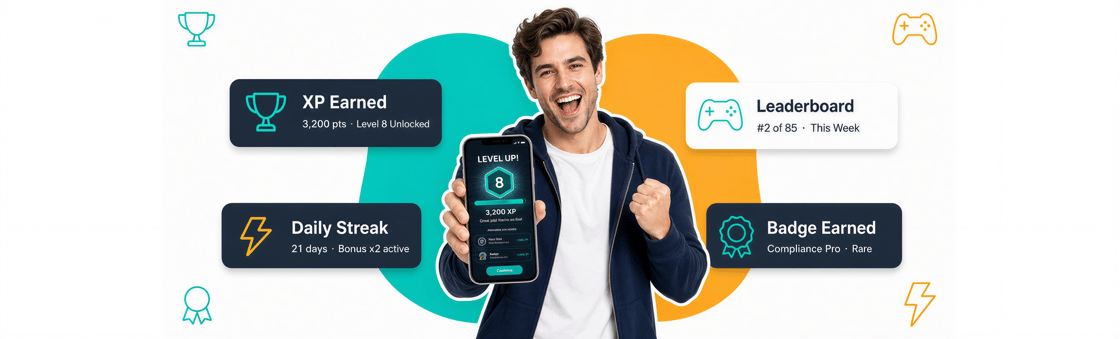
Your team spent three months building a training program. The content is solid. The compliance boxes are ticked. Then you check the numbers: 20% completion, and half of those clicked through without reading. Sound familiar?
You're not alone. Traditional e-learning struggles with a fundamental problem - it asks busy people to sit through content they don't want to watch. Gamified learning flips that equation. By weaving game mechanics like points, streaks, leaderboards, and micro-challenges into bite-sized lessons, organizations are seeing completion rates jump to 80%+ and knowledge retention improve by up to 75%.
This guide breaks down six proven gamification strategies that turn passive training into active engagement - backed by recent data and practical enough to implement this quarter.

- Gamified training boosts completion rates by 40% compared to non-gamified programs and cuts onboarding time by up to 50%.
- 83% of employees receiving gamified training feel motivated, versus just 39% in traditional formats - a 44-point gap.
- Six core mechanics drive results: instant rewards, leaderboards and streaks, micro-challenges, real-time feedback, community building, and adaptive pacing.
- Bite-sized + gamified is the winning combination: microlearning courses average 80-83% completion rates versus 20-30% for long-form e-learning.
- The gamification market hit $19.4 billion in 2025 and is projected to reach $92.5 billion by 2030 - 70% of Global 2000 companies already use it.
Why traditional employee training falls short
Most corporate training programs were designed for a world where employees had time to sit through hour-long modules. That world doesn't exist anymore. Professionals now average just 24 minutes per week for learning and development, and attention spans for passive content have dropped sharply.
The result? Completion rates for traditional e-learning hover between 20% and 30%. Even when people finish, retention is poor. Research shows learners forget up to 50% of new information within two days without reinforcement.
Gamified learning addresses this head-on. A TalentLMS survey found that 83% of employees who receive gamified training feel motivated, compared to just 39% of those using traditional methods. That's not a marginal improvement - it's a fundamentally different experience.
The data backs up the business case too. Organizations using gamification report a 50% reduction in training time, 40% higher completion rates in compliance training, and a 30% reduction in voluntary turnover.
The cost of disengaged training goes beyond wasted budget. When compliance modules go unfinished, organizations carry real regulatory risk. When onboarding content is clicked through without reading, new hires ramp up slower and make more avoidable mistakes. When leadership development sits untouched in an LMS, the skills gap widens quietly until it shows up in performance reviews and exit interviews. Low completion isn't just an L&D metric — it's a business risk. Gamified learning is increasingly being recognized not as a "nice to have" engagement tool, but as the structural fix that makes training programs actually deliver on their investment.
6 gamification strategies that drive real results
Gamification works because it taps into the psychological rewards that drive motivation and consistency. But not all game mechanics are equal. Here are six strategies that deliver measurable outcomes when paired with bite-sized learning.
1. Instant rewards - points and badges that create momentum
The core appeal of gamification is immediate, tangible feedback. When employees complete a five-minute lesson and earn points or a badge, they feel a sense of accomplishment right away. That instant gratification triggers dopamine release and encourages a "just one more lesson" mindset.
Why it works: Short lessons mean learners see results quickly. Pair that with visible progress - a badge for finishing a compliance module, points for a perfect quiz score - and you create a self-reinforcing loop. Research shows gamified feedback improves performance by 12.5%, and 89% of employees say gamification makes them more productive.
How to implement it: Start simple. Award points for lesson completion, bonus points for quizzes, and badges for completing learning tracks. Make progress visible with a dashboard or scorecard that learners can check anytime.
2. Leaderboards and streaks - building consistency through friendly competition
Consistency separates training that sticks from training that's forgotten. Leaderboards and daily streaks create accountability without the heavy-handedness of mandatory deadlines.
When employees see their name on a leaderboard - or notice a colleague climbing the ranks - it triggers healthy competition. Daily streaks add another layer: the psychological cost of "breaking the chain" keeps people coming back. Platforms like Duolingo and 5Mins.ai use streaks and leaderboards to drive continuous engagement, and the results speak for themselves.
The data: Companies using gamified learning management systems report that gamification increases daily active users by 45%. When employees develop a daily learning habit, knowledge compounds over time in ways that one-off training sessions never achieve.

Daily streaks leverage the same behavioral psychology behind habit formation. Once employees hit 7-day, 30-day, or 90-day streak milestones, voluntary participation increases dramatically - learning becomes part of the daily routine rather than a task to be scheduled.
3. Micro-challenges - applying knowledge in real time
Bite-sized learning is designed to be actionable and relevant. It delivers training personalized to each employee's actual responsibilities, making it directly applicable to day-to-day work.
Adding micro-challenges - quizzes, scenario-based assessments, or timed problem-solving exercises - pushes learners to apply what they've just learned. These act as checkpoints in the learning journey, reinforcing new concepts through active recall rather than passive review.
Why active recall matters: A University of Colorado study found that gamified learners score 14% higher on skill-based assessments and 11% higher on factual knowledge tests compared to those in traditional programs. The act of retrieving information strengthens memory pathways in ways that simply re-reading content does not.
4. Real-time feedback - keeping learners on track
Feedback is the engine of gamification, and it's especially powerful in bite-sized formats. When lessons are short, the feedback loop tightens dramatically. A learner completes a five-minute module, immediately sees their score, gets a correction or encouragement, and moves on - all within the flow of work.
This rapid cycle keeps the experience dynamic. Learners know whether they're progressing correctly or need a quick adjustment, and they can act on it right away. No waiting for a quarterly review. No guessing whether the training actually landed.
The impact: Gamified feedback loops contribute to a 25% faster skill acquisition rate compared to traditional training methods. When people know exactly where they stand, they self-correct faster and retain more.
5. Community spirit - turning training into team culture
Gamification doesn't just train individuals - it builds learning culture. When employees enjoy the process, they become advocates for ongoing development. Training stops being something HR mandates and becomes something teams value.
For remote and hybrid teams, this is critical. Gamified training programs that foster collaboration help distributed team members feel more connected and contribute to team building in ways that asynchronous Slack messages and email chains simply can't.
Team-based challenges, department leaderboards, and shared milestones create shared purpose. When a sales team collectively completes a product knowledge track, or a compliance team achieves 100% completion on anti-bribery training, it reinforces the idea that learning is a team sport.
What the research shows: 87% of employees report that workplace gamification fosters a sense of community and belonging, and 88% say it increases happiness at work.
6. Adaptive pacing - matching content to attention spans
People already spend hours engaging with games on their phones. Gamified, bite-sized training taps into this existing behavior and redirects it toward productive skill-building.
By pacing content in quick, digestible bursts - typically three to five minutes per lesson - gamification keeps learners in the flow state where engagement peaks. Lessons feel achievable rather than overwhelming. The result is higher voluntary participation and lower drop-off rates.
The numbers: Microlearning modules that are five to ten minutes long achieve 20% higher completion rates than longer sessions. When you add gamification on top, daily active users increase by 45%. That combination - short format plus game mechanics - is why platforms built around this model consistently outperform traditional LMS solutions.
The science behind gamified learning
Gamification isn't just a buzzword dressed up as strategy. The results are grounded in well-established cognitive science: active retrieval, emotional engagement, and spaced repetition are the three most powerful drivers of long-term knowledge retention, and game-based learning activates all three simultaneously.

Active retrieval — quizzes and challenges strengthen memory by 75%. Emotional engagement — competition and achievement make experiences more memorable (78% of employees say gamification makes work more enjoyable). Spaced repetition — daily streaks combat the forgetting curve, improving 6-month recall by 150%.
Active retrieval is the most consistently underused principle in corporate training. Most e-learning is built around consumption: watch a video, read a slide, click next. Retrieval flips that. Quizzes, scenario challenges, and timed problem-solving exercises force the brain to reconstruct information from memory rather than recognize it on a page. That act of reconstruction is what creates durable knowledge — and it's precisely what game mechanics are designed to trigger. Every time an employee answers a quiz question, completes a branching scenario, or solves a compliance challenge, they're not just checking a box. They're deepening a memory trace.
Emotional engagement matters because neutral experiences are forgotten first. When training is boring, the brain treats it as low-priority information and deprioritizes it during memory consolidation. Competition, achievement, and social recognition change that calculus. Seeing your name move up a leaderboard, earning a badge that appears on your profile, receiving a streak notification — these small moments carry an emotional charge that passive content simply can't replicate. That charge is what makes learning stick past the end of the session.
Spaced repetition is the mechanism behind why daily habits beat marathon sessions. The forgetting curve is steep: without reinforcement, up to 70% of new information is lost within a week. Daily streaks and recurring micro-challenges naturally distribute learning over time, which is exactly what the brain needs to move information from working memory into long-term storage. Organizations that build gamified daily learning habits see the compounding effect clearly in six-month retention assessments — recall rates improve by 150% compared to one-off training events.
This is why gamified learning produces measurably different outcomes. It's not about making training "fun" for the sake of it - it's about aligning the learning experience with how the brain actually processes and stores information.
How to get started with gamified training
You don't need to overhaul your entire training program overnight. The most effective approach is to start with three to four game mechanics and build from there. Research shows that combining a few well-chosen elements produces better outcomes than overwhelming learners with every gamification feature available.
Points, badges, and a leaderboard are the foundation. Add streaks once daily engagement is established.
Pick a compliance module or onboarding program where completion rates are low. Gamify that first and measure the before-and-after.
Scorecards, progress bars, and achievement dashboards give learners a reason to come back.
Five-minute lessons paired with game mechanics consistently outperform longer formats. The data on this is clear.
Track completion rates, knowledge retention (via assessments), and voluntary participation. These three metrics tell you whether gamification is working.
For a deeper look at gamification mechanics and how to choose the right ones for your team, explore our guide on using gamification to enhance your learning programs.
One common mistake is treating gamification as a layer of decoration on top of existing content. Adding a points system to a dry 45-minute e-learning module does not produce the results the research describes - it just adds clutter. The mechanics only work when the underlying content is already short, focused, and tied to something employees actually care about. Gamification amplifies what is already there; it does not rescue content that is not working.
Another pitfall is focusing on extrinsic rewards at the expense of intrinsic motivation. Leaderboards and badges work best when they surface genuine progress - skills genuinely earned, knowledge genuinely retained. When employees can see that their streak reflects real daily learning rather than checkbox-ticking, the engagement becomes self-sustaining. The goal is not to get people to play a game. It is to build a learning habit that produces better performance and sticks long after the notifications stop.
Frequently asked questions
Everything you need to know about gamified learning and how to make it work for your team.
 Sources
- AmplifAI. "50+ Gamification Statistics You Need to Know in 2026." Citing TalentLMS and University of Colorado research. March 2026.
- TalentLMS. "Gamification at Work Survey." TalentLMS, 2024. (83% motivated vs 39% traditional finding.)
- Gitnux. "Gamification Statistics: Market Data Report 2026." February 2026. (40% higher completion, 50% training time reduction, 300% ROI.)
- Visu Network. "Gamification Statistics: 50+ Data Points for 2026." January 2026. (89% productivity, 88% happiness, Deloitte 50% time reduction.)
- StartUs Insights. "Gamification Report 2026." February 2026. ($19.42B market size, $92.5B projected by 2030.)
- BuildEmpire. "Gamification Statistics You Need For 2026." September 2025. (48% engagement boost, 90% retention, 78% enjoyability.)
- eLearning Industry. "Microlearning Statistics, Facts and Trends for 2025." June 2025. (80% completion rate, 94% satisfaction.)
- Engageli. "30 Gamification Statistics to Guide Your Learning Strategy in 2026." April 2026. (University of Colorado findings, active recall research.)
- Engageli. "20 Microlearning Statistics to Guide Your Workplace Learning Strategy in 2026." March 2026. (Mordor Intelligence market data.)
- Gamizign. "Global Gamification Statistics in Learning Institutions." July 2025. (87% community belonging, 88% happiness.)
- Mordor Intelligence. "Microlearning Market Size and Share Analysis." January 2026. ($3.32B market, 11.83% CAGR.)
- WifiTalents. "Microlearning: Data Reports 2026." February 2026. (45% daily active user increase with gamification.)
- Legaki, N.Z., et al. (2020). "The effect of challenge-based gamification on learning." Computers and Education, 151.
- ScienceDirect. "Leveling up in corporate training: Unveiling the power of gamification." August 2024.
 This article is for informational purposes only and does not constitute professional advice. Statistics cited are from third-party sources and may be subject to change. Always verify data for your specific context.
All content is researched and written by the 5Mins team.



Saurav Chopra








_transparent%20background.png)



.png)