.png?width=112&height=28&name=Logo%20(1).png)

 12 minute read

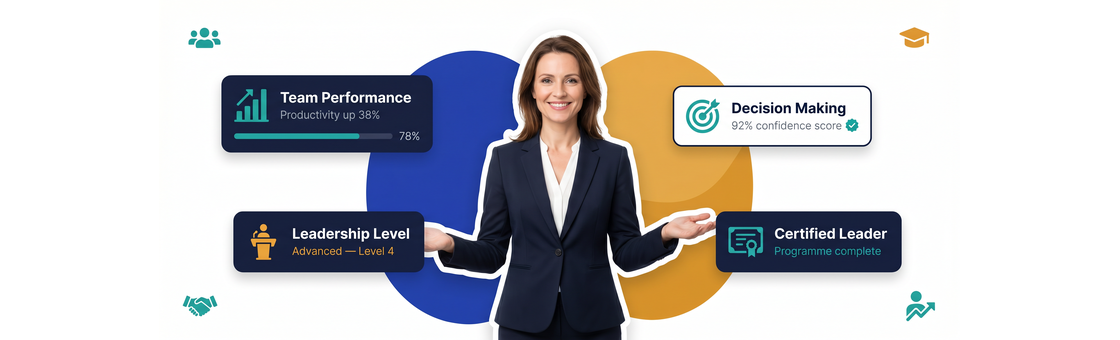
Only 40% of leaders rate their own company's leadership quality as high – the steepest decline in a decade, according to DDI's 2023 Global Leadership Forecast. Just 12% feel confident in their leadership bench. And 26% of managers have never received any formal management training at all.
That's the management gap most HR and L&D leaders are now being asked to close. The hard part isn't budget – it's deciding what to train on, in what order, and for which level of leader. "Management training" gets used as a single bucket, but a first-time team lead managing three people needs something fundamentally different from a director leading a function of forty.
This guide solves that problem. Below are 15 management training topics – grouped by leadership level – that consistently appear in the highest-impact programmes. Each topic explains what it covers, why it matters, what good learning looks like, and how long it takes to build real competence. Use it as a curriculum map, a buyer's checklist when evaluating providers, or a gap analysis against what your current programme already does.

- Management training fails most often because programmes train all managers on the same content. Effective programmes split topics by level – foundational, mid-level, and senior – so each manager gets what they actually need next.
- The 15 topics that matter span hard skills (running 1:1s, giving feedback, delegating) and behavioural skills (emotional intelligence, coaching, change leadership). Most legacy programmes cover four to six of them at most.
- First-time manager training is the single highest-ROI investment in any people-development budget – Gallup attributes 70% of variance in employee engagement to the manager.
- Format beats content. Bite-sized, mobile-first microlearning hits 95%+ completion vs. under 5% on traditional long-form courses – meaning the training actually reaches the manager who needs it.
- Measure behaviour, not attendance. Engagement scores on trained managers' teams, retention rates, and 360 feedback quality are the metrics that justify the budget.
How to use this list
The 15 topics are organised into three tiers – Foundational (topics 1–5), Mid-Level (6–10), and Senior/Executive (11–15). The tiers map roughly to where a manager is in their career, but they are cumulative: a senior leader still needs the foundations. Use the tiers to do three things:
- Sequence learning. New managers should master the Foundational five before being asked to develop strategic thinking or lead change.
- Audit your current programme. If your existing management training only covers six or seven of these topics, you've identified the gap.
- Buy with intent. When you evaluate a leadership training provider, ask which of the 15 they cover – and ask them to show you the lessons, not the brochure.
For new managers and first-time team leads
These are the topics every new people manager needs in their first 90 days. They are the source of nearly every bad management experience – and getting them right is the single biggest predictor of whether a first-time manager will stay in the role.
Running effective 1:1s
What it covers: How to structure a recurring one-to-one – agenda, frequency, who drives it, what good notes look like, and how to use the time for development rather than status updates.
Why it matters: The 1:1 is the single most overused, underprepared meeting in modern work. New managers either skip them, run them as status checks, or do all the talking. Done well, 1:1s are where coaching, feedback, and career conversations actually happen.
What good learning looks like: A short framework (e.g. 30 minutes, employee-led agenda, three recurring questions), two or three example transcripts of good and bad 1:1s, and a practice scenario with an underperformer.
 Time to competence: 2–4 weeks of consistent practice
Giving feedback that lands
What it covers: Models for delivering both positive and constructive feedback (SBI, Radical Candor, BIQ), how to handle defensive reactions, and how to give feedback in writing vs. in person.
Why it matters: Most managers were never taught how to give feedback – they imitate what was done to them. The result is either feedback that is too soft to land or too sharp to be heard. Both end the same way: behaviour doesn't change.
What good learning looks like: Short lessons on each major model, side-by-side examples of weak vs. strong feedback, and AI conversation practice for high-stakes scenarios (calling out a missed deadline, addressing tone in meetings).
Time to competence: 4–8 weeks of repeated practice
Delegation without dropping the ball
What it covers: What to delegate, what not to delegate, how to scope the brief, how to set decision rights and check-in cadence, and how to recover when delegation fails.
Why it matters: New managers under-delegate because of trust, perfectionism, or fear of looking lazy. They become bottlenecks within their first six months. Delegation is the skill that converts a great individual contributor into an effective manager.
What good learning looks like: A clear delegation framework (e.g. Task Relevant Maturity, RACI), worked examples across functions, and a delegation audit each manager runs on their own work.
Time to competence: 6–12 weeks
Performance management and clear expectations
What it covers: Setting goals (OKRs, SMART, KPIs), making expectations explicit, running mid-cycle and end-of-cycle reviews, calibrating performance ratings fairly, and documenting concerns early.
Why it matters: Most performance issues are expectations issues. The manager assumed; the report guessed. By the time it shows up in a review, it's too late to correct. New managers need the language and cadence to make performance visible all year, not at year-end.
What good learning looks like: Templates for goal-setting and reviews, a worked example of a calibration meeting, and short scenarios on documenting underperformance fairly.
Time to competence: One full performance cycle (3–6 months)
Hiring and onboarding the right people
What it covers: How to write a job spec, run a structured interview (vs. unstructured chat), reduce bias in scoring, run reference checks, and design a 30-60-90 onboarding plan that actually works.
Why it matters: Hiring badly is the most expensive mistake a manager makes – and the one most new managers learn by doing. A bad hire costs 30%+ of first-year salary and damages team morale. A great onboarding plan accelerates time-to-productivity by months.
What good learning looks like: A repeatable interview rubric, sample structured-interview questions per role type, an onboarding plan template, and short lessons on common hiring biases.
Time to competence: Each cycle: 2–4 weeks per hire

Gallup's research is consistent across two decades: managers account for at least 70% of variance in employee engagement. If your first-time managers are weak on the five topics above, no amount of senior leadership development will compensate. Every other tier is built on this one.
For experienced managers and managers of managers
Once the foundations are reliable, the next tier focuses on judgement under ambiguity – coaching, conflict, decisions, and the human side of leading more experienced people. These topics rarely respond to one-off workshops. They need consistent reinforcement over 12–18 months.
Coaching and developing high-performers
What it covers: The coaching mindset (asking vs. telling), GROW and CLEAR models, how to coach in a 1:1 vs. as a passing conversation, and how to coach someone who is technically better than you.
Why it matters: A manager who can coach is worth several who can only direct. Coaching is what separates teams that grow from teams that stagnate – and it's the single hardest skill to teach in a classroom because it requires real-time application.
What good learning looks like: Short lessons on each coaching model, video walk-throughs of coaching conversations, and AI roleplay where the manager practises coaching scenarios with adaptive responses.
Time to competence: 6–12 months of ongoing practice
Emotional intelligence at work
What it covers: Self-awareness, self-regulation, empathy, social awareness, and relationship management – applied to specific manager situations like delivering bad news, handling pushback, and reading the room.
Why it matters: EQ is responsible for a significant share of performance across all job types and is the skill most managers overestimate in themselves. Mid-level managers are where EQ gaps start to compound – into team conflict, attrition, and quiet quitting.
What good learning looks like: Self-assessments paired with 360 feedback, scenario-based micro-lessons, and reflective journalling prompts that get applied to real situations the manager faced that week.
Time to competence: 12–24 months
Conflict resolution and difficult conversations
What it covers: Recognising the four common conflict patterns at work, de-escalation techniques, how to mediate between two reports, when to escalate, and how to repair after a hard conversation.
Why it matters: Most managers avoid conflict until it becomes unavoidable. By then, it has cost trust, productivity, and often a person. Mid-level managers need to be able to step into conflict early, with skill, rather than later, with damage control.
What good learning looks like: Frameworks (Crucial Conversations, Nonviolent Communication), short scenarios across remote/in-person/written contexts, and AI practice for the highest-stakes conversations.
Time to competence: 6–12 months
Decision-making under pressure
What it covers: Reversible vs. irreversible decisions, common cognitive biases (sunk cost, availability, confirmation), decision frameworks (DACI, RAPID, 70% rule), and how to make decisions with incomplete information.
Why it matters: Modern managers are asked to decide faster, with less information, than their predecessors. Bad decisions don't usually come from bad analysis – they come from unclear ownership, sunk-cost thinking, and confusing reversible decisions for irreversible ones.
What good learning looks like: Lessons on each common bias, worked examples of real business decisions analysed against frameworks, and a decision journal practice.
 Time to competence: Ongoing – measured over 12+ months
Time management and prioritisation for managers
What it covers: How a manager's calendar should differ from an IC's, the maker/manager schedule split, prioritisation frameworks (Eisenhower, RICE, MoSCoW), and how to protect deep work in a meeting-heavy role.
Why it matters: New managers typically take their IC calendar habits with them. Within six months they're double-booked, reactive, and resentful. Time management for managers is a specific skill – not a generic productivity course.
What good learning looks like: Short, role-specific lessons (a manager's calendar vs. a director's vs. a VP's), tools and templates, and a weekly calendar audit practice.
Time to competence: 3–6 months

Tier 2 topics rarely fail because of a poor curriculum. They fail because the learning is delivered in one block (a two-day workshop) and never reinforced. The mid-level skills above respond to weekly micro-practice paired with a coach or peer group – not annual training events.
For senior managers, directors, and executives
The final five topics are about leading at scale: strategy, change, building leaders rather than doing the work, and influencing across an organisation. Senior leaders rarely need more knowledge in these areas – they need structured reflection, peer challenge, and feedback at a level they don't normally get.
Strategic thinking and business acumen
What it covers: Reading a P&L, understanding unit economics, framing strategic questions (jobs-to-be-done, Porter's Five Forces, OKR cascades), and connecting daily team work to longer-term outcomes.
Why it matters: Senior leaders are paid to zoom out. The ones who can't get pulled back into operational work and stop adding strategic value. Strategic thinking is teachable – but it requires more reflective, longer-form learning than the other 14 topics.
What good learning looks like: Case studies, long-form expert lessons, structured strategy reviews on the leader's own business, and exposure to other industries' problems.
Time to competence: 12–36 months
Change management and leading through ambiguity
What it covers: Why change initiatives fail (Kotter, ADKAR), how to communicate a change a layer at a time, how to handle the dip, and how to lead when the destination isn't fully known.
Why it matters: Every senior leader in 2026 is leading through change – AI adoption, restructuring, shifting business models. Change leadership is no longer a specialised skill; it's a baseline expectation. Leaders who can't guide people through change quietly become barriers to it.
What good learning looks like: Lessons on each major change model, worked case studies of change programmes that succeeded and failed, and reflective practice on the change the leader is currently running.
Time to competence: 12+ months
Building and leading high-performing teams
What it covers: Team formation (Tuscan, Lencioni's five dysfunctions), psychological safety, hiring for complementary strengths, designing team rituals, and rebuilding after attrition or restructure.
Why it matters: Senior leaders are judged on their team's results, not their own. Most senior managers were never explicitly taught how to design a team – they inherit one and tinker. Building a team intentionally is a skill that compounds over a career.
What good learning looks like: Lessons on team design, frameworks for diagnosing team dysfunctions, peer-group case discussions, and a team health assessment the leader runs every six months.
Time to competence: Each new team: 6–12 months to maturity
Inclusive leadership and managing across difference
What it covers: How to lead diverse teams effectively, recognising and reducing bias in decisions (hiring, promotion, project allocation), creating space for under-represented voices, and building inclusive meeting and feedback norms.
Why it matters: Diverse teams outperform homogeneous ones – but only when the leader actively manages the difference. Without that skill, diversity becomes a liability rather than an asset. Inclusive leadership is also one of the most heavily scrutinised skills by employees and investors in 2026.
What good learning looks like: Short lessons on common biases, scenario-based practice on inclusive decision-making, and 360 feedback specifically focused on inclusion behaviours.
Time to competence: 12+ months, ongoing
Executive presence and influence without authority
What it covers: How to communicate concisely with a board or executive committee, frame proposals for senior audiences, build cross-functional alignment, and influence stakeholders you don't manage.
Why it matters: Senior leaders spend more of their time influencing peers and superiors than directing reports. Executive presence isn't about charisma – it's about clarity, brevity, and the ability to land a message in the language of the audience.
What good learning looks like: Lessons on executive communication patterns, video examples of strong vs. weak senior communication, and AI-supported practice for board-level updates and difficult cross-functional conversations.
Time to competence: 12–24 months
"Management training stops working the moment it leaves the room. Done well, it's not an event – it's a habit of learning, applying, reflecting, and coming back for the next lesson. Across all 15 topics, the format does more of the work than the content."

Why most management training programmes only cover four to six of these topics
Walk into the average management training programme and you'll find some version of communication, feedback, delegation, and maybe a half-day on coaching. Useful, but not enough. Three structural reasons explain why most legacy programmes don't make it through all 15 topics:
Time. A two- or three-day classroom programme can credibly cover four to six topics with role-plays. To cover 15 in a classroom format would take a month off the business. So providers triage – and the triage usually drops the harder behavioural topics (EQ, conflict, inclusive leadership) in favour of the easier mechanical ones.
Format. Some topics – strategic thinking, change leadership, executive presence – don't fit a workshop. They need structured reflection over months. Programmes built around in-person delivery quietly skip them.
Audience. Most programmes are designed for one level ("new manager training" or "leadership for directors"). Cross-level programmes are rare because they're harder to staff and harder to sell. The result: managers experience training as a one-off event tied to a promotion rather than a continuous curriculum across their career.
The fix isn't more classroom time. It's a delivery format that can credibly carry 15 topics across a career: bite-sized, role-personalised, mobile-first, and reinforced weekly. That's the shift behind the comparison below. Our deeper analysis is in Transforming Leadership Training with Microlearning and AI for Leadership Development.

| What you measure |  |
Traditional management training |
|---|---|---|
| Completion rate | 95%+ | Under 5% |
| Time per session | 5–10 minutes per day | 1–3 days off-site |
| Personalisation | AI-tailored by role & seniority | One-size-fits-all |
| Practice in real work | Weekly, in-work application | Classroom role-play |
| Coverage of all 15 topics | All 15, structured by level | Selective (3–5 topics) |
| Manager retention impact | Tracked via engagement & 360s | Hard to measure |
How 5Mins covers all 15 topics
5Mins.ai's Leadership Development library is built around all 15 topics above, structured by manager level. Three things make it work in practice.
All 15 topics, sequenced. The library covers every topic in this article – from running 1:1s to executive presence – with 5,000+ micro-lessons from 200+ industry experts, each designed to be completed in around five minutes. Managers see the topics that match their level first, but the full library is available across the career.
AI conversations for high-stakes practice. Topics like giving feedback, conflict, and difficult conversations need rehearsal before they happen for real. AI conversations let managers practise these scenarios safely, with adaptive responses – a format that classroom role-play can't match at scale.
Flipped classroom for behaviour change. Self-paced micro-learning during the week pairs with one hour of group discussion per fortnight, where the actual application and accountability happens. This is the format that converts knowledge into changed behaviour.
Organisations using 5Mins for management development typically see 95%+ completion, 6–10x higher engagement than legacy LMS platforms, and a 60–80% reduction in overall training time – at a lower cost than a traditional classroom-based programme.
For a deeper look at the models that underpin modern management thinking, our guide on the top 5 leadership theories and our piece on leadership development goals are useful companion pieces. Our Leadership Development solution covers all 15 topics directly – worth a look if you're evaluating options.
Frequently asked questions about management training
The most common questions HR and L&D leaders ask when scoping or buying a management training programme.
What are the most important management training topics for new managers?
How long does management training take to be effective?
What is the difference between management training and leadership training?
Are online management training courses as effective as in-person?
How do I measure the ROI of a management training programme?
How many topics should a management training programme cover?
 Sources
- Global Leadership Forecast 2023, Development Dimensions International (DDI). ddiworld.com/global-leadership-forecast-2023
- State of the American Manager: Analytics and Advice for Leaders, Gallup. gallup.com
- State of the Global Workplace 2025, Gallup. gallup.com
- 29 Eye-Opening Leadership Development Statistics 2025, Exec Learn. exec.com/learn
- 2026 Leadership Training Statistics, Research.com. research.com/careers/leadership-training-statistics
- Leadership Training Data Reports 2026, WifiTalents. wifitalents.com/leadership-training-statistics
- 2025 Workplace Learning Report, LinkedIn Learning. learning.linkedin.com/resources/workplace-learning-report
- 5Mins.ai internal completion-rate data, 2026. 5mins.ai
 This article is for general informational purposes only and does not constitute legal, financial, or professional advice. Always consult a qualified professional for guidance specific to your organisation.
 All content is researched and written by the 5Mins team.


Saurav Chopra










_transparent%20background.png)



.png)