.png?width=112&height=28&name=Logo%20(1).png)

 8 min read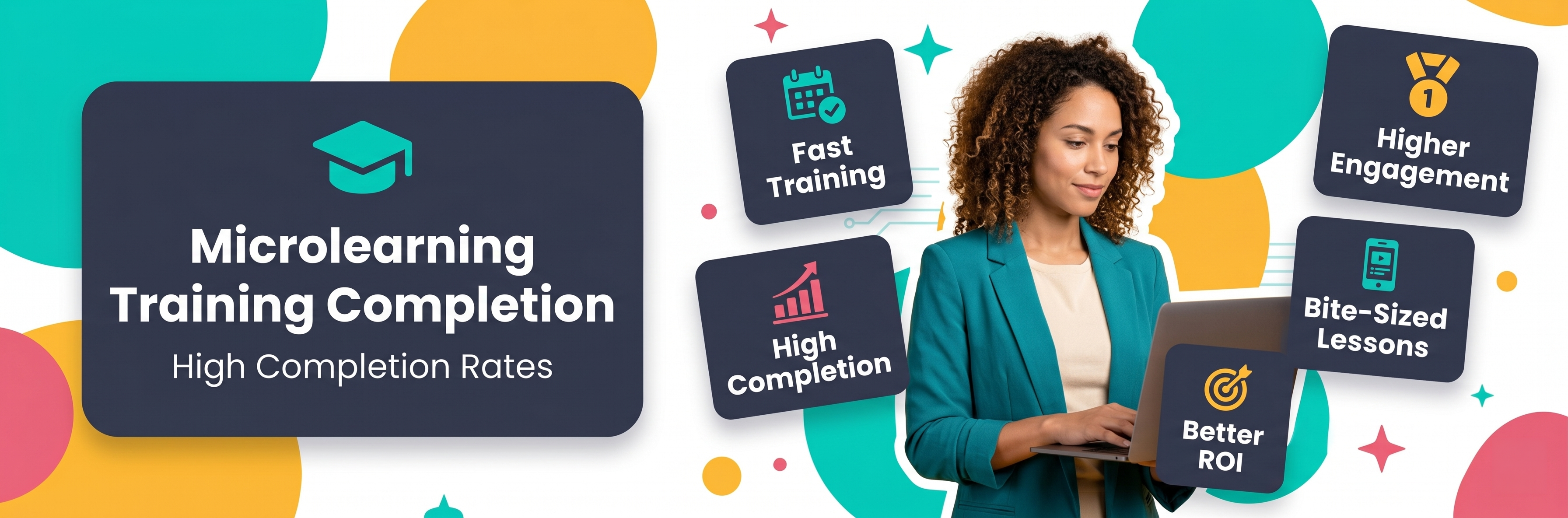
Your LMS says 87% of employees are enrolled. What it doesn't say is that fewer than 20% will ever finish. That gap - between enrolled and done - is where most training budgets quietly disappear.
The average traditional e-learning course has a completion rate of 20-30%.1 Microlearning apps flip that number. Platforms built around 5-minute mobile-first lessons regularly hit 80-100% completion - not by making training compulsory, but by making it genuinely worth finishing.2
Seven features drive that difference. Here they are.

- Traditional LMS courses average 20-30% completion. Microlearning apps consistently deliver 80-100%.
- Gamification is the single biggest lever - gamified training hits 90% completion vs 25% without it.
- 74% of organizations now integrate mobile learning into their training strategy. Mobile-first design isn't optional anymore.
- AI personalization keeps learners returning - employees are more likely to finish content that's actually relevant to their job.
- Real-time analytics let HR and L&D teams act on data now, not at the end of the quarter.
- The 5Mins.ai app (iOS and Android) combines all seven features and averages 95%+ completion across its customer base.
Why Traditional LMS Training Keeps Failing
The problem isn't the content. It's the format.
Traditional LMS platforms were built for a world where training happened at a desk, in a scheduled block, once or twice a year. The average employee can now spare only about 1% of their workweek - roughly 24 minutes - for learning.3 A 45-minute course that requires a desktop login and a quiet room simply doesn't survive contact with that reality.
Low completion is the predictable result. And it compounds. Research shows learners forget 50% of new information within two years when it isn't reinforced.4 Most LMS platforms don't build in reinforcement. They build in re-enrollment.
Microlearning fixes the format, not just the packaging.
The 7 Features That Actually Drive 95%+ Completion
Not all of these features carry equal weight. If you're evaluating a microlearning app and have to prioritize, gamification and mobile-first design are the ones to test hardest. The other five matter - but those two are where the completion gap opens up fastest.
1. Lesson length: 5-10 minutes, hard ceiling
A 10-minute microlearning module achieves an 83% completion rate. Standard 30-60 minute courses average 20-30%.1 That gap exists for a simple reason: employees don't skip short tasks the way they skip long ones. The perceived effort is low enough that starting feels easy.
Short lessons also fit the actual time slots people have. A coffee break. Five minutes between calls. The commute home. Lessons that fit those windows get done. Lessons that don't fit them get deferred, indefinitely.
On 5Mins.ai, every lesson targets one concept, one skill, five minutes. That constraint isn't a limitation - it's the product.
2. Mobile-first design - with offline access
74% of organizations now integrate mobile learning into their training strategy.5 There's a reason for that acceleration: the alternative is building training around a tool employees actively avoid.
Mobile-first means more than a responsive layout. It means the app was designed for a five-inch screen from the start - thumb-friendly navigation, video optimized for mobile playback, no horizontal scrolling. The offline access piece is underestimated. Retail, logistics, manufacturing, and hospitality teams often work in low-connectivity environments. If your training app goes blank on the warehouse floor, your frontline workers aren't learning from it.
The 5Mins.ai app is available on iOS and Android with full offline functionality.
3. Gamification - this is the big one
E-learning courses with gamified elements achieve a 90% completion rate compared to 25% for non-gamified programs.6 That is not a marginal difference. It is a 65-point gap driven entirely by adding game mechanics. If your current training platform has no streaks, leaderboards, or achievement system, that gap is one of the most concrete things you can point to when making the case for switching.
Streaks work because breaking a five-day learning streak feels like a genuine loss - enough of a loss that employees come back to avoid it. Leaderboards introduce social pressure without requiring a manager to apply it. Badges and milestones give learners a sense of progress that a percentage-complete bar never will.
For compliance teams, gamification solves a specific headache: engagement beyond the initial rollout. Traditional training sees a completion spike before the deadline, then nothing. Gamified platforms sustain daily activity across the year - and that's what makes the difference in a regulatory audit.

Organizations implementing gamification report a 47% increase in training completion rates and a 30% improvement in training ROI.8
4. AI-powered personalization
A compliance officer and a new sales hire are both on your payroll. They should not be receiving the same training content. AI personalization handles that automatically - analyzing each learner's role, progress, and skill gaps to surface the next most relevant lesson.
This matters for two reasons. Relevant content gets finished at higher rates. And it removes the admin burden from HR and L&D teams who would otherwise be manually assigning learning paths across a workforce of hundreds or thousands.
The 5Mins.ai AI engine does this continuously - not just at onboarding, but throughout the year as roles evolve and skills are built.
5. TikTok-style video and interactive content
85% of organizations use video-based microlearning.7 That's not a trend - it's table stakes at this point. The TikTok-style format maps onto how employees already consume content in their personal lives: short, vertical, visually led. When training looks like content people choose to watch, the psychological barrier drops.
Interactive elements - quizzes, scenario exercises, drag-and-drop activities - push retention further. Active recall during training improves retention by up to 60% compared to passive watching or reading.4 A microlearning app without interactivity is a video player.
6. Real-time analytics - not quarterly reports
There's a specific frustration in compliance training that analytics solves: finding out in November that half your team didn't complete a mandatory module that was due in September. Real-time dashboards mean you know in week one, not week twelve.
For CLOs, the analytics layer answers the questions that matter to the board: which teams are on track, which skills are improving, and how training completion correlates with performance. 5Mins.ai's analytics give full visibility at individual, team, and organizational level - all updated live.
Channable used this visibility to identify where leadership development was already working and where it wasn't. The result: they cut total leadership training time from 24 hours to 4 hours per quarter - an 83% reduction - while keeping participation at 100%. The time saving wasn't from doing less. It was from knowing what to keep.
7. Integration into tools employees already use
Training that requires a context switch - logging into a separate platform, hunting for the course, remembering a password - generates friction that kills completion. The microlearning apps with the highest adoption rates are the ones employees barely have to think about.
Slack and Microsoft Teams integrations put learning nudges directly inside the tools your team uses every hour. HRIS integrations mean onboarding training can trigger automatically when a new hire is added. Existing LMS connections let you add microlearning as a layer on top of current infrastructure rather than ripping it out.
5Mins.ai supports integrations across the most common HR and communication platforms. See the full integrations page for current connections. When training appears in the tools employees already use, engagement becomes the default - not the exception.
5Mins.ai vs. Traditional LMS: The Honest Comparison
The differences aren't subtle. Here's how the two approaches compare across the dimensions that actually matter to HR, L&D, and compliance teams.

| Feature |  |
Traditional LMS |
|---|---|---|
| Lesson length | 5-minute bite-sized lessons | 30-90 minute courses |
| Completion rates | 80-100% | 20-30% |
| Mobile access |  | ✕ |
| Gamification | | ✕ |
| AI personalization | | ✕ |
| Real-time analytics | | Basic reports only |
| Workflow integration | Slack, Teams, HRIS, LMS | Manual login required |
What 95%+ Completion Looks Like in Practice
Two 5Mins.ai customers are worth looking at in detail - because they illustrate different problems the platform solved.
IKEN: from low engagement to 85% compliance completion
IKEN came to 5Mins.ai with a familiar problem: compliance training that employees were technically enrolled in but weren't finishing. After switching to 5-minute gamified microlessons, compliance training engagement rose to 85%. More tellingly, employees reported higher confidence applying what they'd learned - which is the behavioral change outcome that audit teams actually care about, not the completion number itself.
Channable: 83% less time, same results
Channable's leadership development program was eating time nobody had. Training time dropped from 24 hours to 4 hours per quarter - that's 83% less time - while voluntary participation stayed at 100%. The key wasn't just microlearning. It was the analytics showing exactly where training was working and where it wasn't, so the team could stop doing the stuff that wasn't.

500 employees. Mandatory training. 25% LMS completion rate. That's 375 people not done. At 95%+ with a microlearning app, fewer than 25 are outstanding. That gap has real regulatory exposure attached to it - and it's fixable.
How to Launch a Microlearning App That Gets Used
Getting employees to actually use a new platform is where most rollouts succeed or fail. The features above only matter if adoption happens.
Start with the highest-stakes content, not the easiest content.
Compliance topics with regulatory deadlines, onboarding content that affects time-to-productivity, skills gaps flagged in performance data - these are the ones where high completion rates have real consequences. Start there. Don't spend the first three months running low-stakes optional content through a platform that hasn't proven itself yet.
Evaluate on completion data, not feature lists.
Every microlearning vendor has a feature list. Ask for completion rate data from customers in your industry at your scale instead. The numbers will tell you more than any demo. A platform that can show you 90%+ completion at a 500-person financial services firm is a different conversation from one showing you a polished product tour.
Use the analytics from day one.
Don't wait for a quarterly review to check how things are going. The organizations getting the most value from microlearning treat the analytics dashboard as a live operational tool - checking completion trends weekly, identifying where engagement is dropping, and adjusting before a problem compounds. The data is only useful if someone is looking at it.
Ready to see how it works for your team? Book a demo or explore the full lesson library.
What's Coming Next
Predictive AI: training that finds you, not the other way around
The next shift is AI that doesn't wait for a manager to assign content. Predictive learning engines will surface relevant microlessons based on performance data, career trajectory, and what's happening in other work tools. For CLOs, this means moving from training cycles to continuous, always-on skill development that scales without additional admin overhead.
Team-based gamification
Individual streaks and leaderboards are already proven. The next layer is collaborative learning goals - challenges that teams complete together, turning development into something visible and social rather than a solo checkbox. 5Mins.ai is already building group mechanics that do exactly this.
Training that triggers from events in other systems
A new hire added to an HRIS. A skill gap flagged in a performance review. A regulatory update requiring re-certification. The gap between 'learning platform' and 'performance infrastructure' is closing. Integrations will make training feel less like a separate tool and more like a built-in response to what's already happening at work.
FAQs
Frequently Asked Questions
 Sources
- eLearning Industry, "Microlearning Statistics, Facts and Trends for 2025," June 2025. Completion rate: 83% for 10-minute microlearning vs 20-30% for traditional LMS courses.
- Vouch / Shift Learning, "Microlearning Statistics for 2025," October 2025. Industry-wide microlearning completion rate data.
- LinkedIn Learning, "Workplace Learning Report," 2023. Employees dedicate approximately 1% of their workweek (24 minutes) to learning.
- eLearning Industry, 2025. Microlearning improves retention by 25-60%; learners forget 50% of information within two years without reinforcement.
- ELB Learning, cited in Vouch, 2025. 74% of companies integrate mobile learning into their training strategies.
- Continu, "Corporate eLearning Statistics 2025." Gamified e-learning: 90% completion vs 25% for non-gamified. Employees retain 22% more information with gamification.
- BuildEmpire, "25+ Microlearning Statistics 2025." 85% of organizations use video-based microlearning lessons.
- Careertrainer.ai, "Gamification in Training Statistics 2026." Organizations implementing gamification report 47% increase in completion rates and 30% improvement in ROI.
- 5Mins.ai, IKEN Customer Success Story. Compliance engagement increased to 85% after adopting 5Mins.ai.
- 5Mins.ai, Channable Customer Success Story. Leadership training time reduced from 24 hours to 4 hours per quarter with 100% voluntary participation.
 This article is for informational purposes only. Statistics cited reflect industry research available at time of writing. Organizations should verify current data with their chosen platform provider before making purchasing decisions.
All content is researched and written by the 5Mins team.



Saurav Chopra









_transparent%20background.png)



.png)