.png?width=112&height=28&name=Logo%20(1).png)

 12 minute read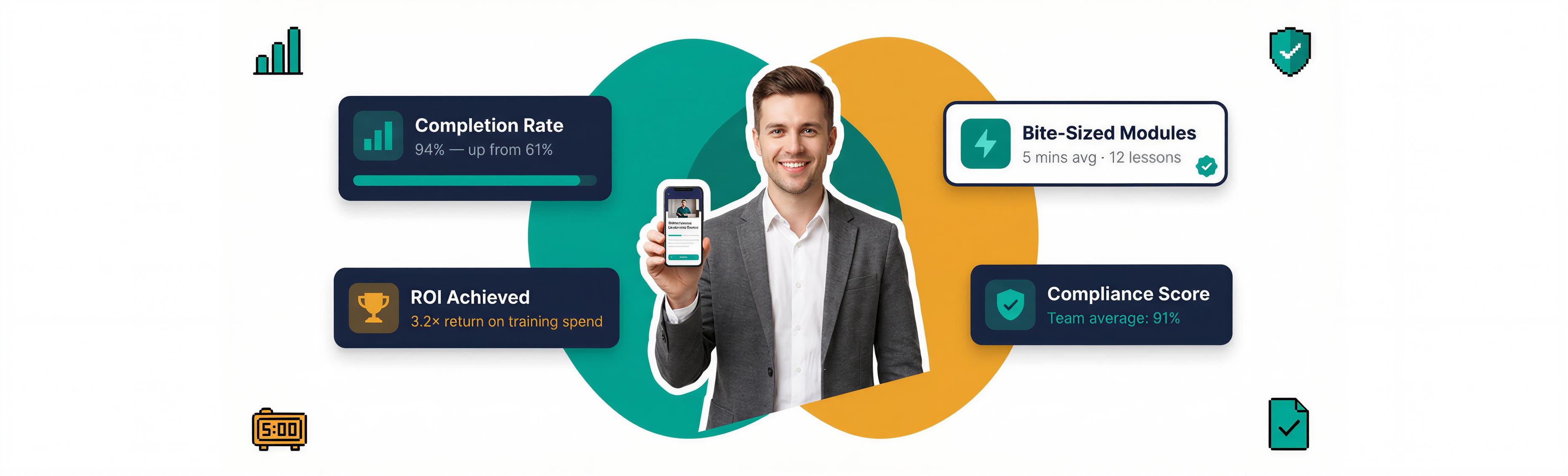
Most compliance programs have a hidden problem hiding in plain sight: nobody finishes the training. Industry research puts the average e-learning completion rate at 20-30% - and that is being generous. For long, mandatory compliance modules, the real number is often single digits. The FCA does not care how thorough the deck is if your team never opens it. In 2024 alone, the regulator handed out £176 million in fines, up 230% on the previous year.1,3 This guide breaks down what the data actually shows about microlearning compliance training: the completion rates, the ROI maths, and the regulatory risk you cut by switching from annual e-learning to continuous, bite-sized lessons.

- The average corporate e-learning course sees 20-30% completion. Microlearning courses average around 80%, and 5Mins customers consistently see 95%+.
- UK regulators are tightening the screws. The FCA issued £176m in fines in 2024, the ICO's largest 2025 fine was £14m to Capita (with training gaps cited), and HSE work-related ill health hit a record 1.9 million cases.
- Microlearning works because of cognitive science, not buzzwords. Spaced repetition, single-objective sessions, and 8-12 minute formats line up with how the brain actually consolidates memory.
- The ROI shows up in four places: training time, L&D admin, regulatory risk, and content lifecycle. A 60-80% reduction in training time per employee compounds fast across an organization.
- Switching from annual to continuous compliance is a 6-step process, not a platform replacement. The roadmap below walks through it.
1. Why most compliance training fails
Walk into any HR director's office and the picture is the same. Annual e-learning rolls out in Q1. The 45-minute module gets opened by a fraction of the workforce. Reminders go out. Spreadsheets get chased. By Q4, completion limps over the line, often manually adjusted to look respectable for the audit.
The numbers back this up. Online courses have a completion rate of 12% to 15%, compared to the 4% to 9% completion rate of traditional classes. Bigger benchmarks aren't much kinder - the industry average for eLearning course completion rates is an abysmal 20-30%.14,15,16 And here is the kicker: a mere 10% of employees report that compliance training has impacted their work practices, and just 23% of employees rate compliance training as "excellent".
That is the gap. People sit through the training, click the box, and forget it. The compliance officer ticks "complete." The behavior never changes.
The regulators have noticed. In the UK alone:
- FCA: Imposed fines of over £186m in 2024/25, issued 37 Final Notices, secured 5 criminal convictions, and cancelled the authorization of 1,456 firms. The 2024 calendar-year total was £176,045,385 - a 230% jump on 2023's £53.4m.1,2,3
- HSE: Work-related ill health and injuries resulted in an estimated 40.1 million working days lost in 2024/25, and the estimated cost of workplace injuries and new ill-health cases reached £22.9 billion.4,5,6
- ICO: Its largest 2025 fine was £14 million against Capita for UK GDPR breaches. In multiple cases between 2024 and 2026, the ICO specifically cited inadequate staff training as a contributing factor - even where training had technically been delivered but was not proportionate to the role or the risk involved.7,8,9
That last point matters. When the ICO writes "training existed but was not sufficiently tailored," what they're describing is the difference between a 45-minute annual GDPR module and continuous, role-relevant reinforcement. One survives audit scrutiny. The other doesn't.
"It's shifted compliance training from a tick-box exercise to something that really does generally support understanding, accountability, and better outcomes for the business."
2. What microlearning actually is (and what it isn't)
Microlearning is short, focused, single-objective training delivered in 3-10 minute lessons. The format works because it lines up with three well-established cognitive principles.
Cognitive load theory. Working memory has a hard ceiling - most studies put it at around four to seven items at once. Cram a regulator's full disclosure framework into a 45-minute module and most of it never makes it to long-term memory. Break that same content into focused, 5-minute lessons and the brain has space to actually process each idea.
Spaced repetition. Hermann Ebbinghaus showed in 1885 that we forget about half of new information within an hour and roughly 80% within 30 days, unless it is reinforced. Spacing learning out at increasing intervals reverses the curve. Research confirms that microlearning benefits are enhanced when content is revisited at strategic intervals - initial review within 24 hours, subsequent reviews at 3, 7, and 14-day intervals.12
Single-objective focus. Studies consistently demonstrate that microlearning sessions focused on single learning objectives produce superior outcomes compared to sessions attempting to cover multiple concepts. One lesson, one idea, one behavior change.13
So what counts as microlearning, and what doesn't?

A 45-minute module chopped into nine 5-minute clips is not microlearning - it's a long course pretending to be a short one. Real microlearning is built ground-up around a single objective per lesson, with spaced reinforcement, retrieval practice (quick quizzes), and mobile delivery. If learners still need to schedule "training time" to consume it, the format hasn't actually changed.
The peer-reviewed sweet spot is 8-12 minute session durations. The 5Mins lessons sit at 3-5 minutes, which keeps engagement high in the flow of work - a phone glance between meetings, not a calendar block.
3. The completion rate problem - and what the data shows
Let's put traditional and microlearning side by side. The table below pulls together what independent research says about each.
Annual e-learning vs microlearning compliance training
| Dimension | Annual e-learning | Microlearning |
|---|---|---|
| Average completion rate | 20-30% | ~80% (5Mins customers see 95%+) |
| Typical session length | 30-90 minutes | 3-12 minutes |
| Time required per topic | Full session in one sitting | 40-60% less time than traditional learning |
| Knowledge retention | Drops ~80% within 30 days without reinforcement | 25-60% improvement vs traditional methods |
| Mobile-first | Rarely | Standard |
| Update cadence when regulations change | Manual content rebuild | Auto-updated content libraries |
| Format | Linear slides, end-of-course quiz | Spaced lessons, retrieval-based quizzes, gamification |
| Audit-readiness | Once a year, post-completion | Real-time dashboards |
Two things stand out. The completion gap (20-30% vs ~80%) is the headline. But the retention gap is the one that actually moves the compliance needle. A workforce that completes training but forgets it within a month is functionally untrained by the time the audit lands.
The 5Mins benchmark is the upper bound of what microlearning can do when it's built well. Completion rates above 95% and 6-10x more engagement than teams got from their previous LMS - which sounds extraordinary until you see what an actual platform switch looks like in practice.
Candyspace, a London digital agency, switched from manual PowerPoint training on Google Drive to AI-powered microlearning. Their compliance training time per employee fell from 45 minutes to 19 minutes - a 58% reduction. L&D admin time dropped from 3-4 days a month to a couple of hours. And 80% of their training content needs were met by pre-built bite-sized programs, not custom builds.18
"Our learning and development workflow from a People Team perspective is a lot more efficient, a lot quicker, a lot easier, a lot less manual."
Numbers like that aren't a happy accident. They're what happens when the format finally fits how people actually consume content in 2026.
4. The ROI of microlearning compliance training
Most ROI conversations about training stop at "completion went up." That's an output, not a return. The actual ROI shows up in four places, and you can model each of them on the back of an envelope.
Where the savings come from
1. Training time per learner. This is the biggest, fastest line. After analyzing 10+ compliance providers in the UK market, 5Mins courses run on average 18 minutes shorter than equivalent compliance courses from other providers. Multiply that by your headcount, by the number of compliance courses each person takes annually, by their fully-loaded hourly cost, and you have a real number. For a 500-person UK firm averaging 8 compliance courses per person per year at £35/hour fully loaded, the math comes out to roughly £21,000 a year in time saved - and that's just the per-course efficiency, before anything else.
2. L&D admin time. Annual compliance programs eat 3-4 days a month of HR time on chasing, spreadsheet wrangling, and manual reporting. Automated platforms recover most of that. 5Mins customers report saving up to 20 hours a month on compliance admin once enrolment, reminders, and reporting run themselves.
3. Regulatory risk reduction. This is the one most teams underprice. A single ICO reprimand for a training gap costs nothing in fines but plenty in remediation. A genuine fine starts at five figures and runs into millions. The Capita fine in October 2025 was £14m. Even a 10% reduction in the probability of a training-cited regulatory finding pays for the platform many times over.7
4. Content lifecycle savings. When the FCA issues new guidance or the ICO updates its training expectations, traditional providers rebuild the module - which means waiting weeks or months. Modern compliance libraries auto-update when regulations change. That removes a hidden line item most L&D budgets don't track but always pay for.

Run the numbers before you pitch the business case. The 5Mins free compliance ROI calculator takes employee count, compliance courses per year, turnover and salary, and gives you a custom savings figure you can take to the CFO.
The combined annual saving for a mid-sized UK firm typically lands in the range above, depending on headcount and regulatory load. And that's before counting the avoided cost of a single enforcement action - which is what actually closes the deal with the board.
| ROI lever | Where the saving comes from | Indicative value (mid-sized UK firm) |
|---|---|---|
| 1. Training time per learner | 5Mins courses average 18 minutes shorter than equivalent compliance courses, multiplied by headcount × courses per year × fully-loaded hourly cost. | ~£21,000 / year for a 500-person firm at £35/hour, 8 courses per person |
| 2. L&D admin time | Automated enrolment, reminders, and reporting recover 3-4 days a month previously spent on chasing and spreadsheets. | Up to 20 hours / month saved on compliance admin |
| 3. Regulatory risk reduction | Continuous, role-tailored training reduces the probability of a training-cited regulatory finding. The Capita ICO fine in October 2025 alone was £14m. | A 10% risk reduction pays for the platform many times over |
| 4. Content lifecycle savings | Modern compliance libraries auto-update when regulations change, removing the cost of manual content rebuilds for each FCA, ICO, or HSE update. | Eliminates a hidden line item most L&D budgets don't track |
| Combined annual saving | For a mid-sized UK firm with typical regulatory load, before counting any avoided enforcement action. | £50,000 - £250,000 / year |
5. What good microlearning compliance training looks like in practice
If you're evaluating platforms, the format matters more than the feature checklist. Five things separate real microlearning compliance training from rebadged e-learning:
Bite-sized by design. 3-5 minutes per lesson, single objective, end with a retrieval quiz or scenario. Not "we shortened our long course."
Spaced reinforcement built in. New content lands. The same concept resurfaces 24 hours later, then 3 days later, then 14 days later. The platform handles the cadence - learners don't manage it themselves.
Mobile-first. If it doesn't work on a phone in 30 seconds, it doesn't work. Frontline staff don't have a desk. Half the workforce learns between calls or on the commute.
Gamified. Not novelty for its own sake. Leaderboards, streaks, skill points, peer competition - these aren't gimmicks; they're the reason people open the app voluntarily on a Tuesday at 7pm.
AI-personalized and auto-updated. Each learner sees the topics that match their role and risk profile. When the regulator updates guidance, the platform pushes updated content automatically. No content rebuild, no quarterly relaunch.
5Mins's AI-powered learning platform ships with all five baked in - that is the whole point of the architecture. But the principles apply whatever platform you evaluate. If three of the five are missing, what you're looking at is e-learning with shorter modules.
6. A 6-step roadmap to switch from annual to continuous compliance
Migrating off annual e-learning isn't a platform swap - it's a change in how compliance gets delivered. Here's the sequence that works.
Step 1: Audit your current state
Pull your last 12 months of compliance data. Real completion rates (not adjusted), time-to-complete, post-training assessment scores if you have them, and a count of any near-misses or training-cited audit findings. This is your baseline. Without it, you can't prove the change worked.
Step 2: Map your regulatory load
List every compliance topic your workforce needs and the cadence each regulator expects. UK firms typically have 8-15 mandatory topics - GDPR, AML (if regulated), H&S, anti-bribery, modern slavery, fire safety, DEI, manual handling, equality. Group them by audience: who needs which?
Step 3: Pick a platform with the right format
Use the five characteristics in the previous section as your scoring rubric. Demos should focus on the learner experience, not the admin dashboard. Watch a real lesson. Time it. Open it on a phone.
Step 4: Run a 90-day pilot in one team
Don't roll out across the whole org. Pick a team where current completion is poor - usually frontline or ops - and run a real pilot. Measure completion, engagement (active days per learner per month), and qualitative feedback. Three months gives you a defensible result.
Step 5: Roll out with manager buy-in
Completion jumps when managers care. According to a study by Gartner, when managers actively discuss training progress with team members, completion rates improve by an average of 37%.17 Brief managers on what the dashboards show and what to do with it before launch - not after.
Step 6: Move from annual to always-on
Stop running compliance as a Q1 campaign. Once the platform is live, mandatory topics drip out continuously, with new lessons or refreshers landing every few weeks. Audit-readiness becomes a side effect of how you work, not a quarterly fire drill.
You can pilot the format quickly with the free compliance training library - it gives you the platform and a curated set of bite-sized compliance lessons to try with a real team before any procurement decision.
7. How 5Mins approaches microlearning compliance training
If you've read this far, the framing is probably clear: 5Mins was built ground-up around the principles in section 5, not retrofitted from a long-course platform.
Here's how it compares to a traditional compliance LMS:
| Capability | Traditional compliance LMS | 5Mins |
|---|---|---|
| Average lesson length | 30-90 minutes | 3-5 minutes |
| Average completion rate | 20-30% | 95%+ |
| Format | Slides + end-of-course quiz | TikTok-style swipeable feed, gamified |
| Personalization | Role assignment | AI skill pathways per learner |
| Spaced reinforcement | Manual recurrence rules | Built-in spaced repetition |
| Content auto-update on regulation change | Manual rebuild | Automatic |
| Mobile experience | Optional | Native iOS/Android, mobile-first |
| Compliance reporting | Periodic exports | Real-time dashboards, 100% audit-ready |
| L&D admin saved | Baseline | Up to 20 hours/month |
| CPD accreditation | Varies | Yes, across the library |
The result is the kind of outcome you saw with Candyspace - 58% less time in compliance training, 95% less L&D admin, and a workforce that actually finishes the lessons. The automated compliance training platform covers GDPR, AML, H&S, anti-bribery, modern slavery, cybersecurity, DEI and dozens more topics, all CPD-accredited and auto-updated when regulations move.
For financial services teams in particular - where FCA expectations are highest and the cost of a finding is steepest - there's a deeper view at 15 best financial compliance training platforms that breaks down how the market compares on engagement, content currency, and audit-readiness.
Frequently Asked Questions
Microlearning compliance training
What HR and compliance leaders ask before switching from annual e-learning to continuous, bite-sized training.
Does microlearning actually work for compliance, or is it just easier?
How long should a compliance microlearning lesson be?
Will microlearning satisfy regulators like the FCA, ICO, and HSE?
What completion rate should we benchmark against?
How quickly can we switch from annual to continuous compliance?
What's the ROI timeline for switching to microlearning compliance?
 Sources
- FCA. 2024 fines. Financial Conduct Authority. fca.org.uk
- FCA. Enforcement data 2024/25. Financial Conduct Authority. fca.org.uk
- SteelEye. Financial Services Fine Tracker 2024. steel-eye.com
- HSE. Health and safety at work: Summary statistics for Great Britain 2025. Health and Safety Executive. hse.gov.uk
- HSE. Work-related fatal injuries in Great Britain, 2024/25. Health and Safety Executive. hse.gov.uk
- HSE Press. HSE publishes annual workplace health and safety statistics. November 2025. press.hse.gov.uk
- Herbert Smith Freehills Kramer. ICO fines Capita £14 million for data breaches. October 2025. hsfkramer.com
- URM Consulting. Analysis of fines imposed by the Information Commissioner's Office in 2024. urmconsulting.com
- Slaughter and May. Cyber enforcement - when an incident is just the tip of the iceberg. March 2026. slaughterandmay.com
- eLearning Industry. Microlearning Statistics, Facts and Trends for 2025. elearningindustry.com
- eLearning Industry. Employee Training Statistics, Trends and Data in 2025. elearningindustry.com
- International Journal of Educational Pedagogy. The Science of Knowledge Retention in Bite-Sized Educational Experiences. 2024. eduresearchjournal.com
- ResearchGate / Gulf Journal of Advance Business Research. Investigating the effectiveness of microlearning approaches in corporate training programs for skill enhancement. 2024. researchgate.net
- 360Learning. Course Completion: Boost Rates with 3 Key Insights. 360learning.com
- Continu. Corporate eLearning Statistics 2025. continu.com
- Teachfloor. 100+ eLearning Statistics for 2025. teachfloor.com
- Gartner research, cited in Training Completion Rate: A Critical Metric. getmonetizely.com
- 5Mins. Candyspace customer story. 5mins.ai
- 5Mins. Delamode customer story. 5mins.ai
- 5Mins. Compliance training platform. 5mins.ai
 This article provides general information about microlearning compliance training and UK regulatory enforcement context. It is not legal or compliance advice. Regulator expectations and enforcement priorities change. Always consult your compliance, legal, or audit advisors before changing how your organization meets specific regulatory training obligations.



Saurav Chopra










_transparent%20background.png)



.png)