.png?width=112&height=28&name=Logo%20(1).png)

 14 minute read
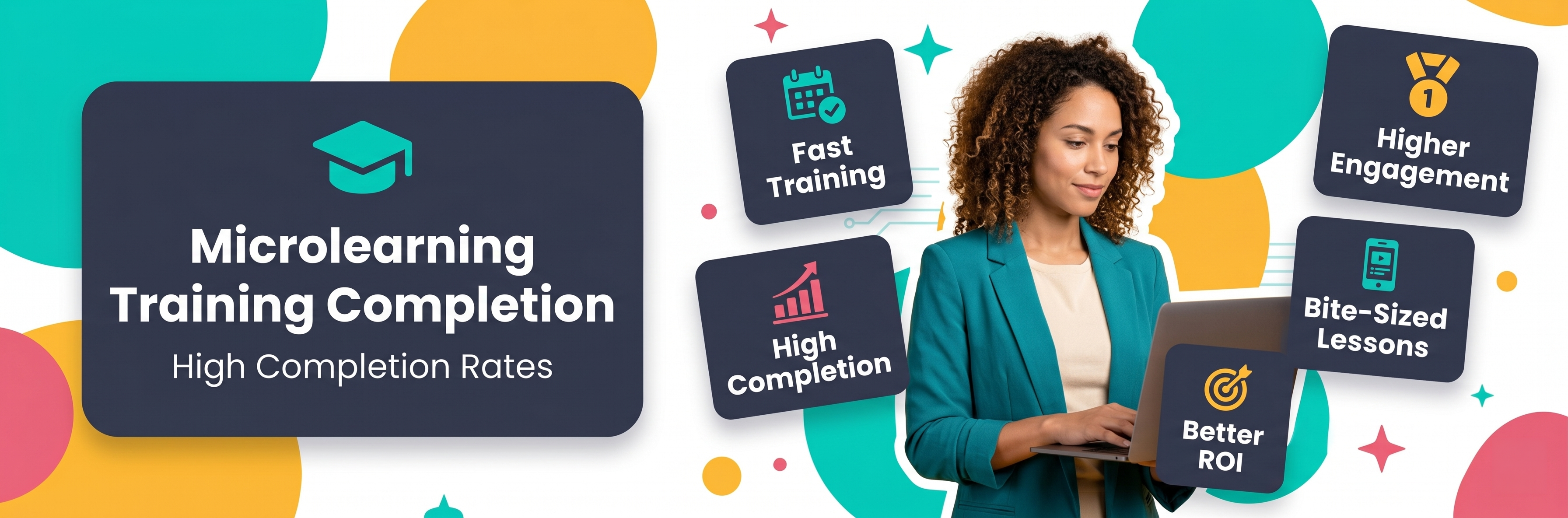
Your team spent three months building a compliance training programme. You rolled it out on the LMS. Six weeks later, the completion report lands on your desk: 12%. Twelve per cent of employees finished the course. The rest clicked 'start', sat through the first five minutes, and never came back.
This is not an outlier. Research consistently shows that traditional e-learning modules — the 45-to-90-minute courses that still dominate corporate LMS platforms — see completion rates of just 20-30%. Some organisations report single-digit figures. Meanwhile, bite-sized learning platforms built around microlearning achieve 80-95% completion rates on the same content, with the same learners, in the same organisations.1
The gap is not about motivation. It is not about content quality. It is about delivery design. This article breaks down the 10 specific mechanisms that make microlearning platforms dramatically more effective at driving training completion — backed by research, industry data, and real-world results.

- Microlearning modules achieve 80-95% completion rates compared to 20-30% for traditional e-learning — a 3-4x improvement driven by structural design, not content alone.1
- Bite-sized learning aligns with how the brain works. Spaced repetition improves knowledge retention by 25-60% over single-session training.13
- Mobile-first delivery removes the biggest completion barrier: scheduling. Learners finish 5-minute modules during natural gaps in their workday.
- Gamified training boosts engagement by up to 150% and drives voluntary repeat usage — turning a compliance obligation into a daily habit.11
- AI personalization eliminates the "I already know this" dropout. Learning paths adapt to individual knowledge gaps automatically.8
- Just-in-time training achieves higher application rates because learners use what they learn immediately, not six months later.
The completion gap: microlearning vs. traditional training
Before diving into the 10 mechanisms, here is the headline data on why bite-sized learning consistently outperforms traditional delivery methods.
| Metric | Traditional E-Learning | Microlearning |
|---|---|---|
| Average Completion Rate | 20-30% | 80-95% |
| Learner Engagement | ~15% active engagement | Up to 90% active engagement |
| Knowledge Retention (30 days) | 10-20% retained | 25-60% retained |
| Average Module Length | 45-90 minutes | 3-10 minutes |
| Time to Develop | Baseline | 40-60% less development time |
| Mobile Accessibility | Limited / desktop-first | Native mobile-first design |
| Learner Preference | 20% prefer this format | 85% prefer this format |
1. Bite-sized modules eliminate the scheduling barrier
The single biggest reason employees abandon traditional training is time. A 60-minute e-learning module requires an uninterrupted hour that most employees simply do not have. Between meetings, emails, and actual work, finding a solid block of time to sit through a course feels impossible — so they postpone it. Then postpone it again. Then forget about it entirely.
Microlearning removes this barrier by compressing training into 3-to-10-minute modules that fit into the natural gaps in a workday. A 5-minute lesson can be completed between meetings, during a commute, or while waiting for a call to start. Research from the TalentLMS 2026 L&D Benchmark Report confirms that employees consistently cite time constraints as their primary barrier to training completion — and that modules under 10 minutes see 20% higher completion rates than longer sessions.9
This is not about dumbing down content. It is about respecting the learner's reality. When the ask drops from 'block out an hour' to 'give us five minutes', completion rates respond accordingly.

85% of learners prefer microlearning over traditional e-learning courses.9
2. Spaced repetition fights the forgetting curve
Hermann Ebbinghaus identified the problem in the 1880s, and it has not changed: learners forget up to 70% of new information within 24 hours and as much as 90% within a week if there is no reinforcement. A single 90-minute training session, no matter how well designed, is fighting a losing battle against the brain's natural forgetting curve.
Microlearning platforms build spaced repetition directly into the learning architecture. Instead of one long session, learners encounter the same core concepts multiple times across days and weeks, at progressively increasing intervals. Each repetition strengthens the neural pathways and moves knowledge from short-term to long-term memory.
The evidence is substantial. Studies show spaced learning improves knowledge retention by 25-60% compared to single-session training.14 A 2025 peer-reviewed study on spaced repetition in medical education found the intervention group scored significantly higher on post-tests (16.24 vs 11.89, p < 0.0001), with over 90% reporting improved retention and confidence.13 When combined with gamification, the effect compounds: one platform reported 30-day knowledge retention jumping from 23% to 68% after implementing spaced repetition with game mechanics.10

Spaced learning is particularly powerful for compliance training, where the goal is not just completion but genuine behaviour change. An employee who encounters anti-bribery scenarios across five spaced sessions will recognise red flags in the real world. An employee who sat through a single 60-minute module six months ago will not.
3. Mobile-first delivery meets learners where they are
Roughly 2.7 billion frontline and deskless workers worldwide rely on smartphones for daily tasks. Many of them have no desktop computer, no dedicated workstation, and no scheduled 'training time'. Traditional e-learning, designed for a desktop browser with a stable internet connection, excludes them by design.
Microlearning platforms are built mobile-first. Lessons are designed for vertical scrolling, touch interaction, and intermittent connectivity. Beverage chain Chatime reached 91% learner uptake with sub-5-minute modules accessed during pre-shift briefings. Pet Supermarket logged 79% completion rates on mobile-delivered microlearning modules.2
The usage data tells a telling story about when mobile learning happens: 52% of people access learning on their phone in bed after waking up, and 46% do so before sleep. These are moments that traditional training can never reach — but bite-sized learning modules fit perfectly.
4. Gamified training transforms obligation into engagement
Nobody has ever opened their LMS and thought 'I cannot wait to sit through this 90-minute compliance module.' But add points, streaks, badges, and leaderboards to a 5-minute daily challenge, and something shifts. The psychology is well documented: gamified training taps into intrinsic motivators — achievement, competition, progress — that turn a chore into something closer to a habit.
The data backs this up consistently. E-learning courses with gamified elements see a 90% completion rate, compared to just 25% without gamification.12 Gamified training boosts engagement by up to 150% compared to non-gamified approaches.11 A 2025 nursing education study found 93% course completion after adding game-like badges and clinical simulations, with researchers noting that gamification 'boosted motivation and reduced drop-out rates'.
The streak mechanic is particularly effective for continuous learning. Platforms that reward daily learning streaks see 3x higher completion rates for sessions scheduled at consistent times. The compulsion to 'keep the streak' means learners revisit material more frequently — which reinforces spaced repetition and accelerates mastery.
5. AI personalization eliminates 'I already know this' dropout
One of the most common reasons experienced employees abandon training is the feeling that the content does not apply to them. A senior compliance officer forced to sit through 'What is GDPR?' basics for the third year running will disengage faster than a new hire. Traditional training treats everyone identically. The AI-powered learning platform approach does not.
Modern microlearning platforms use AI to create personalized learning paths that adapt to each learner's existing knowledge, role, and performance data. If a learner demonstrates mastery of a concept in a quiz, the platform skips ahead. If they struggle with a specific area, it serves more practice on that topic.
LinkedIn Learning's 2025 Workplace Report found that 68% of organisations now use some form of AI-driven learning personalization — up from 54% in 2023. Global adoption of microlearning rose 34% year-on-year, with enterprises increasingly tying it to individual performance metrics rather than generic completion tracking.8

A health and safety microlearning platform might serve warehouse operatives daily modules on manual handling and forklift safety, while office-based employees receive DSE and ergonomics content. Both complete the same compliance framework — but through content that actually matches their daily risks.
6. Just-in-time training delivers knowledge at the point of need
Traditional training operates on a 'just-in-case' model: learn everything now, in case you need it later. The problem is obvious — by the time 'later' arrives, the learner has forgotten most of what they learned. Just-in-time training flips this model by delivering bite-sized content at the exact moment the learner needs it.
A hotel receptionist dealing with a guest complaint can access a 3-minute conflict resolution module on their phone. A warehouse worker about to operate unfamiliar equipment can complete a quick safety refresher at the workstation. A new manager preparing for their first performance review can review a coaching conversation framework during their lunch break.
This approach drives higher completion because it connects learning to immediate application. Employees are more motivated to complete training when they can see an immediate use for the knowledge. Research consistently shows that learners who apply new skills within 24-72 hours of training retain significantly more than those who learn in isolation from application.
7. Video-based content matches modern consumption habits
The average person watches over 17 hours of online video per week. TikTok, Instagram Reels, and YouTube Shorts have conditioned an entire generation of workers to consume information in short, visually engaging bursts. Traditional e-learning — walls of text punctuated by stock photos and a quiz at the end — feels archaic by comparison.
Microlearning platforms lean heavily into short-form video, with expert-led lessons of 3-5 minutes that feel closer to content employees choose to watch than training they are forced to complete. Industry data shows 85% of organisations now use video-based lessons in their training programmes, and 93% consider video-based training critical for success.3
The format matters for completion because it lowers the perceived effort. A 5-minute video feels manageable in a way that a 20-page PDF does not. And because video combines visual, auditory, and narrative elements, it activates more cognitive pathways — which means better retention alongside higher completion.
8. Continuous learning replaces the annual compliance sprint
Most organisations still operate on an annual training cycle: roll out compliance training in January, chase completions until March, then ignore L&D until next year. This 'big bang' approach creates predictable problems — a surge of resentful learners rushing through content to meet a deadline, followed by 11 months of zero reinforcement.
Microlearning enables a continuous learning model where employees complete a few minutes of training every day or every few days throughout the year. This approach distributes the learning load, eliminates the annual scramble, and creates a genuine learning culture rather than a compliance checkbox exercise.
The business impact is clear. Companies using continuous microlearning report nearly 17% gains in productivity, with some data showing 30%+ improvement in knowledge transfer. Revenue per employee correlates with 24% higher profit margins when modern instructional methods — including continuous microlearning — are embedded in the workflow.2
9. Scenario-based assessments replace passive consumption
Traditional e-learning follows a predictable pattern: read (or skim) content, then answer multiple-choice questions that test recall rather than understanding. Learners quickly learn to game the system — speed through the content, guess at the quiz, retry until they pass. The module registers 'complete', but no real learning has occurred.
Microlearning platforms integrate scenario-based assessments throughout the learning experience, not just at the end. Short case studies, decision-tree simulations, and interactive scenarios force learners to apply knowledge rather than simply recognise correct answers. This active engagement keeps learners invested in the content — and the immediate feedback loop means they correct misunderstandings in real time.
Research from the University of Colorado found that interactive, scenario-based training improved exam pass rates by up to 18% compared to passive learning formats. When assessments are woven into microlearning modules rather than bolted on at the end, they become part of the engagement loop rather than a hurdle to endure.
10. Automated nudges and smart reminders close the last-mile gap
Even the best-designed training programme loses learners to inertia. People forget to log in. They start a module and get interrupted. They mean to come back tomorrow and never do. Traditional LMS platforms rely on manual email reminders from L&D teams — emails that quickly become background noise.
Modern microlearning platforms use AI-driven push notifications and smart reminders that adapt to each learner's behaviour. If someone typically completes training at 8am, the reminder arrives at 7:55am. If they have been inactive for three days, the nudge escalates. If they completed a module but struggled on the quiz, a reinforcement prompt appears the next day.
These automated systems eliminate the administrative burden on L&D teams while closing the gap between 'enrolled' and 'completed'. Combined with gamification mechanics like streak protection and progress notifications, smart nudges transform training completion from something employees do when chased into something that fits naturally into their daily routine.
The microlearning market is valued at $3.32 billion in 2026 and growing at 11.83% CAGR, projected to reach $5.81 billion by 2031.5 This is not a trend. It is a structural shift in how workplace learning works.
For HR leaders, L&D managers, and compliance officers evaluating training delivery methods, the data points in one direction: shorter, more frequent, more personalised learning drives dramatically higher completion. Platforms like 5Mins.ai bring all 10 of these mechanisms together — bite-sized lessons, spaced repetition, mobile-first delivery, gamification, AI personalization, and automated tracking. With 20,000+ CPD-accredited lessons across compliance, leadership, and skills development, the platform achieves 95%+ completion rates and 6-10x higher engagement than traditional LMS platforms.
Microlearning completion rates FAQs
Answers to the most common questions about bite-sized learning and training effectiveness.
What is bite-sized learning and how is it different from traditional e-learning?
Does microlearning work for compliance training, or just soft skills?
How does gamified learning improve training completion?
Can a microlearning platform replace our existing LMS?
What is spaced learning and why does it improve knowledge retention?
How do I measure the ROI of switching to microlearning?
 Sources
- Microlearning Statistics, Facts And Trends For 2025, eLearning Industry, June 2025. elearningindustry.com
- Microlearning: Data Reports 2026, WifiTalents, February 2026. wifitalents.com
- 20 Microlearning Statistics to Guide Your Workplace Learning Strategy in 2026, Engageli, March 2026. engageli.com
- 25+ Microlearning Statistics, Facts And Trends For 2025, BuildEmpire, July 2025. buildempire.co.uk
- Microlearning Market - Trends, Statistics & Companies, Mordor Intelligence, January 2026. mordorintelligence.com
- Want to Learn Faster? 5 Microlearning Trends for 2026, UniAthena, May 2026. uniathena.com
- What is Microlearning - The 2026 Guide for L&D Leaders, Disprz, November 2025. disprz.ai
- 2025 Workplace Learning Report, LinkedIn Learning, February 2025. learning.linkedin.com
- The TalentLMS 2026 Annual L&D Benchmark Report, TalentLMS, 2026. talentlms.com
- Spaced Repetition With Gamification For Learning Retention, eLearning Industry, February 2026. elearningindustry.com
- 50+ Gamification Statistics You Need to Know in 2026, AmplifAI, May 2026. amplifai.com
- Gamification Statistics You Need For 2026, BuildEmpire, May 2026. buildempire.co.uk
- Vagha et al., Implementation of a spaced-repetition approach to enhance undergraduate learning, Frontiers in Medicine, July 2025. ncbi.nlm.nih.gov
- Knowledge Retention: What It Is + How to Improve & Measure, Valamis, December 2025. valamis.com
- Corporate eLearning Statistics 2025, Continu, 2025. continu.com
 This article is for general informational purposes only. Statistics cited are sourced from the publications listed above and were accurate at the time of writing. Individual results from microlearning implementation will vary based on content quality, organisational context, and deployment strategy.
All content is researched and written by the 5Mins team.



Madlena (Maddie) Pozlevic










_transparent%20background.png)



.png)