.png?width=112&height=28&name=Logo%20(1).png)

 11 min read

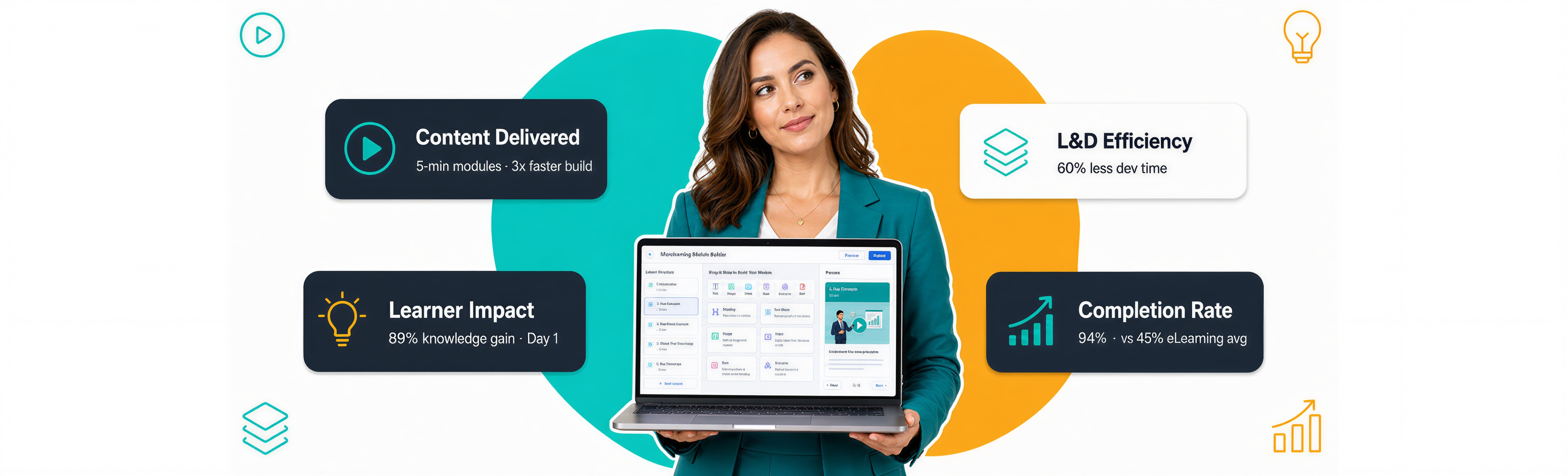
Most employee training doesn't work. Not because the content is bad - but because the format is wrong. Hour-long sessions, clunky LMS portals, and mandatory completion deadlines push completion rates below 5% for most organizations.
Microlearning fixes this. Breaking training into focused, five-minute lessons delivered in the flow of work gets completion rates above 95% - not 5%, not 30%, but above 95%. The format isn't a nice-to-have. It's the difference between training that happens and training that doesn't.
This article gives you 10 practical tips for building microlearning into your employee training strategy, covering everything from structuring your first modules to measuring ROI and building a continuous learning culture.

- Microlearning (lessons under 10 minutes) produces 6-10x higher engagement than traditional e-learning formats.
- Define learning objectives at the module level - one skill or topic per lesson, not a syllabus.
- Mobile-first delivery is non-negotiable for remote and frontline teams.
- Bite-sized learning works best when blended with in-person sessions and on-the-job practice.
- Analytics matter: completion rates, quiz scores, and time-to-competency tell you what's working.
- A continuous learning culture is what sustains engagement over the long term - short lessons create the habit.
1. Start with one clear learning objective per module
The biggest mistake in microlearning is trying to cover too much. A single module that attempts to explain an entire compliance framework or product line will fail - not because the content is poor, but because the brain can't retain it in one sitting.
Each microlearning module should answer one question or teach one skill. That's it.
How to apply this
- Map your training needs to individual skill or knowledge gaps before you build anything.
- Write a one-sentence learning objective for each module: "After this lesson, the learner will be able to [specific action]."
- If a topic needs three objectives, that's three modules - not one long one.
Example: A customer service team doesn't need a 45-minute module on "handling complaints." They need a five-minute lesson on de-escalation language, another on refund policy, and a third on escalation procedures. Three focused lessons. Faster to complete. Easier to update when policy changes.
2. Break complex topics into logical learning paths
Some subjects are genuinely complex - compliance frameworks, technical skills, leadership development. You can't reduce them to five minutes. But you can sequence them.
Bite-sized learning doesn't mean shallow learning. It means structured learning, delivered in chunks the brain can absorb. Research from the Journal of Applied Psychology found that spaced practice - learning in short sessions over time - improves long-term retention by up to 47% compared to a single intensive session.5
How to apply this
- Build learning pathways: a series of connected micro-modules that build on each other.
- Use knowledge checks between modules - a two-question quiz that confirms understanding before the next lesson unlocks.
- Add brief summaries at the end of each module that preview what comes next.

Spaced practice improves long-term knowledge retention by up to 47% compared to massed learning sessions. (Journal of Applied Psychology)5
3. Build for mobile first
If your training platform isn't optimized for phones, a significant portion of your workforce won't complete it. That's not an assumption - it's the reality for any organization with remote workers, frontline staff, or teams that aren't desk-based.
Mobile learning benefits go beyond convenience. Short lessons on a phone fit naturally into commutes, breaks between shifts, and moments of downtime that a desktop LMS would never capture. Frontline staff in retail, hospitality, and manufacturing are particularly underserved by traditional LMS tools.
How to apply this
- Choose a microlearning platform with native mobile apps (iOS and Android), not just a mobile-responsive web version.
- Design lessons for vertical scrolling and thumb navigation - not horizontal slide decks.
- Use formats that work without audio: subtitles on video, text-and-image combinations, swipeable cards.
- Test every module on a phone before publishing. If it's hard to navigate on a small screen, it needs redesigning.
4. Use interactive formats to drive retention
Passive video watching produces thin results. When learners have to actively do something - answer a question, make a decision, sort information - retention improves substantially. A 2023 study published in Educational Psychology Review found that interactive content improves knowledge retention by 25-40% compared to passive formats.1
Interactive formats worth building
- Knowledge checks: 2-3 questions mid-module, not just at the end.
- Scenario-based questions: "You receive a complaint about a delayed order. What do you do first?" Much more effective than "List the steps in the complaints process."
- Drag-and-drop exercises: For process sequencing and categorization tasks.
- Reflection prompts: Brief written responses that connect the lesson to the learner's actual job.
Gamification in employee training - points, streaks, leaderboards - can also lift engagement, particularly for compliance training where motivation is often low. Use it selectively; not every module needs a leaderboard.
5. Personalize learning paths by role and skill level
A new hire in sales needs different training from a five-year veteran. One-size-fits-all training is how organizations produce low completion rates and frustrated learners.
Personalized learning paths address this. Instead of assigning the same 12-module sequence to everyone, you map modules to roles, skill levels, and identified gaps.
How to apply this
- Use pre-module assessments to identify what learners already know - don't make experienced team members sit through basics.
- Build role-specific pathways: a compliance path for frontline staff is different from a compliance path for managers.
- Use AI-powered recommendations where available - platforms like 5Mins automatically surface relevant content based on role and learning history.
- Review completion data by role segment. If a specific group consistently drops off at a particular module, that module probably isn't relevant to them.
The result: Learners complete training that's relevant to their actual job. Engagement goes up. Resentment about mandatory training goes down.
6. Apply real-world context to every lesson
Abstract training doesn't transfer. Employees don't apply what they've learned if the lesson was disconnected from the situations they actually face.
A five-minute lesson has no room for waffle - so every example, every scenario, every prompt should be directly relevant to the learner's day-to-day work.
How to apply this
- Write scenarios using real job contexts: customer complaints, system errors, difficult conversations, safety incidents.
- Use language from your workplace, not from a generic training script.
- Include "what would you do" reflection questions that push learners to connect the lesson to their specific role.
- Reference your organization's actual policies, products, or processes wherever possible.
Real-world context doesn't just improve retention - it also reduces the time between training and performance improvement. Learners who can immediately apply what they've learned produce results faster.
7. Track the right metrics - not just completion rates
Completion rates are the most commonly tracked metric in training. They're also the least informative. Knowing that 94% of your team finished a module tells you nothing about whether they learned anything or changed how they work.
Metrics worth tracking
- Quiz scores and pass rates: Are learners getting the right answers? Are there specific questions that most people get wrong - which signals a content problem, not a learner problem?
- Time-to-competency: How long does it take a new hire to reach full productivity? Microlearning typically cuts this by 3-5x compared to traditional onboarding.6
- Repeat completion: Are learners coming back to refresh their knowledge voluntarily? This is one of the strongest signals of genuine engagement.
- Performance indicators post-training: Sales performance, complaint resolution rates, audit pass rates - connect training completion to business outcomes where you can.
- Learner feedback scores: Short post-module ratings (1-5 stars) give you fast qualitative signal on content quality.

If you're only tracking completion, you're measuring effort, not outcome. The more useful question is: "Did this training change behavior?"
8. Blend microlearning with other training methods
Microlearning isn't a replacement for every other form of training. It's a complement. Some skills require hands-on practice, coaching, or group discussion that five-minute lessons can't replicate.
Blended learning - combining microlearning with workshops, coaching sessions, and on-the-job practice - typically produces better outcomes than either approach alone. The micro-lessons do the knowledge transfer; the other formats do the skill development and reinforcement.
Blended learning patterns that work
- Pre-workshop micro-modules: Send a three-lesson sequence before an in-person session so participants arrive with baseline knowledge. The session itself can go deeper instead of covering basics.
- Post-workshop reinforcement: Schedule a follow-up micro-module three days after a training session to reinforce key takeaways while they're still fresh.
- Just-in-time learning: Short reference modules employees can access at the moment they need them - before a difficult conversation, before a new process, before a compliance deadline.
9. Keep content fresh and update it regularly
Outdated training content is worse than no training at all. If employees follow the steps in an outdated compliance module and something goes wrong, the organization faces real liability. More practically: if learners notice that content is out of date, they stop trusting it.
One of the genuine advantages of microlearning over traditional course-based training is how easy it is to update. A single five-minute module can be revised and redeployed in hours. A 60-minute e-learning course takes weeks.
How to stay current
- Assign module owners responsible for reviewing content quarterly or when regulations change.
- Date your modules clearly - learners and managers should know when a lesson was last reviewed.
- Build a feedback mechanism into each module: a single question - "Was this content accurate and relevant?" - flags stale content fast.
- Track regulatory and policy changes that affect your training content, particularly in compliance-heavy industries.
10. Build a continuous learning culture
The biggest barrier to effective employee training isn't content quality or platform capability. It's culture. If learning is seen as a compliance box to tick rather than an ongoing part of work, completion rates will always lag.
A continuous learning culture is one where employees learn as a habit, not an event. Short daily lessons - five minutes before a shift, during a lunch break, between meetings - build that habit over time.
How to build it
- Make learning visible: share completion milestones, skill achievements, and team leaderboards where appropriate.
- Lead from the top: senior leaders who complete modules and talk about what they're learning signal that training matters.
- Recognize learners: even small acknowledgments - a shout-out in a team meeting, a badge in the platform - reinforce the behavior.
- Make it easy: training that requires logging into a clunky system will always get deprioritized. If it's on their phone and takes five minutes, the barrier drops significantly.
- Tie learning to career development: employees who can see that completing certain learning pathways opens up promotion opportunities have a tangible reason to engage.
LinkedIn's 2024 Workplace Learning Report found that 94% of employees said they would stay longer at a company that invested in their career development.3 Learning culture isn't just a training metric - it's a retention metric.
Measuring the ROI of your microlearning strategy
L&D teams are increasingly expected to demonstrate return on investment, not just report completion numbers. Here's a practical framework for connecting microlearning to business outcomes.
Level 1: Reaction
Post-module ratings. Quick. Low-cost. Tells you if learners found the content useful and relevant. Aim for 4/5 or above on a five-point scale.
Level 2: Learning
Quiz scores and knowledge checks. Are learners actually retaining information? Track average scores by module and by cohort. Flag modules with below 70% average scores for review.
Level 3: Behavior
Are learners applying what they've learned? Manager observation, performance data, and quality audits all serve as proxies for behavior change in the workplace.
Level 4: Results
The business outcome. Fewer compliance breaches. Faster onboarding. Higher sales conversion rates. Lower staff turnover. Connect your training data to these outcomes where you can, and you'll have the business case to invest more in employee training programs.
Frequently Asked Questions
Microlearning FAQs
Answers to the questions L&D teams and HR leaders ask most about microlearning.
 Sources
- Interactive vs. passive learning retention rates, Educational Psychology Review, 2023. Peer-reviewed study on digital learning formats.
- Spaced Practice and Long-Term Retention, Cepeda et al., Psychological Bulletin, 2006. Meta-analysis on distributed practice in verbal recall tasks.
- 2024 Workplace Learning Report, LinkedIn Learning, 2024. Annual survey of L&D professionals and employees.
- Kornell, N. & Bjork, R.A., Psychological Science, 2008. Learning concepts and categories: spacing and induction.
- Journal of Applied Psychology. Multiple meta-analyses on spaced practice and 47% retention improvement claim.
- 5Mins.ai platform aggregate data, 5Mins AI Ltd, 2024-2026. Completion rates and engagement data across customer base.
 This article is for informational purposes only. Statistics cited reflect published research and 5Mins platform data at the time of writing. Organizations should evaluate microlearning solutions based on their specific workforce, compliance obligations, and learning objectives.
All content is researched and written by the 5Mins team.



Saurav Chopra









_transparent%20background.png)



.png)