.png?width=112&height=28&name=Logo%20(1).png)

 7 minute read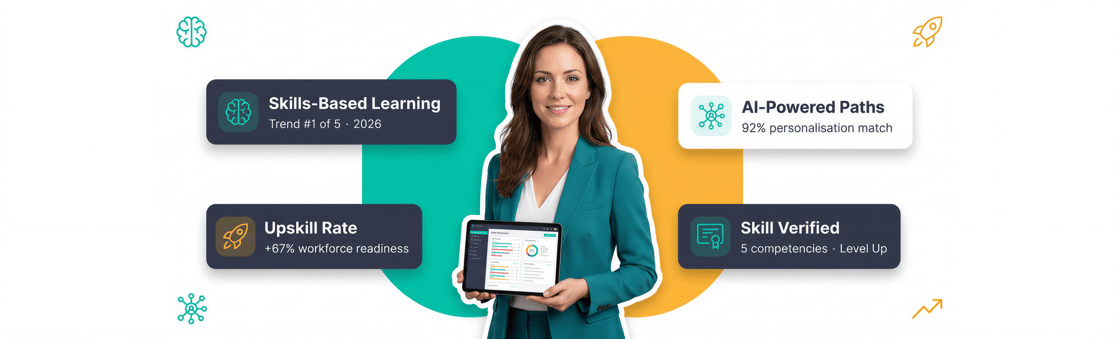
Three-quarters of companies say they cannot keep up with their own demand for new skills, despite spending $400 billion a year on training. That is a delivery problem, not a content problem.
Skills now expire faster than annual training cycles can refresh them. Employee attention spans sit at around 47 seconds before task-switching, according to Harvard Business Review research. And generative AI is rewriting roles at a pace role-based training cannot match.
The corporate training trends shaping 2026 are a direct response to that pressure. L&D and HR leaders are moving away from long courses, generic libraries, and once-a-year training sprints. In their place: bite-sized lessons, AI-driven personalization, gamified engagement, autonomous AI tutors, and a shift from job titles to skills.
5Mins.ai works with L&D and HR teams across more than 80 countries. Here are the five trends to build your 2026 strategy around.

- 74% of organizations cannot keep up with their skills demand, despite a $400 billion global training spend (Josh Bersin Research, 2026).
- Microlearning improves retention by 50 to 60% vs. traditional training, with completion rates of 80 to 90% (LinkedIn Learning, SHRM).
- 91% of companies plan to increase AI spending in L&D in 2026 (WhatFix), with 62% already experimenting with AI agents (McKinsey).
- 70% of employers now use skills-based hiring for entry-level roles, up from 65% the year before (NACE Job Outlook 2026).
- Gamification adoption sits at over 70% of Global 2000 companies (Gartner), and lifts daily active learners by 45%.
1. Microlearning Becomes the Default, Not the Add-On
For years, microlearning was the "innovative" alternative to long e-learning. In 2026, it is the baseline expectation.
The shift is being driven by shrinking attention windows, the collapse of dedicated training time, and the rise of always-on work. According to LinkedIn Learning's 2025 Workplace Learning Report, 72% of organizations have now embedded microlearning into their training mix, up from 54% in 2023.
The performance data is hard to argue with. Bite-sized lessons drive retention 25 to 60% higher than traditional methods, completion rates of 80 to 90% versus around 30% for long-form e-learning, and development costs roughly half of traditional course production (Deloitte, SHRM, LinkedIn).
What's new in 2026 is that microlearning is moving from "short videos" to a full performance system. Lessons sit inside the flow of work (Slack, Teams, mobile apps) and are nudged to the learner at the moment of need. It is closer to a coach in your pocket than a course on a server.

A sales associate finishes a 4-minute lesson on objection handling in the 10 minutes before a discovery call. They apply it on the call. They retake the lesson the next day to lock it in. That loop (learn, apply, reinforce) is the microlearning playbook.
How to get started
- Audit your existing courses. Pick three that are too long, too dry, or have low completion rates. Break each into 3 to 5 minute modules with one objective per module.
- Pilot in a single team. Sales, customer support, and new-hire onboarding usually show fastest results.
- Track two metrics from day one: completion rate and post-lesson recall after seven days. If either underperforms, your modules are still too broad.
2. AI-Powered Personalization Replaces "One Path Fits All"
Personalized learning has been the L&D buzzword of the last decade. In 2026, AI finally makes it real at scale.
The numbers are striking. 91% of companies plan to increase AI spending in L&D in 2026 (WhatFix), and 59% of global L&D and talent leaders now rank AI as their top priority, ahead of leadership development, reskilling, and learning culture (iVentiv). 62% of organizations are already experimenting with AI agents, per McKinsey.
What changes when AI does the heavy lifting? Three things.
First, content recommendation gets specific. Instead of "all new managers complete this course," AI matches each learner to a path based on role, recent performance, completed lessons, and skill gaps. IBM reports 20% productivity gains from AI-driven training, and TechClass research shows AI-powered personalization can lift completion rates by up to 40%.
Second, content creation gets faster. AI converts existing PDFs, presentations, and long videos into bite-sized lessons in hours rather than weeks. For L&D teams stuck on six-month course production cycles, this is the change that matters most.
Third, assessment becomes adaptive. Quiz questions adjust to the learner's level. Reinforcement nudges arrive when the forgetting curve says they should, not on an arbitrary schedule.
The catch: AI personalization is only as good as the data feeding it. Teams that bolt AI onto a poorly-tagged content library tend to underwhelm. Invest in clean role profiles, accurate skill taxonomies, and tight feedback loops before scaling.
For deeper context on how AI is changing the format of training itself, our piece on AI-powered video and personalized content covers the production-side shift in detail.
3. Gamification Drives Engagement That Traditional Training Cannot
Gamification has been talked about for ten years and finally has the data to justify the noise.
According to Gartner, more than 70% of Global 2000 companies have adopted gamification in some form. Microlearning paired with gamification lifts daily active learners by 45% (WifiTalents, 2026). And gamification in compliance training shows outsized impact: 89% of employees find gamified compliance modules more engaging than traditional formats, with measurable improvements in retention and policy adherence.
The mechanics that work in 2026 are familiar (points, badges, leaderboards, streaks, team challenges) but the application is more sophisticated. The best programs do not gamify everything. They gamify the behaviors they want repeated: daily learning streaks (Duolingo-style), team-based compliance pushes ahead of an audit, leaderboard competitions for sales enablement.
A retailer runs a 30-day compliance refresh ahead of an audit. Each store gets a leaderboard. Each employee earns points for completing 3-minute modules and bonus points for streak days. Completion goes from 62% to 96% in three weeks. Engagement is real, and so is the audit readiness.
How to gamify your training without going overboard
- Pick one outcome to gamify first: compliance completion, onboarding speed, or sales-enablement drills.
- Use team-based mechanics where possible. Individual leaderboards motivate top performers but can demotivate the bottom half.
- Tie rewards to recognition over swag. Public praise from a manager beats a £20 voucher every time.
4. AI Agents and Agentic Learning Move From Experiment to Production
If 2025 was the year of generative AI in L&D, 2026 is the year of agentic AI: autonomous AI tools that act on behalf of the learner or the L&D team.
The data shows how fast this is moving. KPMG's Q1 2026 AI Pulse research found that 55% of employees now report some level of integration of AI agents into their work, with leaders projecting average AI spending of $207 million over the next 12 months, nearly double the prior year. Organizations using AI agents in training report 70 to 80% knowledge retention, 80 to 90% course completion rates, and ROI of 300 to 500% (Naitive Cloud, 2026).
What does this look like in practice? Three high-value applications:
- AI tutors and coaches that sit inside Slack or Teams, answer questions in real time, and deliver micro-lessons on demand. Think of it as the always-on subject-matter expert your team has never had.
- AI agents for L&D admin that handle enrollment, reminders, audit reports, and compliance tracking. The work that historically eats 20+ hours a month from L&D teams.
- Agentic skill-building where the AI identifies a skill gap, surfaces the right lesson at the right moment, runs a scenario-based practice round, then assesses whether the skill has stuck.
One risk worth flagging: agentic AI can also be used badly. HRMorning recently reported that some employees are now using AI agents to auto-complete compliance modules, finishing the course without reading a word. Course completion as a success metric is officially dead. The L&D leaders who win in 2026 will measure downstream signals (scenario-based testing, on-the-job performance, follow-up retention checks) not box-ticking.
5. Skills-Based Learning Replaces Role-Based Training
The biggest structural shift in corporate training for 2026 is also the quietest. Companies are moving from training people for jobs to training people for skills.
The hiring side has already shifted. NACE's Job Outlook 2026 survey shows 70% of employers now use skills-based hiring for entry-level roles, up from 65% the year before. Across the broader market, 76% of employers report adopting skills-based hiring approaches (TestGorilla, 2024), and Korn Ferry research finds that organizations focused on skills are 57% more likely to anticipate and respond effectively to change.
Training is following the same logic. Instead of "all customer service reps complete the same onboarding," modern programs map each employee to a skill profile and serve content against the gaps. Skills-based learning aligns training with what the business actually needs and gives employees a transparent path to grow.
The numbers reinforce why this matters now. Gartner research shows 58% of the workforce will need new skill sets to do their jobs successfully. The World Economic Forum projects 39% of workers' core skills will be outdated by 2030. And 87% of leaders rank upskilling and reskilling the existing workforce as their number one priority for building an AI-enabled team, ahead of hiring (KPMG, 2026).
Of every role and every employee, kept current by real assessments rather than self-reported surveys.
So the same lesson can serve a marketer, an SDR, and a PM if it builds the same underlying skill.
So managers can see their team's skill gaps and nudge specific learning rather than relying on annual reviews.
How to start: Pick three to five priority skills your business needs in the next 12 months: communication, AI literacy, sales discovery, conflict management, whatever the gap is. Map current proficiency. Map content against each skill. Run for 90 days. Iterate.
For a fuller breakdown of how this plays out in practice, our guide on microlearning vs. mobile training walks through how skill-based delivery differs from format-led delivery.
The 2026 Training Stack: Old vs. New
| Element | Pre-2024 Approach | 2026 Approach |
|---|---|---|
| Format | Hour-long e-learning courses | 3 to 5 minute microlearning lessons |
| Personalization | One path for the whole team | AI-matched paths per employee |
| Engagement | Annual mandatory training | Streaks, leaderboards, daily nudges |
| Delivery | LMS portal, desktop only | Mobile-first, in Slack/Teams, on-demand |
| Structure | Role-based curricula | Skill-based pathways |
| Measurement | Course completion | Retention, application, business KPIs |
| Admin overhead | High, with manual chasing | AI agents handle enrollment and reminders |
What This Means for L&D and HR Leaders
Three takeaways for anyone building a 2026 training plan.
Stop measuring completion. Start measuring application. Course completion is now a vanity metric in an AI-augmented workforce. The teams that win in 2026 will track post-training business signals (sales conversion, ticket resolution time, audit pass rates, retention) and tie them back to specific learning interventions.
Build for the flow of work, not the flow of training. The single biggest change in 2026 is that learning happens in Slack, in Teams, on the phone between meetings, and inside the tools employees already use. If your training requires an employee to remember to log into a portal, you have already lost.
Skills are the unit of strategy, not roles. Both hiring and learning are converging on skills-first thinking. L&D teams that map content to skills (not job titles) and align with HR's hiring strategy will be the ones whose work gets funded.
5Mins.ai is built around this stack: bite-sized lessons, AI-powered personalization, gamified engagement, agentic AI features, and a skill-based content library of 20,000+ lessons covering compliance, leadership, role-based skills, and Gen AI training. Teams using 5Mins typically see 95%+ completion rates and 6 to 10x higher engagement than legacy LMS platforms.
Frequently Asked Questions
Quick answers to the most common questions about the 2026 corporate training trends.
What are the top corporate training trends in 2026?
Why is microlearning so important in 2026?
How does AI personalize employee training?
What is skills-based learning, and how is it different from role-based training?
Are AI agents replacing trainers?
How do I measure ROI on a 2026 training program?
Conclusion: Build Your 2026 Training Stack Around What Actually Works
The corporate training trends defining 2026 are not new ideas. Most of them have been talked about for years. What's new is the data behind them, the tools that finally make them work, and the urgency that AI-driven skills disruption brings.
If you remember nothing else from this piece: short, AI-personalized, gamified, skill-based learning beats every previous training model on every metric that matters. Completion, retention, engagement, application, and ROI. The teams getting it right are not the ones with the biggest budgets. They are the ones who picked one trend, ran it well, measured it honestly, and scaled.
5Mins.ai helps L&D and HR teams build that stack with AI-powered microlearning, skills-based learning pathways, and compliance training that runs itself. You can browse our full catalogue of 20,000+ bite-sized lessons in our course collection.
 Sources
- Josh Bersin Research, "How AI Transforms $400 Billion of Corporate Learning," 2026. View source
- LinkedIn Learning, 2025 Workplace Learning Report. View source
- NACE, Job Outlook 2026. View source
- McKinsey & Company, "AI Agents in the Enterprise," 2026.
- KPMG US Q1 AI Quarterly Pulse, 2026. View source
- WhatFix, "AI in L&D Spending Report," 2026.
- Gartner, "Future of Work and Learning Trends," 2025-2026.
- Deloitte, "Workforce Learning Report," 2025.
- SHRM, "Microlearning Effectiveness Report," 2025.
- TechClass, "Maximizing AI Training ROI for Enterprises," 2026. View source
- WifiTalents, "Microlearning Data Report 2026". View source
- iVentiv, "L&D Priorities Report," 2026.
- World Economic Forum, "Future of Jobs Report 2025".
- Korn Ferry, "Skills-First Workforce Research," 2025-2026.
- HRMorning, "Agentic AI and the New Era of Corporate Learning," 2026. View source
- TestGorilla, "Global Hiring Report," 2024.
- Naitive Cloud, "AI Agents in Corporate Training: 2025 Key Statistics". View source
 This article is for informational purposes only and does not constitute legal, HR, or financial advice. Statistics cited reflect publicly available research at the time of writing and may change. Organizations should evaluate training strategies in line with their own context and goals.
All content is researched and written by the 5Mins team.



Saurav Chopra








_transparent%20background.png)



.png)