.png?width=112&height=28&name=Logo%20(1).png)

 8 minute read

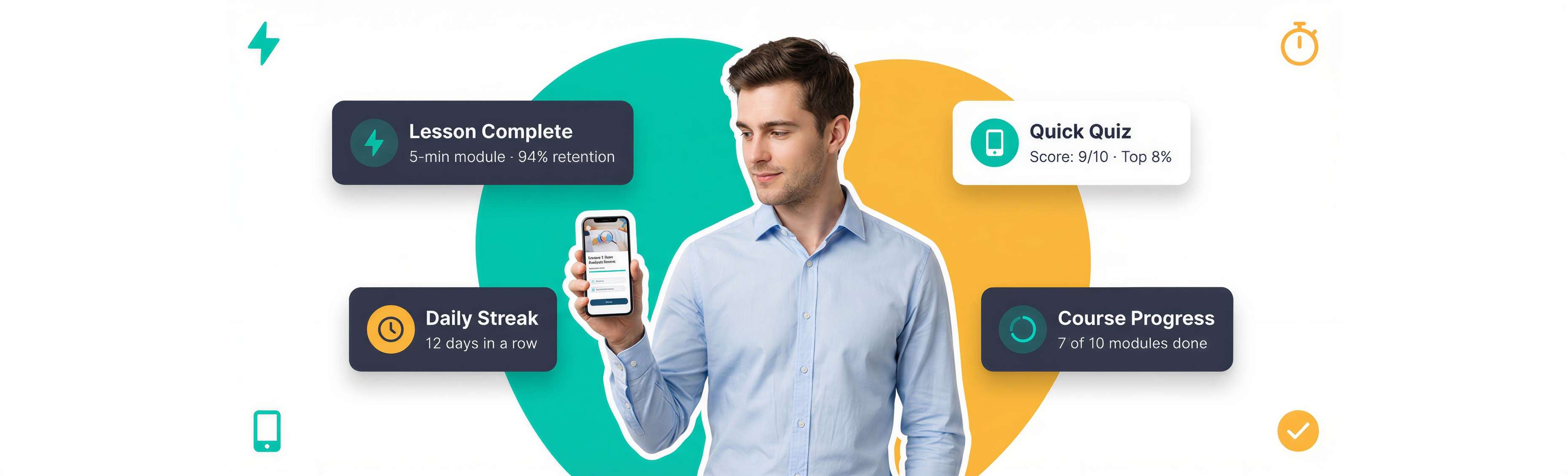
Forty-nine percent of L&D leaders say their executives are worried employees don't have the skills to execute company strategy. That number, from LinkedIn's 2025 Workplace Learning Report, is the highest it has been in the survey's history. At the same time, the average completion rate on a traditional corporate training course is between 20 and 30 percent — meaning seven out of ten employees enrolled in your programmes never finish them.
That's the gap modern training has to close. The legacy model — multi-day classroom sessions, hour-long e-learning modules, dense PDFs — was built for a different workforce, a different attention span, and a different working pattern. It hasn't kept up.
Bite-sized learning, also called microlearning, is the structural answer most L&D teams are converging on. The format is simple: focused 2–10 minute lessons, one concept each, accessible on mobile, designed to slot into the working day rather than interrupt it. The reasons it's winning are less obvious — and less about content than about how the modern workforce actually learns. This article is the thesis: what's driving the shift, what the data shows, and what HR and L&D leaders need to do about it.

- Three forces are driving the shift to bite-sized learning: the skills crisis (49% of L&D leaders cite executive concern about skill gaps), the attention shift (the modern workforce consumes information in short bursts, in and out of work), and the rise of hybrid work (training has to fit around distributed schedules, not the other way round).
- The data is now decisive. Microlearning improves retention by 25–60% over traditional formats, reduces training time by 45–80%, increases engagement by 50%, and develops up to 300% faster than equivalent long-form content.
- Completion is the metric that has flipped. Traditional corporate courses see 20–30% completion. Microlearning typically sees 80%+, and well-designed programmes hit 95% — meaning training actually reaches the people who need it.
- It works because of how the brain actually learns. Spaced repetition, lower cognitive load, and just-in-time application all depend on small, focused units — not long sessions.
- The market is voting with its budget. The microlearning market grew from $1.55B in 2024 to a projected $2.96B in 2025, a 13.5% CAGR. The format isn't a fad — it's the new default.
Three forces driving the shift
Microlearning didn't win because it's shorter. It won because three structural forces made the legacy training model unworkable.
First, the skills crisis. LinkedIn's 2025 Workplace Learning Report found 49% of L&D leaders say their executives are worried employees don't have the skills to execute the business strategy. AI is part of the answer — 71% of L&D pros are now experimenting with AI-driven learning — but speed of skill acquisition is the real challenge. Six-month classroom programmes can't keep up with the pace at which jobs are changing. Bite-sized learning compresses the cycle time: short, role-specific lessons that build skills in weeks, not quarters.
Second, the attention shift. The average human attention span has dropped to roughly 8.5 seconds, and the workforce is now used to consuming information in TikTok-length bursts. This isn't just generational — it's the format the brain has been trained on for over a decade. Long-form training fights against that grain; microlearning works with it. The result: 50% higher engagement on bite-sized formats, and lessons people actually finish.
Third, the rise of hybrid and distributed work. Most companies are now operating across time zones, working patterns, and locations. Training built for a 9am Monday classroom can't reach a hybrid team scattered across countries. Microlearning works because it travels — accessible on mobile, completable between meetings, and consistent in quality regardless of where the learner sits.

These three forces aren't temporary. Skills cycles will keep shortening, attention spans aren't going back up, and hybrid work is now the operating model rather than the exception. Any training programme that doesn't account for all three has a structural disadvantage that compounds every year.
What companies actually see when they switch
The benefits of microlearning are no longer theoretical. Three patterns show up consistently across the research and across customer data.
Higher completion. Traditional courses average 20–30% completion. Microlearning programmes average 80%+, with well-designed ones hitting 95%. The gap matters because uncompleted training has no impact at all — it's pure spend with no return.
Better retention and faster application. Studies aggregated by eLearning Industry show microlearning improves retention by 25–60% compared to traditional methods. Brandon Hall Group research found that adding social and collaborative micro-content lifts engagement by another 75%. The mechanism is well understood — spaced repetition, lower cognitive load, immediate application — but the practical effect is that knowledge actually sticks long enough to be used on the job.
Lower cost and faster delivery. Microlearning modules can be developed up to 300% faster than equivalent long-form content. They cost less to produce, less to update, and less to deliver — no facilitators, venues, or print materials. Organisations switching to bite-sized formats typically reduce overall training time by 45–80% while maintaining or improving outcomes.

| What you measure |  |
Traditional corporate training |
|---|---|---|
| Completion rate | 80%+ | 20–30% |
| Knowledge retention | +25–60% improvement | Standard forgetting curve |
| Time per session | 5–10 minutes per day | Half-day to multi-day |
| Development speed | Up to 300% faster | Months to update content |
| Engagement | +50% engagement | Passive consumption |
| Fit with hybrid work | Anytime, anywhere, on mobile | Hard to schedule across zones |
Why it works: the science behind the format
The temptation is to think microlearning works because it's shorter. The deeper reason is that it matches how the brain actually processes and stores information.
Working memory is small. Research on cognitive load shows working memory holds about seven items at once, and longer sessions push the brain past that limit — at which point new information starts displacing old. Short, single-concept lessons stay within the limit and let learning consolidate before the next idea arrives.
Forgetting starts immediately. People forget about 50% of new information within an hour, and 33% of what they learned after a year. Microlearning combats this with spaced repetition — short reviews at increasing intervals — which research shows lifts retention by up to 150% over a single training event.
Application beats absorption. Skills only stick when they're used. Bite-sized lessons sit close to the work — a five-minute refresher between meetings, or a quick lesson before a customer call — so learners apply what they've just learned. This 'learning in the flow of work' is the hardest thing for traditional formats to replicate.
"Corporate training stopped working when it kept getting longer while the work kept getting faster. The fix isn't more content — it's less content delivered more often, in the format the brain actually wants. That's all microlearning is. It's why the data has been so consistent for so long, across every industry we work with."

What good bite-sized learning actually looks like
Not all microlearning is equal. Switching format alone doesn't deliver the outcomes — chopping a three-hour course into 18 ten-minute segments isn't bite-sized learning, it's traditional learning sliced thinly. Five things separate effective programmes from imitations.
- One idea per lesson. Each module teaches a single concept or skill, completable in 2–10 minutes, with a clear takeaway the learner can apply that day.
- Personalised by role and level. The same content shouldn't reach a new joiner and a senior leader. AI-driven pathways match content to the learner's role, seniority, and skill gaps.
- Mobile-first and asynchronous. Learning has to fit around the workday, not the other way round. Mobile-accessible content with offline support reaches teams where they are.
- Reinforced through spaced repetition. Single exposure isn't enough. Good programmes resurface concepts at increasing intervals to lock them in long-term memory.
- Measured by behaviour, not attendance. Completion is necessary but insufficient. The metrics that matter are skill progression, application in real work, and downstream business outcomes — engagement, productivity, retention.
How 5Mins delivers this
5Mins.ai was built on this thesis. The platform delivers AI-driven microlearning across compliance, leadership, role-based skills, and onboarding — with 20,000+ lessons from 200+ industry experts, each designed to be completed in around five minutes. The format combines TikTok-style content delivery with gamification (streaks, leaderboards, skill points) and AI-powered personalisation that matches lessons to individual roles and goals.
Organisations using 5Mins typically see 95%+ completion rates, 6–10x higher engagement than legacy LMS platforms, and 60–80% reduction in overall training time — at lower cost than traditional classroom-based programmes. The deeper analysis is in our companion pieces: Microlearning: Why Bite-Sized Training Works Better covers the mechanics; How Bite-Sized E-Learning Delivers Big ROI covers the financial case; and Bite-Sized Learning vs. Traditional Training covers the head-to-head comparison.

→ See the full AI Microlearning platform.
→ Browse 20,000+ lessons across compliance, leadership, and role-based skills.
Frequently asked questions
The most common questions HR and L&D leaders ask about bite-sized learning and microlearning.
What is bite-sized learning?
How effective is microlearning compared to traditional training?
Does microlearning work for complex topics?
How long does it take to implement microlearning across a workforce?
Is microlearning right for compliance training?
What's the difference between bite-sized learning and just shorter videos?
 Sources
- 2025 Workplace Learning Report, LinkedIn Learning. learning.linkedin.com/resources/workplace-learning-report
- Microlearning Statistics, Facts and Trends for 2025, eLearning Industry. elearningindustry.com/microlearning-statistics-facts-and-trends
- Research on social and collaborative microlearning effectiveness, Brandon Hall Group. brandonhall.com
- 20 Microlearning Statistics to Guide Your Workplace Learning Strategy in 2025, Engageli. engageli.com/blog/20-microlearning-statistics-in-2025
- 13 Eye-Opening Microlearning Statistics for 2025, Vouch. vouchfor.com/blog/microlearning-statistics
- Research on long-term retention through microlearning, Dresden University of Technology. tu-dresden.de
- The Effectiveness of Microlearning in Skill Development and Knowledge Retention (2025), Journal of Informatics Education and Research. jier.org
- 5Mins.ai internal customer-aggregate data on completion, engagement, and time-to-competence. 5mins.ai
 This article reflects current research and our experience working with L&D teams across industries. Outcomes vary by context, sector, and starting point.
 All content is researched and written by the 5Mins team.


Saurav Chopra










_transparent%20background.png)



.png)