.png?width=112&height=28&name=Logo%20(1).png)

 10 minute read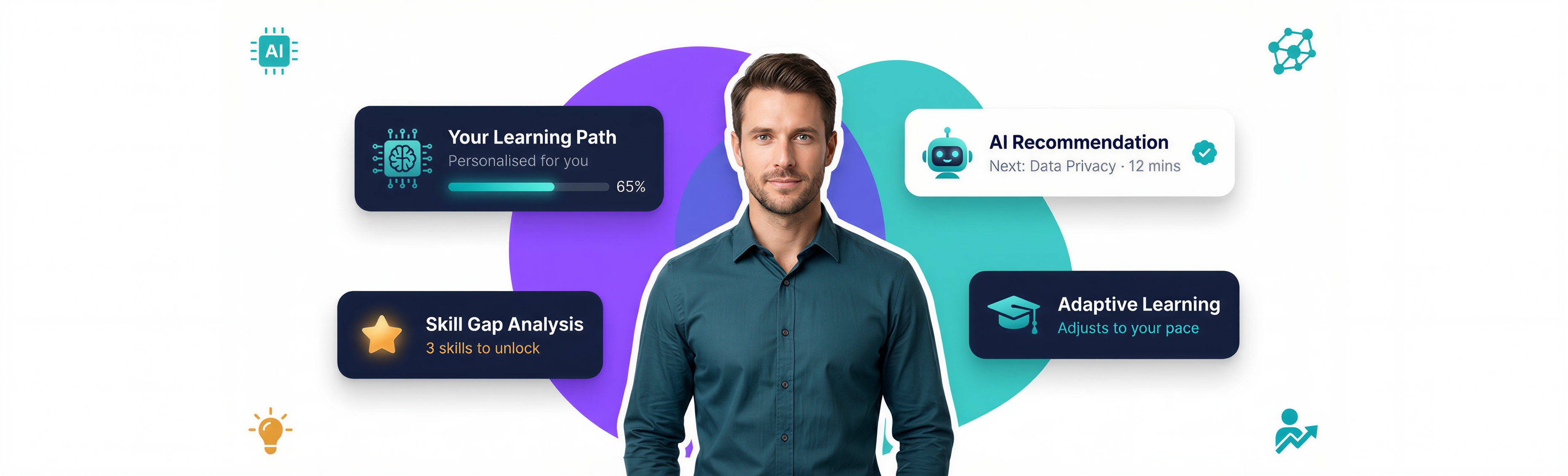
63% of business leaders now identify skills gaps as the single biggest barrier to transformation through 2030, according to the World Economic Forum’s Future of Jobs Report 2025.1 Yet most companies still run training like it’s 2015: static courses, generic pathways, and an LMS that treats a frontline manager and a software engineer exactly the same way.
AI-powered personalized learning paths change that. They match content to each employee’s role, skill gaps, and career goals, then deliver it in the flow of work. This guide shows HR Directors and L&D leaders how to build them: what “AI-powered” actually means, which LMS features matter, and a 6-step framework you can apply with the platform you already have.

- The skills half-life is now around two years, so annual training cycles can’t keep up with how fast roles change.
- AI-powered personalized learning paths use role data, skill assessments, and learner behavior to serve each employee the right content at the right moment.
- The 8 LMS features that matter most include role-based automation, AI skill gap analysis, content recommendation engines, adaptive learning, and microlearning delivery.
- Microlearning is the format that makes personalization practical. Short, modular lessons can be reshuffled into unique pathways without a content rebuild.
- Start with role profiles and skill taxonomies you already have. Don’t wait for a full tech swap. Layer AI onto current data and iterate.
Why Personalized Learning Paths Matter More in 2026
Most corporate training is losing a race. McKinsey’s 2025 research shows 92% of companies plan to increase AI investment in the next three years, while only 1% of leaders call their current AI deployment “mature.”2 At the same time, IBM research estimates the half-life of technical skills has dropped to about two years, meaning half of what an employee knows technically is out of date before most annual training plans finish rolling out.3
Generic training can’t close that gap. A software engineer, a customer service rep, and a finance manager might all need “AI skills,” but the specific skills, depth, and sequence differ wildly. When every employee gets the same linear path, completion rates collapse. LinkedIn’s 2025 Workplace Learning Report found that 71% of L&D pros are now exploring, experimenting with, or integrating AI into their work precisely because it breaks the old scale-vs-personalization trade-off.4
The business case is sharp:
- Talent retention. Career development champions - companies that invest in personalized growth - are 42% more likely to be frontrunners in generative AI adoption, per LinkedIn.4
- Faster upskilling. Josh Bersin reports that companies deploying AI-native learning systems are seeing 30-40% reductions in L&D staff effort with “vast improvements in workforce enablement.”5
- Engagement. Research across workforce studies links personalized learning to measurably higher engagement and knowledge retention compared with one-path-for-everyone programs.6
If you’re updating training strategy for 2026, personalization is no longer an upgrade. It’s table stakes.
What Makes a Learning Path “AI-Powered”?
A traditional learning path is a fixed sequence: take module A, then B, then C, pass the quiz, done. An AI-powered personalized learning path is dynamic. It starts with data about the learner - role, skills, recent performance, stated goals - and continuously adjusts what comes next based on behavior, outcomes, and business priorities.
Three layers make it work:
1. Skills intelligence. The system maps every learner against a skills taxonomy. This is what enables the platform to say “Priya is a marketing manager in Berlin, strong on campaign planning, weak on attribution modeling” rather than just “Priya is in Marketing.”
2. Content intelligence. Lessons are tagged by skill, proficiency level, format, and duration. This lets the platform pull a 4-minute video on attribution for Priya while surfacing a deeper case study for someone more advanced.
3. Recommendation and adaptation. Using learner behavior, completion signals, and assessment results, the platform re-ranks what appears next. If Priya struggles with a concept, it serves a different angle. If she breezes through, it moves her to the next challenge.
The net effect is a learning experience that feels less like a course catalog and more like a personal feed. Josh Bersin calls this the shift “from publishing to enablement” - training that answers the learner’s actual question in the moment, rather than waiting for them to find it.5
| Layer | What it does | Example in practice |
|---|---|---|
| Skills intelligence | Maps every learner against a structured skills taxonomy, tied to role and level | “Priya is a marketing manager in Berlin, strong on campaign planning, weak on attribution modeling” |
| Content intelligence | Tags every lesson by skill, proficiency level, format, and duration | A 4-minute intro video for Priya; a deeper case study for an advanced learner on the same topic |
| Recommendation & adaptation | Re-ranks what appears next using behavior, completion signals, and assessment results | If Priya struggles, serves a different angle; if she breezes through, moves her to the next challenge |
8 LMS Features That Enable AI-Powered Personalized Learning
Not every LMS can deliver real personalization. When evaluating a platform, these are the features that separate AI-native systems from repackaged legacy tools. (For a broader evaluation framework, read our guide on how to choose the right LMS for your team.)
1. Role-based automation. The LMS auto-assigns content based on job role, department, and location, without manual admin. A new hire in Compliance should receive AML and data protection training on day one without anyone pressing a button.
2. AI-driven skill gap analysis. Built-in assessments and AI inference across completion data identify what each employee needs to learn next. For more on closing gaps with targeted content, see our breakdown on how HR teams are using bite-sized lessons to tackle skill gaps.
3. Content recommendation engines. The heart of personalization. AI surfaces the right lesson at the right time based on role, goals, progress, and peer behavior - the same logic behind modern media platforms, applied to training.
4. Adaptive learning. Difficulty and pacing adjust to the learner. If someone aces a quiz, they skip to the next concept. If they struggle, they get additional practice or a different explanation format.
5. Microlearning delivery. Lessons are short, modular, and mobile-friendly. This is critical because it means the same content library can be reshuffled into infinite pathways without rebuilding courses.
6. Career-pathing integration. The LMS connects to career frameworks so employees can see how today’s training maps to tomorrow’s promotion. This is the feature most likely to drive retention.
7. Real-time analytics. Managers and L&D leaders see engagement, completion, and skill progression in dashboards - not quarterly reports. AI flags learners at risk of falling behind.
8. Integrations with the rest of your stack. The LMS connects to HRIS, Slack, Teams, and SSO so learning lives in the flow of work, not in a separate portal most employees forget about.
Platforms like 5Mins combine these capabilities with a TikTok-style microlearning experience and a 20,000-lesson library, which is how they hit 95%+ completion rates against the sub-5% industry benchmark for traditional LMS. For a deeper look at the underlying tech, see the AI microlearning platform overview.
How Microlearning Makes Personalized Learning Possible
Microlearning is the format that makes personalization practical. A 60-minute compliance course is a single unit. A 60-minute course broken into twelve 5-minute lessons is twelve units - each tagged by skill, role, and depth. That’s what AI needs to compose unique pathways for every employee.
Why microlearning and personalization belong together:
- Modularity. Short lessons can be recombined infinitely without rebuilding content. One library serves hundreds of role-based paths.
- Completion. Employees finish short lessons. Research shows traditional e-learning completion hovers well below 20%, while short-format learning consistently clears 90%+ on engagement-focused platforms.7
- Application. A 5-minute lesson on objection handling right before a sales call beats a 2-hour course scheduled next Tuesday.
- Data density. More lesson units means more completion signals, which means AI has richer data to personalize with.
For global teams, microlearning also solves a coordination problem. Long-form training creates scheduling conflicts across time zones. Five-minute lessons do not. For a deeper treatment of this in distributed workforces, see how microlearning supports global talent management in remote and hybrid workforces.

A new sales associate at a B2B SaaS company is assigned a role-based path the morning they start. The AI sees they’ve completed the prospecting module quickly but stumbled on the objection-handling quiz. Next login, they see a 4-minute lesson on handling price objections, a peer-generated example video, and a practice scenario. The following week, the system notices they’ve closed three calls and promotes them to advanced negotiation content. No L&D manager built that pathway manually.
| Dimension | AI-Powered Path | Traditional Path |
|---|---|---|
| Content sequence | Dynamic, adapts to the learner | Fixed A → B → C |
| Starting point | Role, skills, goals, behavior | Same course for everyone |
| Response to struggle | Serves a different angle or format | Repeat the same module |
| Response to mastery | Promotes to the next challenge | Still move through all modules |
| Data used | Role + skills + behavior + peers | Completion only |
| Admin effort per learner | Near zero after setup | Manual pathway curation |
| Typical completion rate | 90%+ | Under 20% |
A 6-Step Framework to Build Personalized Learning Paths with AI
You don’t need to rip and replace your tech stack to start. This framework works with what most HR and L&D teams already have.
Define the outcomes, not the content
Start with the business question. “We need to upskill 400 salespeople on new product positioning by Q3.” “We need every manager to complete inclusive leadership training before performance reviews.” The outcome determines the path. Skip this and you end up with more courses but not more business impact.
Build or import a skills taxonomy
You cannot personalize what you cannot categorize. A skills taxonomy is a structured list of the capabilities that matter in your organization, mapped to roles. Start with frameworks you already have - job descriptions, competency models, performance review criteria. You don’t need perfection; you need a starting point.
Audit your content library
Tag every lesson, course, or video by skill, proficiency level, role relevance, and duration. If your content sits in documents, videos, and PDFs, AI tools in modern LMS platforms can auto-bite-size and tag legacy content, which dramatically speeds up step 3.
Run baseline skill assessments
Use quick, built-in LMS assessments to establish where each employee sits on the key skills. Keep assessments short - long assessments kill completion. The data here is what makes the AI recommendations specific rather than generic.
Automate path assignment
Set up rules: by role, by department, by skill gap, by manager request. The best platforms combine rules with AI recommendations, so 80% of a learner’s path is automatic and the remaining 20% adapts based on their behavior. Build in manager visibility so team leads can nudge content when relevant.
Measure, feed back, iterate
Move beyond “courses completed” as your primary metric. Track skill progression, on-the-job application (via manager feedback or performance data), and business outcomes tied to the training goal. Feed that data back into the platform so recommendations improve over time. Brandon Hall research confirms organizations with mature, data-driven learning practices see materially stronger retention and performance outcomes than those running static training.8
For HR leaders building a broader strategy around this, see our guide on building a corporate learning strategy that aligns learning needs with modern delivery.
Common Pitfalls to Avoid
Even with the right tech, most personalization programs fail for non-tech reasons. Three pitfalls come up repeatedly:
Pitfall 1: Starting with content, not skills. Teams load 500 courses into an LMS, add some tags, and call it personalization. The result is a bigger catalog, not a smarter one. Start with the skills map; the content decisions follow.
Pitfall 2: Setting and forgetting. AI-powered platforms get better with data. If no one is reviewing recommendations, auditing outcomes, or re-tagging content, the system drifts. Assign a clear owner - usually someone in L&D - who reviews performance monthly.
Pitfall 3: Over-personalizing and losing the shared baseline. Compliance and certain core topics need to be universal. If personalization leaves gaps in what everyone must know - AML, data protection, health and safety - you create regulatory risk. The best programs combine non-negotiable baseline training with personalized development layered on top.
For a different angle on keeping strategy nimble as priorities shift, our piece on building an agile corporate learning strategy is worth a read.
Getting Started
Personalized learning paths are not a new idea. What’s new in 2026 is the ability to deliver them at scale without an army of L&D staff managing each learner by hand. The AI, the data, and the platforms are all mature enough to make personalization the default, not the exception.
The teams pulling ahead aren’t waiting for perfect tech. They’re starting with the skills map they have, tagging the content they already own, and letting AI-powered LMS platforms do the matching. If you want to see what that looks like in practice, explore the 5Mins AI microlearning platform or browse the full 20,000+ lesson library.
Frequently Asked Questions
AI-Powered Personalized Learning Paths
Everything HR and L&D leaders need to know about AI personalization, LMS features, and building learning paths that actually adapt.
What is a personalized learning path?
How does AI create personalized learning paths?
What LMS features enable personalized learning?
What is the difference between an LMS and an LXP?
How do you measure the effectiveness of personalized learning paths?
What are examples of AI-powered personalized learning?
 Sources
- Future of Jobs Report 2025, World Economic Forum, January 2025. Link
- Superagency in the workplace: Empowering people to unlock AI’s full potential, McKinsey & Company, January 2025. Link
- IBM Global Skills Study, cited in workforce analyses on the shrinking half-life of technical skills (ongoing, 2020-2025)
- 2025 Workplace Learning Report, LinkedIn Learning, 2025. Link
- It’s Time for an L&D Revolution: The AI Era Arrives and Gen AI Is Going Mainstream: Here’s What’s Coming Next, Josh Bersin, 2025. Link 1 · Link 2
- We’re all techies now: Digital skill building for the future, McKinsey & Company, July 2025. Link
- Industry benchmarks on e-learning completion rates, drawn from multiple workforce learning analyses; 5Mins internal data on microlearning completion rates (95%+)
- Brandon Hall Group, research on learning as a retention and performance driver (2024-2025). Link
 This article is for general informational purposes only. Specific platform capabilities and outcomes will vary based on your organization’s size, existing tech stack, and implementation approach.
 All content is researched and written by the 5Mins team. Originally published 15 May 2025. Last updated 22 April 2026.



Saurav Chopra








_transparent%20background.png)



.png)