


Contents
Low compliance training completion is a system problem, not a people problem. Long modules, generic content, weak reminders and invisible deadlines push completion down, and a few design changes bring it back up without anyone chasing stragglers by hand. Short lessons, automated escalation, manager visibility and role-based assignment do most of the work.
- Chasing is a symptom. If your team spends hours every cycle hunting down stragglers, the system needs work, not the people.
- People skip training for practical reasons. It feels irrelevant to their job, it's too long for the gaps in their day, nothing happens until the deadline, and nobody above them seems to care.
- Shorter wins. Microlessons of about 5 minutes fit inside a real workday. A 60-90 minute module asks for an hour most people don't have.
- One reminder isn't a system. A learner nudge, then a manager alert, then a compliance flag is. Automate all three.
- Managers move the needle. Give them a clear view of their team's status and the conversation happens naturally in a 1:1.
- Report against the deadline, not the catalogue. You need to know who is overdue on what, by when, with their manager attached.
It's the Tuesday before quarter-end. Your dashboard shows 61% completion on a mandatory AML refresher, and the deadline is Friday. So you do what every HR and compliance team does at this point: you start chasing. Personal emails. A Slack message to managers. Maybe a calendar invite with "URGENT" in the subject line. By Friday afternoon you've burned six hours getting people to do something they were supposed to do three weeks ago.
This happens in nearly every organization that runs mandatory training, and it rarely gets better by itself. Laziness rarely explains why a third of the workforce needs chasing. The system was never built to do this job on its own. Fix the system and most of the chasing disappears.
This guide covers why people disengage from compliance training and which changes lift completion without manual follow-up. If you want the product view, our compliance training solution shows how this works in practice.
Why employees ignore mandatory training
Before fixing completion, be honest about why it's low. It's rarely apathy. Four patterns show up again and again, and each one points at something you can go and fix.
1. The content doesn't feel like it applies to them
Picture accounting staff sitting through anti-bribery scenarios written for a sales team closing deals overseas. It happens in organization after organization. People judge relevance within seconds, and once they can't see themselves in the content, they check out. Generic training built for everyone ends up relevant to no one.
2. It's too long for how people actually work
A 90-minute module assumes an uninterrupted hour. Almost nobody has one. The real gaps in a workday, between meetings, on a commute, waiting for a call to start, run five to ten minutes. Training built for a different shape of time gets pushed to "later," and that's how a module ends up sitting half-finished for three months.
3. There's no consequence until there suddenly is
Training has to be mandatory. The trouble is that most systems pair the requirement with nothing that feels real in the moment. A deadline three months out with no visible follow-up in between works as a suggestion everyone quietly agrees to ignore until week eleven.
4. Nobody above them seems to care
This one is underrated. If a manager never brings training up, never checks in, and treats it as HR's problem, employees read the signal correctly: it isn't a priority here. The reverse holds too. When managers talk about it, their teams finish it.
What moves completion rates
Once the causes are clear, the fixes stop looking like willpower problems and start looking like design problems. Here's what works, roughly in order of impact.
Pull your last completion report and compare two numbers: the abandon rate (started but never finished) and the never-started rate (never opened). High abandon with low never-started usually points to module length or relevance, because people try and give up. High never-started points to missing reminders or manager visibility, because people never reach the content. Knowing which one you have stops you fixing the wrong problem first.
Shorten the modules
This is the highest-leverage change available, and the most resisted internally, because shorter feels "less thorough" to the people writing the content. A 60-minute video doesn't improve retention. It gives people more time to multitask through it or abandon it halfway. Microlessons of about 5 minutes are built around how attention works, not how compliance teams wish it worked.
Test-out models help too. A short pre-assessment lets experienced employees skip what they already know, and follow-up targets the specific gap rather than repeating the whole course. That means less seat time for low-risk employees and more real engagement where it matters.
Replace manual reminders with automated escalation
One reminder email is a courtesy that mostly gets ignored. A real escalation workflow looks like this:
- A nudge when the course is assigned.
- A deadline reminder seven days out.
- A manager notification three days out, showing their whole team's status and not just one straggler.
- A compliance alert the day something goes overdue.
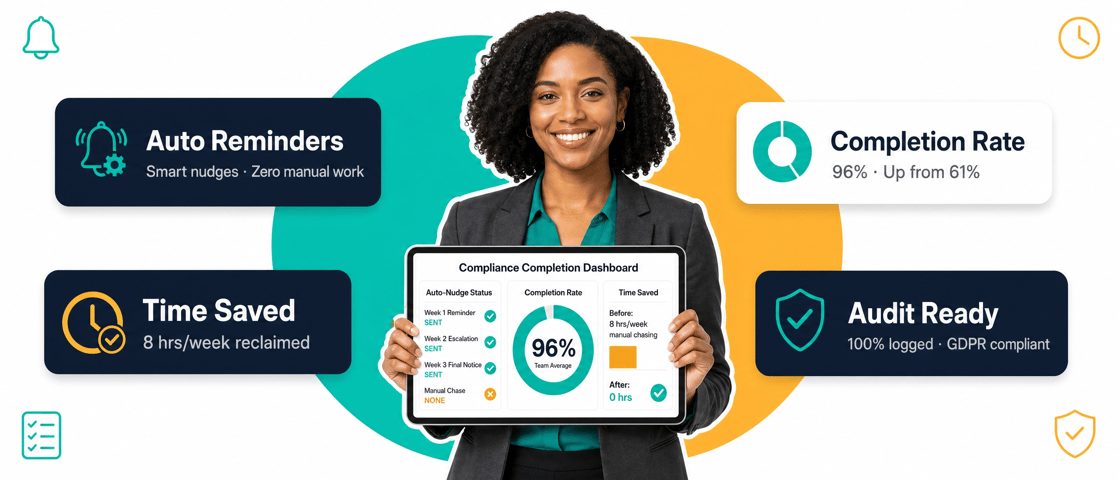
The shift from "someone has to remember to chase this" to "the system chases it" saves the most admin time. Reminders should also go where people already are. With 5Mins, automations send course reminders by email, push, Slack and Microsoft Teams, and managers get a Team Progress Email so they see who is behind without logging in anywhere.
Give managers visibility, not a CC on an email
Manager involvement works because it turns an abstract HR requirement into something the team can see. Visibility does the heavy lifting here, more than any stern reminder. When a manager can see exactly which direct reports are on track and which aren't, they raise it in a normal 1:1. That casual conversation moves completion further than any automated email will.
Assign training by role, not by headcount
Sending everyone the same catalogue inflates the volume of irrelevant content people sit through, which is exactly what drives the disengagement covered above. Role-based assignment means people receive what applies to their actual job instead of a course built for the lowest common denominator.
One honest caveat: L&D doesn't always own the content. If Legal or an external provider built your AML or anti-bribery modules, you may not have the authority to shorten them. In that case, bring the completion data to whoever owns the content and make the case with numbers. A report showing exactly where in the module learners drop off gets a faster response than "people find this boring."
Make it work on the device people have in their hand
If part of your workforce doesn't sit at a desk, such as retail staff, warehouse teams or field technicians, a platform that only works on a company laptop guarantees low completion for that whole group. A mobile app with push notifications closes the gap, because deskless workers may never check email. The 5Mins mobile app runs on iOS and Android, and microlessons work offline in the app. There's no clever workaround here. Either the platform meets people where they are, or it doesn't.
Track time-to-completion, not just completion
Completion rate hides a real problem. Someone who finishes a 20-minute module in four minutes by clicking through has almost certainly absorbed nothing. Time-to-completion data surfaces this. Pair it with a knowledge check that has a pass mark, and you close the gap between people finishing training and people retaining it.
Report against the deadline, not just the catalogue
Most LMS dashboards default to total completion across everything ever assigned. That's close to useless three days before an audit, when you need one answer: who is overdue on this deadline, right now. Deadline-based reporting flips the view. Instead of "82% completion across all courses," you see "14 people are overdue on the AML refresher, due Friday, and here are their managers." That's the report people actually use, because it tells you who to act on.
If your platform can only show a flat percentage, raise it with whoever owns the LMS contract. Reporting by deadline and by manager is what makes a dashboard something compliance officers check on a Monday morning instead of something they assemble by hand before a board meeting. Our Reporting & Insights page shows how 5Mins handles this, including 100% compliance tracking and audit log CSV export.
Set deadlines that fit the work calendar
Deadlines that land in quarter-end, peak season or a holiday week quietly guarantee a late scramble. Check the business calendar before you set a due date, and give people a window of several weeks that avoids the busiest days for their team. For new starters, count the deadline from their start date and assign the first lessons on day one, so training becomes part of settling in and not a backlog item. Ask managers to mention it in the first 1:1, and make the first assignment short so a new hire's early experience of training is a quick win.
5Mins is built around these mechanisms by default: lessons of about 5 minutes instead of hour-long modules, automated course reminders, a Team Progress Email for managers, and a mobile app for people who aren't at a desk. 5Mins delivers 95%+ completion on assigned training. At AZA Finance, participation went from 30-40% to 80% once training moved onto the platform.
A 30-60-90 day plan to fix low completion rates
If completion is stuck in the 20s or 30s, you don't need to rip out your LMS to start moving it. Here's a sequence most teams can actually execute.
Days 1-30: stop the bleeding on your current cycle
Pull your overdue learner report
Segment it by department and manager. The gaps usually cluster, with certain teams or locations lagging every cycle. That tells you where to focus first.
Turn on every automated reminder your platform supports
Even if it's basic. A single nudge at the seven-day mark recovers a meaningful slice of the people who start training and never finish it.
Send managers their team's status directly
Push it to them instead of burying it in a report they have to find. Visibility changes behavior before you've changed anything else.
Days 31-60: fix the structural problems
- Audit your longest modules and pick candidates to split into shorter, role-specific pieces. Start with the course that has the worst completion rate.
- Build an escalation workflow with defined triggers at seven days, three days and the day of the deadline, routing to the learner, then their manager, then compliance.
- Check whether training is assigned by role or blanket-assigned to everyone. If it's the latter, that's where most of your completion fatigue comes from.
Days 61-90: make it sustainable
- Add knowledge checks with a minimum pass mark so completion data reflects understanding and not just clicking through.
- Check mobile access for frontline and deskless teams. If they can't reach training on a phone, that's your biggest remaining gap.
- Review completion data on a schedule by department, not just organization-wide, so gaps surface before the next audit cycle and not during it.
Conclusion
Completion is a design outcome. Training that is short, relevant to the role, reminded automatically and visible to managers gets finished. Training that is long, generic and tracked in a spreadsheet gets chased. Start with the overdue report, find out whether your problem is abandonment or never starting, and fix that first. Then check the next cycle's report to see whether the chasing has shrunk.
Frequently asked questions
What completion rate should compliance training hit?
There is no single regulatory benchmark, so aim for as close to 100% as is practical on mandatory training, and treat high-risk roles and new hires as the first priority. If you're well short of that with no active follow-up, the cause is more often the system than the workforce. For reference, 5Mins delivers 95%+ completion on assigned training.
Do automated reminders actually work, or do people ignore those too?
They work as part of a system. A single reminder email gets ignored about as often as the original assignment. What moves the needle is escalation: a nudge to the learner, then a notification to their manager showing the whole team's status, then a flag to compliance if the deadline passes.
Is microlearning effective for compliance, or is it a trend?
For most compliance uses, such as policy training, security awareness and refreshers, short lessons work because they fit the real gaps in a workday. The caveat is that complex, scenario-heavy training, like deep technical safety procedures, may need a layered approach: microlessons for the core concepts, with deeper sessions where they matter.
How much does manager involvement affect completion?
A lot, and most organizations underuse it. The mechanism is visibility. When managers can see their team's status, they mention it naturally in a regular check-in, and that informal nudge often does more than another automated email.
How do we reach contractors and frontline staff without company email?
Use a mobile app with push notifications, since deskless and contractor workers rarely check a company inbox. If your LMS needs a desktop browser and company credentials, that's a structural reason this group shows near-zero completion. It's an access problem, not a behavior problem.
Should we punish people who don't complete training on time?
Consequences have a place, but as a last resort, after the system-level fixes are in place: shorter content, automated reminders, manager visibility and role-relevant assignment. Jump straight to penalties and resentment tends to rise faster than completion. Reserve consequences for repeated non-completion once the easy barriers are gone.
What should a useful compliance training report show?
Skip the flat completion percentage across everything ever assigned. A useful report is deadline-based: who is overdue on a specific course, by a specific date, with their manager attached. That's the difference between a dashboard you check out of obligation and one you use to decide who to follow up with this week.
Sources
- 5Mins completion, activation and admin-time figures: 5Mins platform data, 2026. See Reporting & Insights.
- AZA Finance participation figures (30-40% to 80%): 5Mins customer results.
- Escalation, mobile and automation features: 5Mins LMS automations and mobile app.
This article is general information, not legal or regulatory advice. Compliance training requirements vary by industry, jurisdiction and regulator, so check what applies to your organization.

Madlena (Maddie) Pozlevic
Customer Success Lead, 5Mins
Maddie leads customer success at 5Mins.ai, helping teams move from box-ticking training to learning cultures that actually stick. She has worked hands-on with companies across industries to drive adoption, cut time-to-value, and make sure learners, and the managers tracking them, never have to wonder if training is working.
More articles by Madlena
 Saurav Chopra
 James Francis
 Madlena (Maddie) Pozlevic