.png?width=112&height=28&name=Logo%20(1).png)

 12 minute read
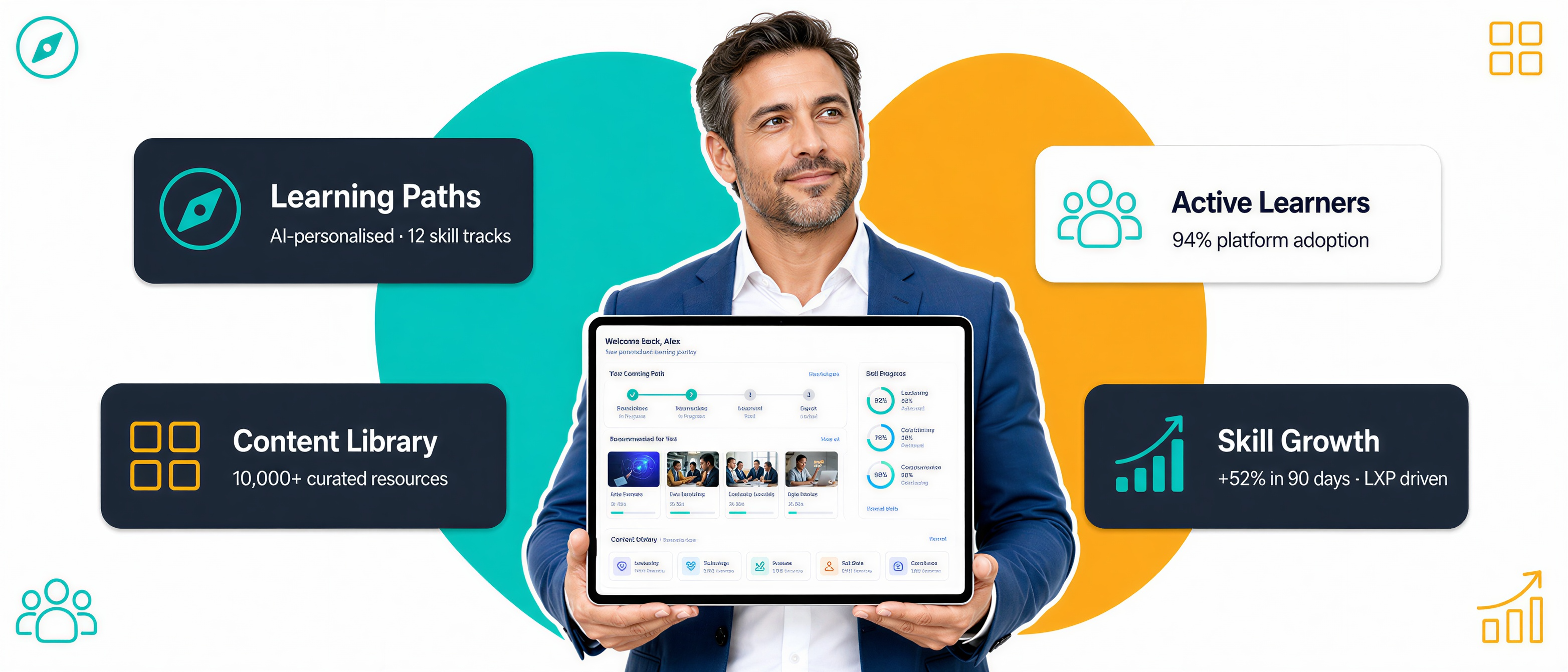
94% of employees say they'd stay longer at a company that invests in their learning and development.1 Yet most organizations still rely on clunky systems that nobody finishes. Completion rates for traditional training platforms sit below 20% — and that's being generous.
A learning experience platform (LXP) changes the equation. Instead of pushing mandatory content through a static interface, an LXP puts the learner in control — using AI to personalize recommendations, gamification to drive engagement, and mobile-first design to meet people where they already spend their time.
The LXP market reflects the shift. Valued at over $5 billion in 2026, it's growing at more than 30% year on year as organizations move away from legacy systems that treat training as a checkbox exercise.2 This guide covers everything you need to know about learning experience platforms — what they are, how they differ from an LMS, the features that matter, and how to choose the right one for your organization.

- LXPs are learner-centric. Unlike an LMS, which is admin-driven and compliance-focused, an LXP prioritizes the learner's experience — personalized content, self-directed pathways, and social features.
- AI is the engine. Modern LXPs use artificial intelligence to recommend content based on a learner's role, interests, skill gaps, and behavior — getting smarter with every interaction.
- The market is booming. The global LXP market is valued at over $5 billion in 2026, growing at a CAGR exceeding 30%, driven by demand for personalized, skills-based learning.2
- LXP vs LMS isn't either/or. Many organizations use both — an LMS for structured compliance training and an LXP for self-directed learning and skills development. Some platforms now combine both.
- Engagement is the differentiator. Organizations using LXPs report dramatically higher completion rates and knowledge retention compared to traditional training approaches.
- Mobile-first matters. With 80% of companies integrating mobile learning, any LXP you choose must deliver a strong experience on phones and tablets — not just desktop.9
What is a learning experience platform (LXP)?
A learning experience platform (LXP) is a type of corporate learning software designed to personalize how employees discover, consume, and engage with training content. Think of it as a smart content layer that sits on top of your learning resources — curating and recommending the right content to the right person at the right time.
Where a traditional learning management system (LMS) focuses on administration — assigning courses, tracking completions, generating compliance reports — an LXP focuses on the learner. It aggregates content from multiple sources (internal training materials, third-party libraries, videos, articles, podcasts), then uses AI and machine learning to build personalized learning pathways for each employee.
The result is something closer to a Netflix or TikTok experience for workplace learning. Employees log in and see a feed of recommended content tailored to their role, interests, and career goals — rather than a static list of mandatory courses.
Most modern LXPs share a few defining characteristics:
- AI-powered personalization — algorithms learn each user's preferences and recommend relevant content automatically.
- Content aggregation — pulls together internal and external learning resources into a single platform.
- Learner-driven — employees choose what to learn and when, rather than being assigned everything by an admin.
- Social learning — features like sharing, comments, and peer recommendations that mirror how people learn naturally.
- Cloud-based and mobile-first — accessible anywhere, on any device, without needing IT to install anything.
LXPs emerged in the mid-2010s as a response to the limitations of traditional LMS platforms. The term was first coined by Josh Bersin, who recognized that organizations needed technology that focused on the learning experience itself — not just the management of it.
Key features of a modern LXP
Not all LXPs are created equal. The market has matured significantly since 2022, and the best platforms in 2026 go well beyond basic content curation. Here's what to look for.
1. AI-powered content recommendations
This is the feature that separates an LXP from a glorified content library. A strong recommendation engine analyzes a learner's role, skills, past behavior, and stated interests to surface the most relevant content. The best systems improve over time — the more a learner interacts, the smarter the recommendations become.
42% of L&D leaders now rank AI-powered learning among the top drivers of their strategy, and 91% of companies plan to increase AI spending in L&D through 2026.103
2. Personalized learning pathways
Rather than a one-size-fits-all course catalog, modern LXPs create individualized learning paths that adapt to each employee's skill gaps and career goals. Learning efficiency increases by up to 57% when AI-tailored learning paths are implemented — a stat that makes the ROI case almost self-evident.4
3. Social and collaborative learning
70% of skills are picked up through on-the-job experience and peer interaction, not formal training.6 LXPs tap into this by building social features directly into the platform — content sharing, discussion threads, peer recommendations, and team challenges. When a colleague recommends a lesson, you're far more likely to complete it than if an administrator assigned it.
4. Gamification and engagement mechanics
Leaderboards, badges, streaks, skill points, team competitions — gamification works. Research published in Smart Learning Environments found that gamified learning environments have a measurable positive impact on engagement and completion rates.11 5Mins's TikTok-style gamified learning approach keeps learners coming back without making the experience feel gimmicky.
5. Microlearning and bite-sized content
58% of employees prefer microlearning for its relevance and conciseness.7 Modern LXPs deliver content in short, focused bursts — typically 3–7 minutes — that fit around busy schedules. This approach aligns with how the brain actually retains information: spaced repetition of short lessons dramatically outperforms hour-long courses for long-term knowledge retention. See our guide on microlearning best practices for a deeper look.
6. Content curation from multiple sources
An LXP isn't limited to a single content provider. The best platforms aggregate resources from across the organization — internal training materials, third-party libraries, YouTube videos, articles, podcasts, and user-generated content. This gives learners a diverse, always-fresh content feed rather than a static course catalog.
7. Analytics and reporting
Strong analytics go beyond simple completion rates. Modern LXPs track engagement metrics (time spent, content shares, repeat visits), skills development progress, learning pathways, and business impact indicators. Managers get real-time dashboards showing how their teams are developing.
8. Integrations
An LXP should connect with the tools your organization already uses — HRIS systems (BambooHR, HiBob, ADP), communication tools (Slack, Microsoft Teams), SSO/SAML for authentication, and existing LMS platforms. Seamless integration reduces friction and drives adoption.
Benefits of learning experience platforms
The business case for LXPs goes beyond "better training." Here's what organizations actually see when they make the switch.
Higher engagement and completion rates
This is the headline benefit. Traditional LMS platforms struggle with single-digit completion rates. Organizations using LXPs with personalized, gamified, bite-sized content consistently report completion rates above 90% — a step change that transforms training from a compliance burden into a genuine driver of capability.
Better knowledge retention
Short, spaced, and personalized content beats marathon training sessions every time. Understanding cognitive load and memory makes it clear why: spaced repetition — revisiting material at increasing intervals — is the most effective method for moving knowledge from short-term to long-term memory. LXPs are built around this principle.
Stronger employee retention
94% of employees say they'd stay longer at a company that invests in their learning and development.1 That number has been consistent across multiple studies over several years. An LXP makes your commitment to development visible and tangible, which directly impacts retention.
Reduced training time and cost
Microlearning through an LXP can reduce training time by 60–80% compared to traditional classroom or long-form digital training. Shorter content, delivered at the point of need, eliminates the padding and repetition that inflate training hours without adding value. The cost savings compound when you factor in reduced time away from productive work.

Employees have less than 1% of their working week available for training.5 That's roughly 24 minutes. Microlearning-first LXPs are built for exactly this constraint.
Closing skills gaps at scale
63% of employers identify skills gaps as the biggest barrier to business transformation.8 LXPs address this by mapping learning content to specific skills and competencies, then recommending the right content to close individual gaps. 5Mins's skills-based learning approach means this happens automatically at scale — something no L&D team could do manually across hundreds or thousands of employees.
LXP vs LMS: what's the difference?
The LXP vs LMS question is one of the most common in L&D today. The short version: an LMS manages training; an LXP enhances how people experience it. But the distinction has become more nuanced as platforms evolve.
| Feature | LMS | LXP |
|---|---|---|
| Primary purpose | Manage, deliver, and track training | Personalize and enhance the learning experience |
| Content approach | Admin assigns courses to learners | AI recommends content based on learner behavior |
| Learner experience | Structured, compliance-focused | Self-directed, personalized feed |
| Content sources | Internal / single-provider courses | Aggregated from multiple internal and external sources |
| Engagement model | Mandatory completion | Gamification, social features, self-motivation |
| Analytics | Completion tracking and compliance reporting | Skills development, engagement depth, business impact |
| Best for | Regulatory compliance, onboarding checklists, mandatory training | Skills development, continuous learning, employee engagement |
| AI capabilities | Limited — basic automation | Advanced — content recommendations, skill mapping, adaptive paths |
Many organizations use both. An LMS handles the structured, compliance-driven training that needs to be assigned, tracked, and audited. An LXP handles the broader learning culture — self-directed development, skills building, and engagement. The line is blurring: over 60% of large enterprises have already shifted from pure LMS to platforms that incorporate LXP features.12
For a deeper comparison, see our guides: LXP vs LMS — Does Your Organisation Need Both? and Decoding Learning Tech: LXP vs LMS.
How to choose the right LXP for your organization
The LXP market has hundreds of vendors, from enterprise platforms to niche players. Choosing the right one comes down to matching the platform's strengths to your organization's specific needs. Here's what to evaluate.
Content library and quality
How large is the content library, and — more importantly — how relevant is it? A platform with 20,000+ lessons means nothing if the content doesn't cover your industry, regulatory requirements, or skill areas. Check whether the library includes CPD-accredited compliance courses if that matters to your sector, and whether you can upload and track your own internal training alongside the external library.
AI and personalization depth
"AI-powered" has become a marketing buzzword. Push past the label. Ask how the recommendation engine works: does it use role-based rules, or genuine machine learning that improves with usage? Can it create individualized skill maps? Does it adapt learning pathways automatically as an employee develops? 5Mins's AI-powered learning platform uses genuine behavioral ML — not static rules.
Mobile experience
80% of companies have integrated mobile learning.9 If your workforce includes frontline, deskless, or remote employees, the mobile experience isn't optional — it's the primary interface. Test the mobile app yourself. Does it feel native and intuitive, or like a shrunken desktop site?
Compliance and tracking capabilities
If your organization has regulatory training requirements (financial services, health and safety, data protection), your LXP needs to handle these properly. Look for automated assignment and tracking, completion certificates, audit trails, and reporting that satisfies regulators. Some LXPs are strong on engagement but weak on compliance — and vice versa.
Integrations
Your LXP should plug into your existing tech stack without heavy IT involvement. Key integrations to check: HRIS (BambooHR, HiBob, ADP), communication tools (Slack, Microsoft Teams), SSO/SAML for single sign-on, and any existing LMS you plan to run alongside it.
Analytics and reporting
Can managers see real-time data on their team's learning progress? Can you track skills development over time, not just course completions? Does the platform provide organization-wide analytics for leadership? The depth of analytics separates platforms that drive accountability from those that just host content.
Pricing and scalability
LXP pricing models vary widely — per-user, per-seat tier, or enterprise agreements. Understand the total cost including setup, training, and ongoing support. Make sure the platform can scale with your organization without requiring a major re-procurement in 18 months.
The future of learning experience platforms
The LXP market is growing at a CAGR exceeding 30% and is projected to reach well beyond $25 billion by 2033. Several trends are shaping where the technology goes next.
AI moves from recommendation to creation
Today's LXPs use AI to recommend existing content. The next generation will use AI to create it — automatically converting long documents, policies, and procedures into bite-sized micro-lessons. Some platforms already offer content bite-sizing tools that turn PDFs and slide decks into interactive learning modules in minutes.
Skills-based organizations drive demand
73% of HR managers rank digital skills as their top priority for 2026.9 As more organizations shift from job-based to skills-based talent strategies, LXPs become critical infrastructure — the system of record for what your people know and what they need to learn next. Expect tighter integration between LXPs, HR systems, and internal mobility platforms.
LMS and LXP convergence continues
The boundary between LMS and LXP is dissolving. Organizations don't want two separate platforms — one for compliance, one for engagement. The winning vendors will be those that deliver both: structured, trackable compliance training alongside personalized, AI-driven skills development in a single experience.

Employees have less than 1% of their working week for training. That constraint isn't going away. Microlearning — lessons delivered in 3–7 minute bursts — is becoming the standard format for workplace learning, not the exception.
Learning experience platform FAQs
Answers to the most common questions about LXPs.
What does LXP stand for?
What is the difference between an LMS and an LXP?
How much does an LXP cost?
Do I need both an LMS and an LXP?
What are the main benefits of using an LXP?
Can an LXP handle compliance training?
 Sources
- LinkedIn Workplace Learning Report, LinkedIn, 2025. Employee retention and L&D investment correlation.
- Global LXP Market Size, Business Research Insights, 2026. Valued at $5.03 billion in 2026.
- AI in L&D spending plans, ATD / TD.org, 2025. 91% of companies plan to increase AI spending in L&D.
- AI-tailored learning paths efficiency, Continu, 2025. Learning efficiency increases 57% with AI-tailored paths.
- Time available for training, Deloitte. Employees have less than 1% of their working week for learning.
- 70-20-10 Model of Learning. 70% on the job, 20% peers, 10% formal training.
- Employee microlearning preferences, Oakinnovation, 2025. 58% of employees prefer microlearning.
- Skills gap barrier to transformation, AIHR, 2025. 63% of employers cite skills gaps as the biggest barrier.
- TalentLMS L&D Report, TalentLMS, 2026. 73% of HR managers rank digital skills as top priority; 80% integrate mobile learning.
- AI-powered learning strategy drivers, LearnUpon, 2025. 42% of L&D leaders rank AI-powered learning among top drivers.
- Gamification and learning engagement, Smart Learning Environments Journal. Positive impact of gamification on learning engagement.
- Enterprise LXP adoption, Business Research Insights, 2026. 60%+ of large enterprises shifted to LXP-inclusive platforms.
 This article is for informational purposes only. Market data and statistics are sourced from third-party research reports; figures may vary across sources and geographies. Organizations should seek advice specific to their circumstances.
All content is researched and written by the 5Mins team.



Saurav Chopra








_transparent%20background.png)



.png)