


Contents
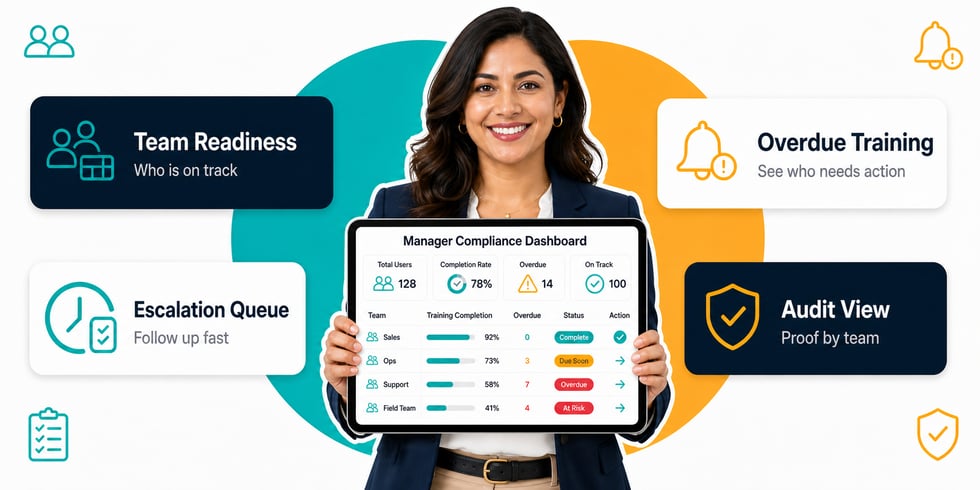
A manager dashboard for compliance training shows each line manager who on their team is overdue, what is due soon and what to do about it, in one view that is separate from HR's audit reporting. Six views cover it: overdue learners by name, team completion against a benchmark, upcoming deadlines, certificates, exception reports and a built-in escalation path. HR owns the LMS, but the manager is the person who can actually talk to the employee who is three weeks late, so the manager needs something specific enough to act on.
- HR's report and a manager's dashboard do different jobs. HR needs the full audit view. A manager needs to know who on their own team is overdue this week.
- Six views are enough. Overdue learners, team completion, upcoming deadlines, certificates, exception reports and an escalation path.
- Exception reports catch what a percentage hides. A team can show 90% complete while the same three people miss every deadline.
- Managers shape whether training gets finished. Careertrainer.ai reports that 61% of employees say their manager influences whether they complete it.
- Completion is not the whole picture. In a Gallup survey, only 11% of employees strongly agreed that their coworkers apply what they learn in compliance training.
- Show enough to act, not everything HR sees. Admin-level detail overwhelms managers as much as no detail at all.
HR owns the LMS, sets the deadlines and builds the reports. But HR isn't in the daily stand-up with the employee who is three weeks overdue on their data protection refresher. Their manager is. Careertrainer.ai's 2026 round-up reports that 61% of employees say their manager influences whether they finish training at all.1 Most managers still can't see that status in any useful way.
Instead, they get looped in through a CC'd reminder email or a spreadsheet that HR forwards once a quarter. That isn't a dashboard, and it rarely changes behavior. This article sets out what a manager dashboard for compliance training needs to show, what to leave out and how to avoid the usual mistakes.
Why HR can't be the only one watching
Most LMS reporting is built for the person who owns the system: HR or the compliance team. That view is comprehensive by design, because it has to serve audits, board reports and regulator requests. It's also the wrong view for a manager who just needs to know whether Priya on their team has done her anti-bribery refresher yet.
That mismatch creates a chasing cycle. HR runs a report, HR emails managers a spreadsheet, managers skim it or ignore it, and HR follows up again next month. The problem usually isn't the LMS. Nobody built a view the manager could use.
Gallup's research on compliance training points the same way. Its article on ethics and compliance training notes that managers can connect policies and values to daily habits, and it recommends manager follow-up alongside web-based training. That follow-up only works if the manager can see who needs it.
The 6 things every manager dashboard needs to show
Overdue learners on their team, by name
Show an actual list of who is overdue and by how long, not a percentage or an aggregate. A manager can act on "Priya, 12 days overdue" in a way they can't act on "82% team completion."
Team completion rate, with enough context to judge it
A single number is a vanity metric without a benchmark. Show the team's completion against the site, department or company average, so the manager knows whether 82% is a good result or a warning sign.
Upcoming deadlines, before they become overdue
The most useful dashboards flag training due in the next week or two, not just training that is already late. That gives a manager time to mention it in a normal one-to-one instead of scrambling afterward.
Certificates and proof of completion, in one place
When an auditor or a client asks whether someone on the team is certified, the manager shouldn't have to email HR and wait. A dashboard that surfaces certificates directly turns a multi-day back-and-forth into a quick lookup.
Exception reports, not just completion counts
A completion percentage can hide a real problem. If the same two or three people are late every cycle, that pattern deserves its own flag, separate from the raw numbers. Build the report around anyone who has missed a mandatory deadline, which is how Coggno describes good compliance tracking systems.2
A clear escalation path, built into the view
When someone is significantly overdue, the dashboard should make the next step obvious: a nudge, an automated reminder or an escalation to HR or the compliance owner. The manager shouldn't need to remember the process.
If a team is under 10 or 15 people, much of this is overkill. A manager who sees everyone daily already has this visibility informally. The dashboard earns its place once headcount grows past the point where one person can hold the whole team's status in their head.
Why manager visibility moves completion
The mechanism is simple. People tend to respond when their own manager notices something, and Careertrainer.ai reports that 61% of employees say their manager's involvement influences whether they complete required training.1 A manager who can see that a teammate finished a lesson last week has a natural, low-friction reason to bring it up. A manager with no visibility has nothing to work with except whatever HR forwards.
This is also why exception-based visibility beats blanket reporting. Gallup surveyed 13,583 full-time US employees in 2018, and only 11% of them strongly agreed that their coworkers apply what they learned in compliance training. Completion alone was never the full picture.3 A dashboard that flags patterns gives managers something more useful to act on than a single quarterly number.
None of this asks managers to become compliance experts. It asks you to give them a narrow, specific view of their own team that stays current, instead of a static report that is out of date by the time it lands in their inbox.
Common mistakes that make manager dashboards useless
A dashboard built for audits, with every field and filter HR needs, overwhelms a manager who just wants to know who is overdue this week.
Limit the manager's screen to their own team, with overdue, due soon, certificates and next steps.
Showing data with no action attached
A number without a next step creates awareness without behavior change. If a manager sees that someone is overdue, the dashboard should make it obvious what to do, whether that is a nudge or a clear escalation trigger.
Reporting on a schedule instead of staying current
A spreadsheet emailed monthly is stale by the time a manager opens it. Deadlines and overdue status change daily, so the view a manager relies on should be refreshed often.
Where this fits in your stack
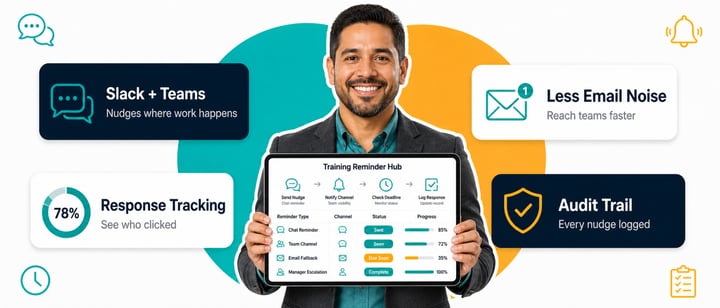
The six views above are what a manager-facing report should be built around, whichever platform you use. In 5Mins, managers get a Team Progress Email with their team's overdue courses and the courses due in the next 30 days, so the list arrives without anyone asking HR for it. Learners get course reminders in Slack, Microsoft Teams, email and push, and admins can export the audit log as CSV when the compliance team needs the full record. 5Mins delivers 95%+ completion, with microlessons of about 5 minutes.
To see the content side, browse the global compliance catalogue, which covers 500+ accredited compliance courses. You can also start a free trial and look at the manager view with your own team.
Manager dashboards for compliance training FAQs
What's the difference between an HR compliance report and a manager dashboard?
An HR report is built for audits and covers the whole organization in detail. A manager dashboard shows only what one manager needs to act on for their own team: who is overdue, what is coming due and what to do next.
Why don't managers just use the HR reporting tool directly?
HR reporting tools usually carry every filter and field an audit needs, which is far more than a manager needs to run a team. That complexity is often why managers stop looking at the report after the first month.
Does giving managers more visibility improve completion?
It gives them the chance to follow up. Careertrainer.ai reports that 61% of employees say their manager influences whether they finish training, and Gallup recommends manager follow-up alongside web-based compliance training. Visibility only helps if it is specific: names, dates and a next step, not a single percentage.
What should an exception report flag?
Anyone who has missed a mandatory training deadline, and ideally anyone with a recurring pattern of lateness across cycles. A pattern is a bigger signal than one overdue course.
Should managers see certificates directly or request them from HR?
Directly, where possible. Every step that makes a manager email HR and wait slows down a client audit or a client question that needed an answer straight away.
How often should a manager dashboard refresh?
As often as the platform allows. A view that is accurate as of last month's export doesn't show who is overdue today, and managers lose trust in a tool that is visibly out of date.
Sources
- Training Completion Rates Statistics 2026, Careertrainer.ai, 2026, careertrainer.ai
- Enterprise Compliance Training Tracking Systems: What HR and Risk Teams Should Look For in 2026, Coggno, 2026, coggno.com
- The Hard Truths About Ethics and Compliance Training, Gallup (survey of 13,583 full-time US employees, July-August 2018), gallup.com
This article gives general information on compliance training reporting as of November 2026. It isn't legal advice, so speak to a qualified adviser about your organization's obligations.

Saurav Chopra
Founder & CEO, 5Mins
Saurav is a serial HR tech entrepreneur on a mission to solve workplace challenges with technology. He previously co-founded Perkbox, the global employee experience platform now serving 5,000+ employers and 3M+ employees, before exiting to Great Hill Partners. His latest venture, 5Mins AI - the "TikTok of workplace learning" - combines generative AI, microlearning, gamification and peer learning to deliver a highly engaging learning experience for HR and compliance teams. Saurav holds an MBA from London Business School and an engineering degree from IIT Delhi, and is the recipient of the Barclays Scale Up Entrepreneur of the Year award.
More articles by Saurav
 Madlena (Maddie) Pozlevic
 James Francis
 Saurav Chopra