


Contents
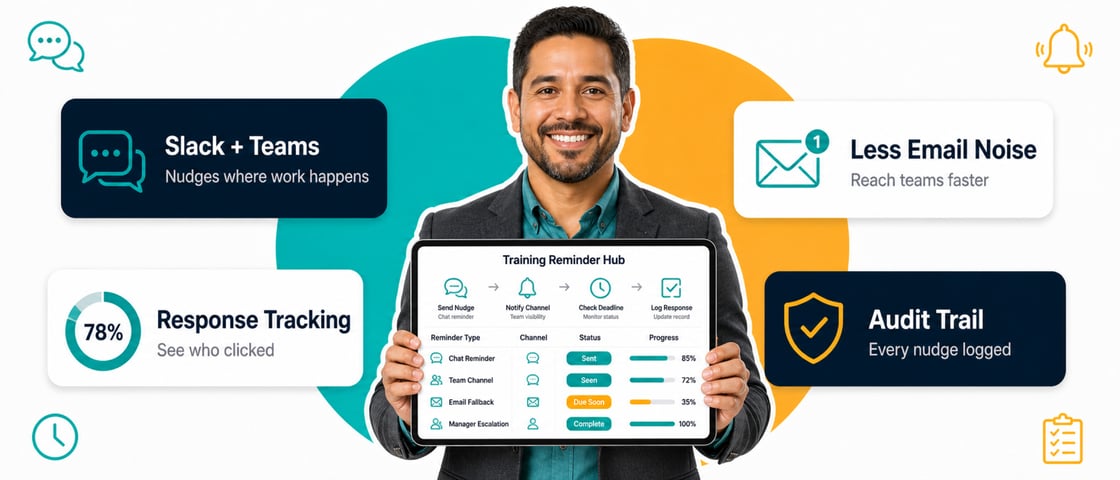
Use email for the first assignment and the written record, then move to Slack or Microsoft Teams as the deadline gets close. Email gets opened but rarely acted on: ContactMonkey's 2025 benchmark put internal email open rates at 67-68% with a 13% click-through rate, and PoliteMail's 2025 benchmark found 64% and 6.8%. A chat message lands in a place people already work, so it suits the last-week push and manager nudges. Three escalating reminders beat five identical ones.
- Opening isn't the weak point. Internal email was opened 67-68% of the time in ContactMonkey's 2025 benchmark and 64% in PoliteMail's, but click-through was only 13% and 6.8%.
- Chat wins on timing. Slack and Teams messages suit the final days before a deadline, when an email from two weeks ago reads as old news.
- Email keeps three jobs. It carries the first assignment, the written record and the message to anyone without a chat seat.
- Some staff are beyond both channels. An estimated 80% of the global workforce is deskless, and an estimated 83% of non-desk employees have no corporate email address.
- Managers move people more than wording does. A reminder that shows a manager who on their team is behind turns a system nag into a team task.
- Escalate, don't repeat. Change the channel, the tone or the sender at each step, and stop the moment someone finishes.
Your compliance training reminders go out four times. First by email, two weeks before the deadline. Again at one week. Again three days out, with the subject line now in capitals. By the fourth send, half the team has stopped reading past the sender name.
The question most L&D teams ask is whether the channel is the problem. This guide looks at what the data says about Slack, Microsoft Teams and email for compliance training reminders, where each one works best, and how to build an escalation sequence that gets courses finished.
Why email isn't the main culprit
The instinct is to blame email for low completion. The numbers say people do read it. ContactMonkey's 2025 Internal Email Benchmark Report puts the average internal email open rate at 67-68%.1 PoliteMail's 2025 Internal Communications Benchmark Report, built on billions of internal emails sent to more than 12 million employees, found a similar but slightly lower overall open rate of 64%, with finance and energy organizations higher at 73.9% and 70.9%.2 PoliteMail's analysis has also been reported as showing public sector and healthcare organizations opening internal email above 70% of the time.
The drop comes after the open. ContactMonkey puts average click-through on internal email at 13%, while the newer PoliteMail report puts it at 6.8%. People see the subject line, register that a course is due and close the message planning to come back to it. Most never do.
That changes the goal. Opens are already high, so the target is closing the gap between noticing a deadline and acting on it the same day. An unread email costs nothing to ignore, because it sits in a folder that never goes away. That is where email struggles.
Treat benchmark figures as a guide only, because they vary by vendor and sample (ContactMonkey's current pages also show newer 2026 figures) and the PoliteMail data most likely reflects 2024 activity. Your own numbers will differ, so measure completion within 48 hours of each send and compare that instead.
When Slack and Teams outperform email
Chat tools win in four specific situations, mostly because of where they sit in the working day.
1. When the workforce already lives in the tool
If Slack or Teams is where your team runs standups, approvals and customer escalations, a reminder there competes with active work. It reaches attention that is already switched on.
2. When you need urgency without a fourth "final reminder" email
A message in a training channel or a direct message from a bot reads as current. An email from ten days ago reads as something you meant to deal with. Nobody scrolls back through old email to check they missed one, but a message in an active channel is right there today.
3. When the deadline is close and the stakes are high
For the final-week push ahead of a regulatory deadline, an audit window or a certification lapse, a short and specific ping works well: "2 days left: AML Refresher, about 5 minutes." It shows up once, now, instead of piling up.
4. When a manager needs to see who is behind
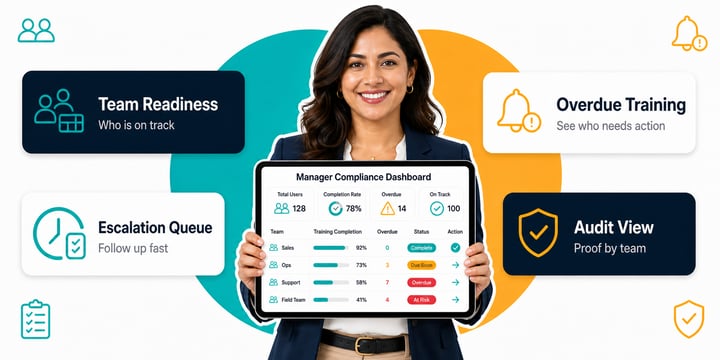
This is the biggest lever, and it has little to do with reminder copy. When a manager can see which people on their team are overdue, a generic nag becomes a conversation. The Team Progress Email in 5Mins sends managers their team's overdue courses and the courses due in the next 30 days, so the follow-up reaches the person who can actually have it.
Delamode, a logistics company with 350+ staff, uses 12-month automated recurrence for its mandatory courses and gives line managers access to their own teams' progress. Carol Wraight, Head of People at Delamode, describes the effect on chasing:
"If the managers have access, that divides down then into smaller chunks for them and takes the pressure completely off of us."
When email still wins
None of this makes email obsolete. It is still the better choice for three jobs.
Written records. For firms covered by the UK Money Laundering Regulations 2017, regulation 24 requires a written record of the measures taken to train relevant employees, including the training given. Email timestamps can support that record, but the record itself should live where your completions, dates and course names are stored.
Anyone the chat tool doesn't reach. Contractors, franchise staff and new hires who haven't been provisioned yet won't see a Teams message. Email is the safety net for them, and a mobile app is the other option for people who work away from a desk. That group is bigger than most head-office teams assume: an estimated 80% of the global workforce is deskless, and an estimated 83% of non-desk employees have no corporate email address.3,4 The Tribe figure is older, but no more recent study of it turned up.
The first assignment. The opening "here is your training and your deadline" message works best somewhere searchable that people can return to. An inbox serves that better than a channel that scrolls past within an hour.
Assign and document by email, escalate in Slack or Teams as the deadline nears, and use push notifications on the mobile app for people who spend their day away from a desk.
How to build a reminder escalation that works
Set three touchpoints, not five
Two weeks out by email. One week out by email or Slack or Teams, depending on where the team works day to day. A direct message, not a channel post, in the final 48 hours.
Name the course and the time cost every time
"Complete your compliance training" gets skipped. "Anti-Money Laundering Refresher, about 5 minutes, due Friday" gets done, because the reader can judge the cost of doing it right now.
Route manager messages differently
A manager should see team-level status, such as "3 of 8 not done," rather than the same generic reminder their reports get.
Give the reminder its own channel or a direct bot message
If it lands in the same feed as IT tickets and HR announcements, it tends to get muted along with everything else in that channel.
Stop the reminders the moment someone finishes
Few things erode trust in a reminder faster than being nagged about something you completed yesterday. Check that your setup does this before you add more touchpoints.
The fix underneath the channel
Channel and cadence only get you so far. A 45-minute module gets put off however well the reminder is timed, because the friction is in the course, not the notification. Shorter lessons need fewer reminders to get finished, since there is less gap between seeing the message and completing the work.
Candyspace, a London digital agency, saw 58% less time spent on compliance training after moving to 5Mins, and cut its monthly content creation work from 3-4 days to a couple of hours. 5Mins lessons take about 5 minutes, and 5Mins delivers 95%+ completion on assigned training. Reminders in Slack and Microsoft Teams, plus email and push, run alongside manager visibility, so the channel question and the completion question get solved together. See the compliance training solution for how it works.
If you are setting this up for the first time, start with three touchpoints, put the course name and time cost in every message, and turn the reminders off the second someone finishes. Get that right before worrying about which app the message lands in.
Slack, Teams and email reminders FAQ
Does Slack or Teams work better for compliance reminders?
Neither wins by default. Use whichever tool your people already work in. The advantage comes from matching the channel to where attention already is, and from the timing of the message, not from a feature difference between the two.
Should we drop email reminders entirely?
No. Keep email for the first assignment, for people without Slack or Teams access, such as contractors and new hires who haven't been provisioned, and as a supporting record. Use chat to escalate as the deadline gets close.
Why do people ignore compliance emails if open rates are high?
Opening a message and acting on it are different steps. ContactMonkey's 2025 benchmark found internal email opened 67-68% of the time but clicked 13% of the time, and PoliteMail's found 64% and 6.8%. The reminder registers, gets deferred, and nothing forces the follow-up.
How many reminders are too many?
Three escalating reminders, at two weeks, one week and the final 48 hours, are easier to act on than five identical ones. Repeating the same message teaches people to ignore the whole sequence, so change the channel, the sender or the tone at each step.
How do we reach staff who don't use Slack, Teams or company email?
Use a channel they do check. 5Mins learners can watch in the browser or on the iOS and Android apps, and course reminders also go out by email and push. Make the training itself work on a phone, because the format has to match the channel.
What do UK regulations say about keeping training records?
Under regulation 24 of the Money Laundering Regulations 2017, firms in scope must keep a written record of the measures they take to train relevant employees, including the training given. Other regimes set their own record-keeping rules, so check the one that applies to your sector.
Sources
- Internal Email Benchmark Report 2025, ContactMonkey, 2025, contactmonkey.com
- 3 key insights from PoliteMail's 2025 Internal Communications Benchmark Report, PR Daily, July 2025, prdaily.com; 2025 Internal Email Communications Benchmarks, PoliteMail, Ragan Communications, ragan.com
- State of the Global Workplace 2026, Gallup, 2026, cited for roughly 80% of the global workforce being frontline or deskless, gallup.com
- Communicating to Non-Desk Employees, Tribe, Inc., 83% of non-desk employees lack a corporate email address (older than two years, retained because no more recent primary study was found), tribeinc.com
- The Money Laundering, Terrorist Financing and Transfer of Funds (Information on the Payer) Regulations 2017, regulation 24, legislation.gov.uk
- Delamode customer story, 5Mins, 5mins.ai
- Candyspace customer story, 5Mins, 5mins.ai
This article gives general information on compliance training reminders and UK record-keeping rules as of November 2026. It isn't legal advice, so speak to a qualified adviser about your organization's circumstances.

Saurav Chopra
Founder & CEO, 5Mins
Saurav is a serial HR tech entrepreneur on a mission to solve workplace challenges with technology. He previously co-founded Perkbox, the global employee experience platform now serving 5,000+ employers and 3M+ employees, before exiting to Great Hill Partners. His latest venture, 5Mins AI - the "TikTok of workplace learning" - combines generative AI, microlearning, gamification and peer learning to deliver a highly engaging learning experience for HR and compliance teams. Saurav holds an MBA from London Business School and an engineering degree from IIT Delhi, and is the recipient of the Barclays Scale Up Entrepreneur of the Year award.
More articles by Saurav
 Madlena (Maddie) Pozlevic
 James Francis
 Saurav Chopra