


Contents
- 1Where Workday Learning fits in your HR stack
- 2What Workday Learning does well
- 3Where Workday Learning can fall short for compliance training
- 4Alternative or add-on? The real question to ask first
- 5A 6-question decision framework for your compliance team
- 6Workday Learning vs. a dedicated compliance layer: side by side
- 7How the add-on approach works in practice
- 8FAQ: Workday Learning and compliance training
- 9Sources
Workday Learning is enough for compliance training when your workforce sits inside Workday and your content needs are simple. It usually needs a dedicated compliance layer when you need deeper content, wider reach or reminders where people already work. Most teams don't replace it. They keep Workday as the HR system of record and add a compliance platform for delivery and reporting. Six questions below help you decide in one meeting.
- Workday Learning's strength is HR data. Assignments update automatically as job and organization data change, which is hard to match from outside Workday.
- Content and analytics are the usual gaps. Valamis's 2026 comparison describes its content creation tools as basic and its analytics as less deep than dedicated compliance platforms.
- Reach depends on what you license. Workday sells Extended Enterprise for learners outside your organization, so check what your contract covers before assuming contractors are out of reach. BCG puts deskless workers at 70-80% of the global workforce, and Udext reports 83% of frontline staff lack a work email.
- Format drives completion. Self-paced compliance training sits at 18-25% completion in Zahan's 2026 data, while interactive formats can pass 85%.
- Replace or keep is the wrong question. Adding a layer is usually lighter than swapping the learning module.
- Six questions settle it: audience reach, completion data, audit requirements, authoring capacity, reminder channels and total cost.
Your compliance team runs HR and payroll through Workday, so Workday Learning felt like the obvious choice for training too. Some months in, the questions start: reminders aren't getting through, contractors need access, and the reports tell you who finished but not much else. That is common: Zahan Research's 2026 benchmarks put self-paced compliance training completion at just 18-25% even in regulated industries, against 85% or more for interactive formats.
This guide covers when Workday Learning is enough, when it benefits from a dedicated layer on top, and gives you six questions to settle the decision for your team. Product details come from Workday's own pages and independent reviews, and they change, so confirm anything critical with Workday.
Where Workday Learning fits in your HR stack
Workday Learning is the learning module inside Workday's HR platform, not a separate system. If you already run HR, payroll and org structure through Workday, adding Learning keeps training data in the same environment as everything else, with no separate login for employees.
That link is its biggest advantage for compliance. Valamis's 2026 comparison notes that when an employee changes role, compliance assignments update automatically, and retraining can be assigned to affected groups using live organizational data. Nobody has to re-map who needs the anti-bribery refresher this quarter.
The AI side is changing quickly too. Workday completed its acquisition of Sana on November 4, 2025, and Workday now describes Workday Learning as powered by Sana, with AI course generation, learning agents and a personal AI tutor. Workday has said Sana Learn is meant to complement Workday Learning, which remains the system of record for governance and compliance. For a workforce that sits inside Workday, in one country, with straightforward content needs, that can be enough.
Many compliance teams don't fit that description.
What Workday Learning does well
Before the gaps, credit where it is due. Three strengths come up most often.
- Little manual re-mapping. Assignments follow job profile, location and org structure, using data Workday already holds.
- One system for records. Workday describes assignment management, completion tracking and audit trails to help organizations meet mandatory training requirements, and the records sit alongside employment data.
- No new login. Employees use the credentials they already have for HR self-service.
If your workforce is entirely inside Workday and your compliance content needs are modest, that is a defensible reason to stop here.
Where Workday Learning can fall short for compliance training
The gaps show up once compliance training gets specific. They cluster around content depth, reach and delivery.
Content and analytics. Valamis's comparison says that as a standalone compliance platform, Workday Learning has limitations: the content creation tools are basic and the analytics depth doesn't match dedicated compliance platforms. That is fine for tracking completion. It is thinner if you need ready-made, regularly updated compliance courses or want to see which teams are disengaging before it becomes a violation. FitGap's 2026 review also found fewer social-learning features, less peer-generated content and less flexibility to customize the learner journey than platforms built purely for engagement. Workday's AI authoring through Sana narrows the content-creation gap, though you still have to build and maintain the library.
Reach. Workday Learning is built around people in your Workday tenant. Workday does offer Extended Enterprise, a product built on Workday Learning that gives suppliers, partners and contractors a way to reach training content, so the gap here is one of licensing and setup rather than a hard limit. Deskless workers matter for compliance because, by BCG's estimate, they make up 70-80% of the global workforce, and many don't sit at a desk with a work account. Udext's 2026 engagement trends report goes further, saying 83% of frontline staff lack a work email. Training Central's 2026 guide adds that Workday Learning works best for people who already hold a company account. Ask what your current contract covers for contractors, franchisees and shift workers.
Rollout overhead. CloudShine's 2026 practical guide says native xAPI support is thin, so teams often add an external learning record store or route around it with SCORM, and pair the module with separate authoring tools for anything beyond basic content. FitGap notes that because Learning sits inside a larger enterprise suite, changes usually need formal configuration and governance sign-off.
Delivery. Compliance completion depends on whether the training reaches people where they work. If your teams live in Slack or Microsoft Teams more than in an HR system's inbox, notifications inside the HR platform alone may not move completion. Check which reminder channels your Workday configuration supports.
Workday has been adding AI features through Sana during 2026. Compare the current version of Workday Learning against your own requirements instead of relying on an older review.
None of this makes Workday Learning a bad product. It is a strong HR-data layer, and for some teams that is all they need.
Alternative or add-on? The real question to ask first
Most teams frame this as replace or keep, and that is why so many evaluations stall.
Few organizations switch HR systems to fix training. What usually happens is narrower: Workday stays the system of record for HR and payroll, and a dedicated compliance or microlearning platform runs the training layer, with rosters and completions syncing so the audit trail stays whole.
Depth tends to suffer when a platform's main job is something other than training. That is the trade-off compliance teams weigh with any HR suite. The practical question becomes what compliance training needs to do that Workday Learning wasn't built for, and what is the lightest way to add it.
A 6-question decision framework for your compliance team
Work through these with your compliance and L&D leads. Two or more "yes" answers in the first four usually mean an add-on is worth a serious look.
Does compliance training need to reach anyone outside your Workday tenant?
Contractors, franchisees, seasonal staff and deskless workers may sit outside your current setup. Check whether Extended Enterprise or another option is licensed for them, and what it costs.
Is your completion rate actually a problem?
Pull the last two audit cycles and look at completion by team, not just overall. If specific teams lag, format and reminders are the likely cause. If your completion sits near the 18-25% Zahan reports for self-paced training, format is doing the damage. If completion is already high, the gap is probably reporting depth.
Do auditors need more than the native reports show?
If your regulator or internal audit team wants role-based views, overdue escalation logs or a particular export format, check whether your configuration can produce it or needs a workaround.
How much content can your team author and keep current?
Regulations change. If your library needs frequent updates across languages or business units, weigh Workday's authoring tools and AI assistant against a library that someone else keeps up to date.
Do you need reminders outside Workday's own notifications?
If your workforce lives in Slack or Microsoft Teams, in-platform notifications alone may not be enough.
What does adding a layer cost versus replacing the module?
Price both paths. Adding a platform that connects to Workday is often lighter than replacing the module, but get quotes before assuming either.
Workday Learning vs. a dedicated compliance layer: side by side
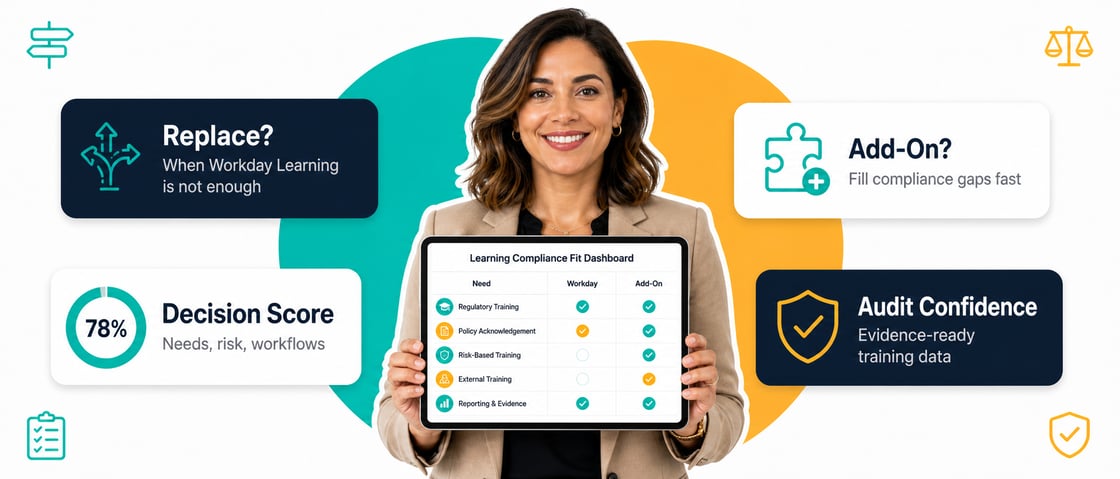
The table compares what Workday and independent reviews say about Workday Learning with what 5Mins offers. Use it as a starting checklist for your own evaluation.
| Capability |  | Workday Learning |
|---|---|---|
| HR data connection | Integrates with Workday; SSO via SAML and OIDC on all plans | Native to Workday, using live job and org data |
| Compliance content | 500+ accredited compliance courses, kept up to date as regulations change | Authoring tools described as basic; AI course generation through Sana |
| Learning format | Microlessons of about 5 minutes | E-learning content plus an AI tutor |
| Where learners access it | Browser, plus iOS and Android apps | Through your Workday tenant; Extended Enterprise for outside audiences |
| Reminders | Slack, Microsoft Teams, email and push | Depends on your configuration |
| Reporting | Audit log exportable as CSV; Team Progress Email for managers | Assignment management, completion tracking and audit trails |
| Time to go live | Most customers are live in 2-4 weeks | Set up within your Workday configuration |
This article doesn't argue for ripping out Workday Learning. Keep Workday as the system of record and let a compliance layer own delivery, reminders and reporting for training, if your answers to the six questions point that way.
How the add-on approach works in practice
Running a compliance layer alongside Workday is usually simpler than teams expect.
Employee and org data typically syncs from the HR system through an API or a scheduled feed, so new hires, role changes and leavers flow through without manual updates in a second system. Single sign-on means employees don't need another password, and completion data can be exported back to the HR record or reported separately.
 How 5Mins helps
Compliance training people actually finish
5Mins integrates with Workday, and with HiBob, BambooHR and ADP, so training can sit alongside your HR system. Ask during a demo how the Workday connection handles rosters and completions for your setup.
- 500+ accredited compliance courses
- 95%+ completion
- Up to 20 hours a month saved on training admin
The result is that Workday stays the source of truth for who is employed and where, while the training layer focuses on getting content in front of people who finish it. See the compliance training solution for how that works, or start a free trial.
FAQ: Workday Learning and compliance training
Can Workday Learning handle compliance training on its own?
For a workforce based entirely in Workday with straightforward compliance needs, it can. It ties assignments to job and organization data and keeps training records with HR data. It gets harder to rely on alone when you need deeper content, wider reach or analytics beyond completion.
What is the difference between Workday Learning and a dedicated compliance training platform?
Workday Learning is a module inside a broader HR suite, so its strengths come from HR integration. A dedicated platform is built around compliance delivery, with ready-made content, reminders and reporting as the core product.
Do I need to replace Workday Learning to fix compliance training gaps?
Usually not. Many organizations keep Workday as the HR system of record and add a compliance platform for delivery and reporting. Replacing an HR-integrated module is rarely needed just to close training gaps.
Can Workday Learning train contractors or people without a company account?
Workday offers Extended Enterprise, built on Workday Learning, to give suppliers, partners and contractors access to training. It is a separate product, so confirm what your contract includes and whether it suits your deskless workforce.
How does training data from another platform get back into Workday?
Platforms typically connect to an HR system through APIs or scheduled data feeds, pulling employee data in and sending completions back. Ask each vendor exactly what their Workday connection covers.
What should I ask before adding a layer on top of Workday Learning?
Start with the six questions above: who needs reaching beyond current employees, whether completion is a problem, what auditors require, how much content you can author, which reminder channels you need and what the cost comparison looks like.
Sources
- 20 best compliance training software in 2026, Valamis, 2026, valamis.com
- Workday Learning, Workday, workday.com
- Workday completes acquisition of Sana, Workday, 4 November 2025, newsroom.workday.com
- Launching the Workday Learning Center, powered by Extended Enterprise, Workday, blog.workday.com
- Facing the deskless labor shortage with technology, Boston Consulting Group, 2024, bcg.com
- Training completion rate benchmarks by industry (2026 data), Zahan Research, 2026, zahan.ai
- Training completion rate: a critical metric for strategic learning and development, GetMonetizely (citing Brandon Hall Group), 2025, getmonetizely.com
- Workday Learning reviews 2026, FitGap, 2026, fitgap.com
- Employee engagement trends to watch in 2026, Udext, 2026, udext.com
- Workday Learning: features, access, login help, and demo, Training Central, 6 January 2026, training-central.net
- Workday Learning: practical guide for HR leaders 2026, CloudShine, 2026, cloudshinepro.com
This article reflects publicly available product information and independent reviews as of November 2026. Workday's features may change, so check Workday's documentation for current specifications. It gives general information and isn't legal or compliance advice.

Saurav Chopra
Founder & CEO, 5Mins
Saurav is a serial HR tech entrepreneur on a mission to solve workplace challenges with technology. He previously co-founded Perkbox, the global employee experience platform now serving 5,000+ employers and 3M+ employees, before exiting to Great Hill Partners. His latest venture, 5Mins AI - the "TikTok of workplace learning" - combines generative AI, microlearning, gamification and peer learning to deliver a highly engaging learning experience for HR and compliance teams. Saurav holds an MBA from London Business School and an engineering degree from IIT Delhi, and is the recipient of the Barclays Scale Up Entrepreneur of the Year award.
More articles by Saurav
 Saurav Chopra
 James Francis
 Madlena (Maddie) Pozlevic