


Contents
Compliance training for high-turnover teams has to work for people who may leave within months, so it needs short lessons, automatic assignment on day one and refreshers that don't depend on anyone's memory. CIPD's analysis of ONS data puts annual turnover at 52.2% in accommodation and food services and 41.6% in wholesale and retail. In GB health and safety law, training is due when someone is recruited, and a completed record doesn't follow the leaver out of the door.
- Turnover is highest where compliance risk is real. CIPD's analysis of ONS data found 52.2% turnover in accommodation and food services and 41.6% in wholesale and retail (January 2022 to December 2023).
- Manufacturing turnover has fallen, the training duty hasn't. Make UK reports 10.85% for 2024, down from 20.75% in 2022.
- Call centers churn fast, and new agents need months to ramp up. Insignia Resources reports benchmarks of 30-45% annual agent turnover, with some centers up to 60%, and four to eight months to full proficiency.
- The law starts on day one. Regulation 13 of the Management of Health and Safety at Work Regulations 1999 requires adequate training when employees are recruited, and again when their risks change.
- Short, automatic and visible beats long and manual. Assign by role, keep lessons to about 5 minutes, automate refreshers and show managers who is overdue.
- Measure against who is working today. A completion rate against a hire list hides the new starters who haven't finished yet.
Retail, hospitality, manufacturing and customer support teams share a problem that most compliance programs were never built for: people don't stay long. Every leaver takes their completed training with them, and every new starter needs the full set again, often before their first full shift.
A 40-minute induction module designed for a captive, long-tenured audience struggles when the workforce rotates every few months. This guide covers what the turnover numbers actually say, what the law expects on day one, and how to build a compliance program that keeps up. It's written for HR, compliance and L&D leaders in Great Britain.
Why high turnover breaks traditional compliance training
Most compliance programs assume a stable employee who sits through an induction once and refreshes it once a year. That assumption falls apart when a third or more of the workforce turns over every year.
The gap shows up in two numbers that drift apart. The first is the completion rate on paper. The second is the share of people on shift today who have actually finished the training for their role. A worker who hasn't done fire safety training is still working a shift with a fire risk. An agent who hasn't done data protection training is still handling customer data. The distance between those two numbers is where risk builds up.
The legal position makes the gap more than an admin problem. Section 2(2)(c) of the Health and Safety at Work etc. Act 1974 requires employers to provide the information, instruction, training and supervision necessary to ensure employees' health and safety at work, so far as is reasonably practicable. Regulation 13 of the Management of Health and Safety at Work Regulations 1999 adds that employees must get adequate health and safety training on being recruited, and again when they move to a new role, get new equipment or face a changed system of work. That training must take place during working hours and be repeated periodically where appropriate.
Employers must ensure employees receive adequate health and safety training when they are recruited and when they are exposed to new or increased risks. Training is repeated periodically where appropriate and takes place during working hours.
Source: legislation.gov.ukThe real numbers, industry by industry
Turnover figures vary a lot with how they are measured. The CIPD figures below come from its analysis of the ONS Annual Population Survey, which counts people who left a sector over a year. They run higher than employer-reported voluntary turnover, so compare your own numbers against the same type of measure.
Retail
At 41.6%, wholesale and retail loses well over a third of its people a year on CIPD's measure. The Retail Bulletin's coverage of the 2025 State of the UK Hourly Workforce Report adds a forward-looking signal: 63% of hourly workers surveyed said they plan to leave their current job within 12 months, with more than two-thirds of those wanting to leave the industry altogether. Seasonal peaks add to it, and a single store can pass through several rosters of temporary staff in one December. The compliance load doesn't shrink to match. Health and safety, data protection and cash handling all still apply to someone who may work only a handful of weekends.
Hospitality
Accommodation and food services sits at 52.2%, the highest of the sectors in the figures above, and seasonal and casual staff push real-world churn higher in many venues. Mandatory onboarding is layered on top of food safety and allergen training, which makes the first week heavy for every new starter.
Paris Baguette is a useful example. After moving its training to short microlessons, the company reports 80% less training time and external audit scores of 93%+. You can read the detail in the Paris Baguette case study.
Manufacturing
Make UK's Labour Turnover Report 2025 puts overall manufacturing turnover at 10.85% in 2024, down from 16.12% in 2023 and 20.75% in 2022. That's good news for continuity. It doesn't change the training duty, because shop floors are safety-critical and multi-shift patterns make scheduled classroom sessions hard to run. Lower turnover buys time to get compliance right and doesn't excuse getting it wrong.
Customer support
Customer support and contact centers run higher than almost anywhere else covered here. Insignia Resources reports industry benchmarks of 30-45% annual agent turnover, with some centers as high as 60%, and four to eight months for new agents to reach full proficiency. It is a vendor-published benchmark and we couldn't trace a primary dataset, so check it against your own attrition data. For most of that ramp-up window, an agent is handling live customer data, payment details or complaints while still learning the job, so training has to fit between calls in short blocks rather than sit in a single onboarding week.
Ask your HR system for turnover by team, not just by company. A site-wide average can hide one department that replaces half its staff each year, and that's the department where a day-one training gap matters most.
What works: the bite-sized model
Across all four industries the pattern is the same: compliance training has to survive a workforce that doesn't stay long enough for a traditional program to make sense. Two things make the difference.
The first is format. Short lessons that work on a phone get finished in the gaps of a shift, where a 45-minute desktop module doesn't. 5Mins builds on this with microlessons of about 5 minutes, and 5Mins delivers 95%+ completion on assigned training.
The second is automation. Delamode, a logistics company with 350+ staff, runs 12-month automated course recurrence, so refreshers get assigned without anyone chasing them. In a business that hires and loses people every month, automatic assignment is what keeps people compliant without a full-time person chasing records. The Delamode story has the full picture.
Building a compliance program that survives turnover
Assign by role, automatically, on day one
New starters should get the right compliance training the moment they're added to your HR system, not whenever someone has time to set it up. In a business with high monthly turnover, "whenever someone has time" often means never. It also lines up with the recruitment trigger in regulation 13.
Keep lessons short
Anything longer competes with a shift, a break or a commute, and loses. A worker with 8 minutes between deliveries can finish an 8-minute lesson. They're far less likely to finish a 45-minute one in three sittings. Courses can still be long, as long as they are made of short lessons.
Make mobile the default
Deskless workers such as shop floor staff, housekeepers and warehouse operators don't have a desktop to log into mid-shift. If mobile is the exception, a large part of the workforce is quietly excluded from finishing on time.
Automate refreshers
Annual and multi-year requirements shouldn't depend on someone remembering to reassign them. Automated reminders in the tools people already use, such as Slack, Microsoft Teams, email and push, keep a revolving workforce inside its compliance window.
Give managers visibility, not just HR
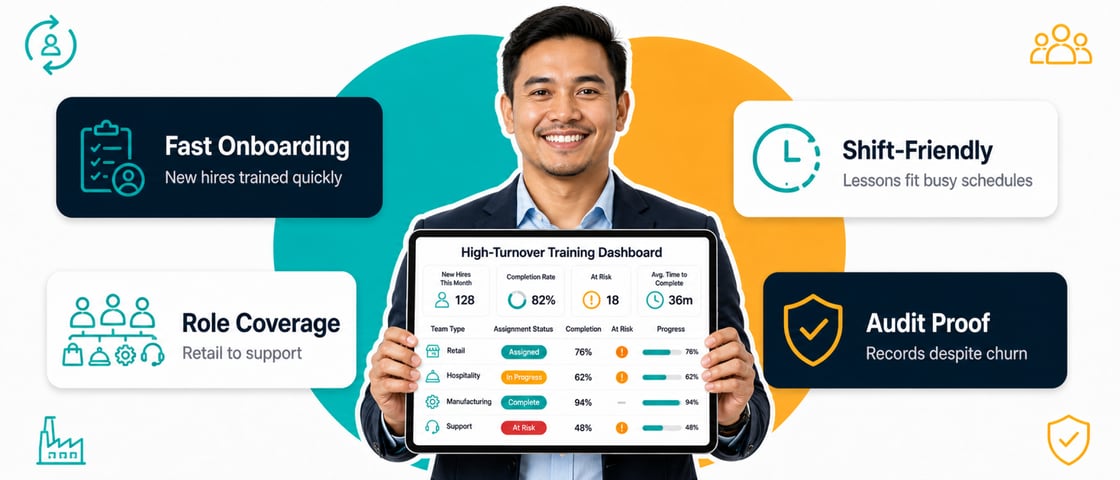
A manager who can see which of the team hasn't finished can chase it in a 30-second conversation on shift. 5Mins sends managers a Team Progress Email with their team's overdue courses and the courses due in the next 30 days. A report only HR can see catches the same gap weeks later.
Track completion against headcount, not against hires
A 95% completion rate sounds strong until it is measured against the 40% of the team that started this quarter. Report compliance against who is on the rota today, not a hire list that is already out of date.
Start with the roles that turn over fastest and the topics that are legally non-negotiable, such as health and safety, fire safety and data protection. Get those to completion in the first week, then add the rest.
Where this leaves you
No compliance team is going to solve turnover on its own. Training has a narrower job: stop breaking every time someone new starts. Build it for a workforce that rotates, and completion stops being a monthly scramble.
5Mins has 500+ accredited compliance courses, built from microlessons of about 5 minutes. You can explore 5Mins compliance training or start a free trial and see how it looks against your own turnover numbers.
FAQ: compliance training for high-turnover teams
What is compliance training for high-turnover teams?
It's training designed on the assumption that a meaningful share of your workforce will be new within months. That usually means short mobile-friendly lessons, assignment triggered by hiring rather than manual setup, and refreshers that run without anyone remembering to reassign them.
When must new starters complete health and safety training?
Regulation 13 of the Management of Health and Safety at Work Regulations 1999 requires adequate health and safety training on recruitment, and again when risks change, for example a new role or new equipment. It must happen in working hours. The regulations don't set a number of days, so aim to cover the essentials before or during the first shift.
How often should seasonal or temporary staff repeat training?
Temporary staff need the same essential training as permanent staff for the risks of their role, and they need it at the start. For short contracts, trim the induction down to the topics that cover the actual tasks and legal obligations of the job. Refresher cycles matter less for a few weeks of work than getting the first lesson done on day one.
Which compliance topics matter most for retail and hospitality?
Health and safety, fire safety, manual handling, food safety and allergen awareness where food is served, and data protection wherever staff handle customer details. Your risk assessments should decide the exact list for each role.
How can manufacturers keep training up to date across shifts?
Use lessons people can complete on a phone in the gaps of a shift so you don't have to pull a whole team off the floor. Automated refreshers also help: safety topics such as machine safety and COSHH need consistent refreshers whichever shift or worker is on that week.
Does bite-sized training work for frontline and customer support teams?
It fits how these roles work. Frontline and support staff rarely have a block of desk time, but they do have a few minutes between customers, calls or deliveries. Microlessons of about 5 minutes fit those gaps, and 5Mins delivers 95%+ completion on assigned training.
Sources
- Benchmarking employee turnover: what are the latest trends and insights?, CIPD, June 2024 (Annual Population Survey data, January 2022 to December 2023), as summarized by HR Data Hub
- Labour Turnover Report 2025, Make UK (copy hosted by EMN), emn.org.uk
- Health and Safety at Work etc. Act 1974, section 2, legislation.gov.uk
- Management of Health and Safety at Work Regulations 1999, regulation 13, legislation.gov.uk
- Paris Baguette case study, 5mins.ai
- Delamode case study, 5mins.ai
- Call Center Turnover Rates: 2026 Industry Average, Insignia Resources, 2025/2026, insigniaresource.com
- Insights from the 2025 State of the UK Hourly Workforce Report: Retention, The Retail Bulletin, 2025, theretailbulletin.com
This article gives general information on compliance training and related law in Great Britain as of November 2026. It isn't legal advice, so speak to a qualified adviser about your organization's circumstances.

Saurav Chopra
Founder & CEO, 5Mins
Saurav is a serial HR tech entrepreneur on a mission to solve workplace challenges with technology. He previously co-founded Perkbox, the global employee experience platform now serving 5,000+ employers and 3M+ employees, before exiting to Great Hill Partners. His latest venture, 5Mins AI - the "TikTok of workplace learning" - combines generative AI, microlearning, gamification and peer learning to deliver a highly engaging learning experience for HR and compliance teams. Saurav holds an MBA from London Business School and an engineering degree from IIT Delhi, and is the recipient of the Barclays Scale Up Entrepreneur of the Year award.
More articles by Saurav
 James Francis

 Madlena (Maddie) Pozlevic

 Saurav Chopra