


Contents
- 1What is role-based compliance training?
- 2Why one-size-fits-all training fails
- 3How to build a role-based training matrix
- 4Risk levels and refresh frequency
- 5New starters, role changes and leavers
- 6Measuring role-based compliance training
- 7How 5Mins helps
- 8Conclusion
- 9FAQ: role-based compliance training
- 10Sources
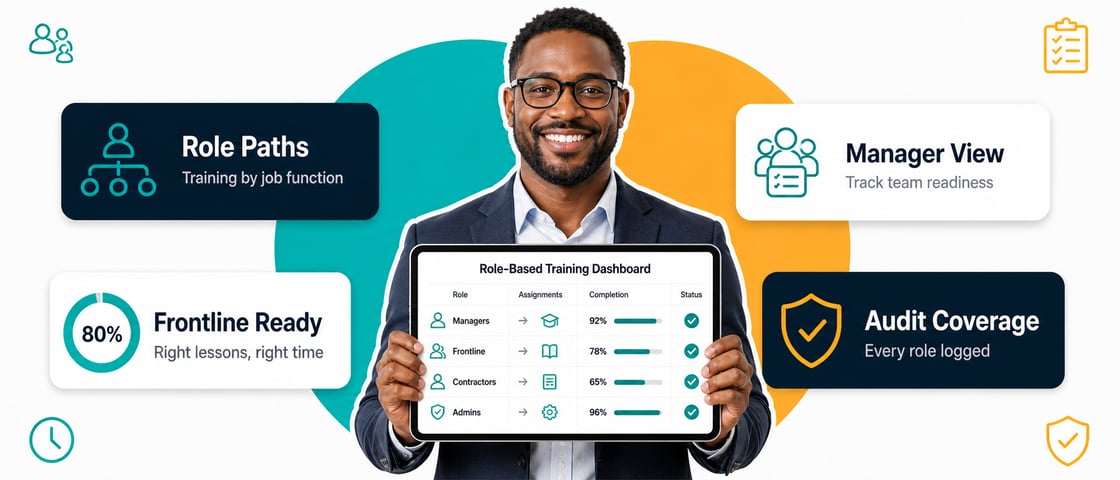
Role-based compliance training assigns each employee the compliance courses their job, department, location and risk level require, and refreshes them on a schedule that matches that risk. Build it as a training matrix: list the roles, list the obligations, map one to the other, set refresh periods and let your HRIS trigger enrollment when people join, move or leave. UK law points the same way: the duty to train is tied to the work someone does, and several regimes expect training to be repeated or kept regular.
- Training follows the job. The Money Laundering Regulations 2017 and the Management of Health and Safety at Work Regulations 1999 both tie training to what someone's work involves.
- One course list for everyone fails twice. Some people are over-trained, and the roles that carry real risk are under-trained.
- A matrix is the working tool. Roles on one axis, obligations on the other, with an owner and a refresh period for every cell.
- Risk sets the refresh cycle. The law says "regularly" or "periodically where appropriate", so you choose the interval and write down why.
- Job changes are the weak point. New starters, movers and leavers are where manual assignment breaks, which is why enrollment should come from your HRIS.
Most compliance programs start by assigning every course to every employee. It is quick to set up, until the organization opens a second office, hires a finance team or starts handling sensitive customer data, and the single list stops matching the risk.
This guide is for HR, L&D and compliance leads in UK and global organizations. It explains what role-based compliance training is, shows how to build a training matrix step by step, covers risk levels, refresh frequency and the job-change moments that cause gaps, and ends with the measures worth tracking. UK legal points are cited to the legislation or regulator. If you operate elsewhere, treat them as examples of the pattern and check local law.
What is role-based compliance training?
Role-based compliance training is the practice of assigning compliance courses according to what a person's job exposes them to, instead of giving every employee the same list. Four factors usually decide the assignment:
- Role. A payroll analyst, a warehouse operative and a recruiter face different compliance risks.
- Department. Finance, HR, sales and operations each carry their own obligations, such as anti-money laundering checks, employment law or product safety.
- Location. Site, country and regulator change which rules apply. The Equality Act 2010, for example, applies in Great Britain, not across the whole UK.
- Risk level. Handling client money or personal data, working at height or supervising others raises the depth and frequency of training.
A baseline still applies to everyone, such as data protection, health and safety basics and your code of conduct. Role-based training adds layers on top of that baseline for the people who need them.
Why one-size-fits-all training fails
A universal course list looks fair and easy to audit. In practice it creates three problems.
Over-training dilutes attention. A warehouse operative assigned an anti-money laundering course learns to click through compliance training, and the habit carries over to courses that matter.
Under-training leaves risk uncovered. A baseline course cannot cover what a finance approver or a data protection lead needs to know. The regulators who write the rules expect training to reach that depth. The Money Laundering Regulations 2017 (regulation 24) require firms to take appropriate measures so that relevant employees, whose work is relevant to compliance with the Regulations or could contribute to spotting or preventing money laundering, are made aware of the law and regularly trained to recognize and deal with suspicious transactions. They must also keep a written record of the training given.
Gaps appear when people move. The Management of Health and Safety at Work Regulations 1999 (regulation 13) require adequate health and safety training on recruitment and again when someone is transferred, given a change of responsibilities, or exposed to new work equipment, technology or systems of work. A single list assigned at hire does not cover those moments.
How to build a role-based training matrix
A training matrix is a grid that shows, for every role, which courses are required, how often they refresh and who owns them. It is the document a manager, an auditor or a new compliance lead can read in two minutes. Build it in six steps.
List your obligations
Start with the laws, regulator rules, contracts and internal policies that require training. Include sector rules, such as FCA expectations, and location rules for each country.
Define your roles and groups
Group by what people do, whatever their job title says. Examples: people managers, finance approvers, client-facing staff, data handlers, site-based staff and contractors.
Map obligations to roles
For each role group, mark the courses that are required, recommended or not needed. Keep the baseline for everyone, then add the role layers.
Assign a risk level
Rate each role and course combination as high, medium or low, using the questions in the next section. The rating sets the refresh period.
Set owners, deadlines and refresh periods
Name one owner per course, give new starters a completion window, and set the refresh interval. Record the reason for each interval so you can explain it later.
Connect it to your HR data
Role, department, location and manager already live in your HRIS. Use them as the rules that trigger enrollment, so the matrix runs without a spreadsheet and a person remembering to update it.
Here is a simplified example matrix. Your courses, groups and intervals will differ, so treat it as a template.
| Course | All staff | People managers | Finance and payments | Site-based staff | Risk |
|---|---|---|---|---|---|
| Data protection | Required | Required | Required, advanced | Required | High |
| Health and safety basics | Required | Required | Required | Required | Medium |
| Manual handling | - | - | - | Required | Medium |
| Anti-money laundering | - | Awareness | Required | - | High |
| Fraud and bribery | Awareness | Required | Required | Awareness | Medium |
| Equality and harassment | Required | Required, with manager scenarios | Required | Required | Medium |
Risk levels and refresh frequency
The law rarely names a number of months. Regulation 13 of the 1999 Regulations says health and safety training should be repeated periodically where appropriate. The Money Laundering Regulations 2017 say relevant employees must be regularly trained. The FCA tells firms they must review employee competence and training needs regularly, taking account of changes in the market, products, regulation and legislation. The interval is your call, and you need to be able to defend it.
Three questions help you set it:
- How severe is the harm if this goes wrong? Injury, regulatory action and large financial loss justify shorter cycles.
- How often does the rule or process change? Fast-moving areas need updates when the rule changes, not only on the calendar.
- Has something already gone wrong? An incident or audit finding is a reason to retrain early.
| Risk level | Typical roles | Example refresh | Extra triggers |
|---|---|---|---|
| High | Finance approvers, data protection leads, safety-critical roles | Every 6-12 months | Law or policy change, incident |
| Medium | People managers, client-facing staff | Every 12-24 months | Role change, new system |
| Low | Baseline topics for staff with limited exposure | Every 24-36 months | Policy change |
Write the reason next to each refresh period in your matrix, for example "12 months: high-risk, rules updated yearly". When a regulator or auditor asks why, the answer is already on the page.
New starters, role changes and leavers
Most gaps in a role-based program open at the edges: someone joins, moves team or leaves. Each event needs a rule, not a reminder in somebody's calendar.
New starters. Assign the baseline and the role layer on the start date and give a clear completion window. Regulation 13 of the 1999 Regulations expects health and safety training on recruitment, so do not wait for the next annual campaign. For data protection, the ICO's training and awareness toolkit recommends induction and refresher training for all staff, plus additional training for specialist roles.
Role changes. When someone moves into a role with higher risk, the new layer should be assigned automatically, with a deadline, and the old record should stay on file. A promoted team member now needs the manager content, for example.
Leavers. Deactivate access on departure and keep the training record for as long as your retention policy requires. Under regulation 24 of the Money Laundering Regulations 2017, regulated firms must keep a written record of the training given, and an auditor may ask about people who have since left.
Contractors and agents. The Money Laundering Regulations apply the training duty to agents as well as employees where their work is of the relevant kind. Include contractors in your matrix.
Measuring role-based compliance training
Completion rate alone says little when the audience differs by role. Track these instead, by role group, department and location:
- Coverage. The share of people who have every course their role requires assigned. A gap here means the matrix and the HR data disagree.
- Completion on time. The share finishing within the deadline, shown separately for new starters, who carry the most risk.
- Overdue by manager. Which teams carry the backlog, so you chase the manager and not the whole company.
- Refresh compliance. How many high-risk learners are inside their refresh period today.
Review the matrix itself twice a year, or whenever a law, process or reporting line changes. A matrix nobody revisits becomes the single list you were trying to escape.
How 5Mins helps
5Mins is built to run a role-based program without extra admin. Here is what that looks like in practice:
- Automatic enrollment. 5Mins connects to 100+ HRIS platforms, so role, department and location data can trigger assignment when people join or move.
- Reminders where people work. Course reminders arrive in Slack, Microsoft Teams, email and push.
- Manager visibility. The Team Progress Email gives managers their team's overdue courses and courses due in the next 30 days.
- Content to fill the matrix. 500+ accredited compliance courses, kept up to date as regulations change, plus the AI Course Creator in AI Studio for your own policies.
- Records. The audit log can be exported as CSV.
- Completion. 5Mins delivers 95%+ completion, built on microlessons of about 5 minutes.
Candyspace, a 5Mins customer, reports 58% less compliance time. You can read how the compliance training solution works, or start a free trial to see the learner experience first. Free access needs no credit card.
Conclusion
Role-based compliance training matches the training to the work. Start with the obligations, group people by what they do, rate the risk, set refresh periods you can explain and let your HR data trigger enrollment. Then measure coverage and overdue work by role, and revisit the matrix twice a year.
FAQ: role-based compliance training
What is role-based compliance training?
It is compliance training assigned by role, department, location and risk level, instead of one course list for everyone. Everyone gets a baseline, and higher-risk roles get extra courses and shorter refresh cycles.
Is role-based training a legal requirement in the UK?
Several laws tie training to the work someone does. The Money Laundering Regulations 2017 (regulation 24) cover relevant employees, the Health and Safety at Work etc. Act 1974 (section 2(2)(c)) requires necessary training, and the 1999 Management Regulations (regulation 13) require training on recruitment and on a change of responsibilities. None of them says you must use a matrix, but a matrix is a practical way to show you met the duty.
How often should compliance training be repeated?
The law generally says "regularly" or "periodically where appropriate" and leaves the interval to you. Set it by risk: shorter for high-risk roles, longer for low-risk baseline topics, and earlier when a law, process or incident changes things. Record the reason for each interval.
Does UK GDPR require staff training?
Article 39(1)(b) of the UK GDPR lists awareness-raising and training of staff involved in processing as part of the monitoring tasks of a data protection officer. The ICO's training and awareness toolkit recommends induction and refresher training for all staff, with more for specialist roles.
How do you handle people who change roles?
Assign the new role's courses automatically when the HR record changes, set a deadline and keep the old training record. Regulation 13 of the 1999 Management Regulations expects health and safety training when someone is transferred or given a change of responsibilities.
Sources
- Money Laundering, Terrorist Financing and Transfer of Funds (Information on the Payer) Regulations 2017, regulation 24 (training), legislation.gov.uk
- Health and Safety at Work etc. Act 1974, section 2, legislation.gov.uk
- Management of Health and Safety at Work Regulations 1999, regulation 13 (capabilities and training), legislation.gov.uk
- UK General Data Protection Regulation, Article 39 (tasks of the data protection officer), legislation.gov.uk
- Training and awareness toolkit, Data protection audit framework, ICO, ico.org.uk
- Training and competence, FCA, fca.org.uk
This article gives general information on compliance training and related UK law as of November 2026. It isn't legal advice, so check your obligations with a qualified adviser.

Saurav Chopra
Founder & CEO, 5Mins
Saurav is a serial HR tech entrepreneur on a mission to solve workplace challenges with technology. He previously co-founded Perkbox, the global employee experience platform now serving 5,000+ employers and 3M+ employees, before exiting to Great Hill Partners. His latest venture, 5Mins AI - the "TikTok of workplace learning" - combines generative AI, microlearning, gamification and peer learning to deliver a highly engaging learning experience for HR and compliance teams. Saurav holds an MBA from London Business School and an engineering degree from IIT Delhi, and is the recipient of the Barclays Scale Up Entrepreneur of the Year award.
More articles by Saurav
 James Francis
 Madlena (Maddie) Pozlevic

 Saurav Chopra