










Dementia Awareness training

Six microlessons on the types of dementia, how it affects people, communication, dementia-friendly environments, person-centered planning and living well, with situational tests and a certificate of completion.

Start free trial
G24.6Capterra4.7
Dementia Awareness (UK) course preview
6Short, TikTok-style microlessonsIn the browser or the iOS and Android apps

Compliance teams that chose 5Mins

Read their stories
Collingwood nsave ICAB Delamode LOQBOX Kennedys GSK Student Cribs Millennium Hotels Paris Baguette
  • 2Assessments
  • 6Microlessons
  • IncludedCertificate of completion
About this course

What the Dementia Awareness course covers

This course helps care teams support people living with dementia in six microlessons. It covers the main types of dementia and how to spot delirium, the impact on the person and their family, communication that reduces distress, dementia-friendly environments, person-centered care planning under the Mental Capacity Act 2005, and how to help people live well through meaningful activity.

Learning outcomes

What your people will be able to do

  • Identify the main types of dementia and recognize delirium and sudden changes
  • Use person-centered communication to reduce distress
  • Understand behavior as communication and spot non-verbal signs of pain
  • Make changes to the environment that improve safety and independence
  • Apply Mental Capacity Act principles, including advance decisions and lasting power of attorney
  • Plan meaningful activities and non-drug approaches that support wellbeing
Course contents

6 microlessons

Each microlesson is a short, TikTok-style video lesson, with knowledge checks along the way.

1Understanding Dementia
2How Dementia Affects the Person
3The Importance of Good Communication
4Dementia-Friendly Environments
5Active Planning and Active Caring
6Living Well With Dementia

  1. Understanding Dementia: Dementia as an umbrella term, the main types and how to spot delirium.
  2. How Dementia Affects the Person: How dementia affects someone emotionally and practically.
  3. The Importance of Good Communication: Communication that reduces distress, and behavior as communication.
  4. Dementia-Friendly Environments: Simple changes to surroundings that support safety and independence.
  5. Active Planning and Active Caring: Life story work, person-centered care plans and planning ahead.
  6. Living Well With Dementia: Meaningful activity, music and wellbeing.
A 5Mins certificate of completion for Dementia Awareness (UK), lying on a desk next to a laptop
Certificate

A certificate for every learner who completes it

Learners finish every microlesson and complete the assessments. 5Mins then issues a certificate of completion for Dementia Awareness (UK).

  • Certificates and e-signatures stored against each learner
  • Audit-ready records, ready whenever an auditor asks
  • Completion shows on the Compliance Dashboard in real time
Audience and regulation

Who it's for and the law it covers

Who it's for

  • Care workers and support workers
  • Nurses and healthcare assistants
  • Domiciliary care teams
  • Activity coordinators and team leaders

Laws covered

  • Mental Capacity Act 2005. Capacity is presumed, assessed decision by decision, and supported by tools such as advance decisions and lasting power of attorney.
  • Equality Act 2010. Dementia can be a disability, so services must make reasonable adjustments.
How it runs in 5Mins

Assign it once, then let 5Mins do the chasing

Every course in the 5Mins library runs on the same zero-admin engine.

  • EnrollAuto-enroll

    Enroll people automatically from your HR system, with 100+ HRIS platforms supported.

  • RemindReminders

    Nudges by email, Slack, Microsoft Teams and push until the course is done.

  • RepeatRecurrence

    Set the course to repeat, for example every 12 months, and 5Mins re-enrolls people for you.

  • CertifyCertificates

    Certificates and e-signatures are issued and stored for every completion.

  • ProveAudit-ready records

    See who is complete, at risk or overdue on the Compliance Dashboard, and prove it any time.

Customer stories

Compliance teams that swapped chasing for results

Compliance, HR and L&D leaders on what changed when they moved their training to 5Mins. Pick a team to see what changed.

ComplianceCompliance Training Insurance, 205 colleagues 100%

compliance completion and pass rate since go-live

  • ~1 day saved on each compliance course (HR estimate)
  • Automated reminders and reporting

Since go-live, our compliance completion and pass rates are 100%, and it's the quickest we've ever got there. Automated reminders and reporting save us about a day per course.

Laura ChappellLaura ChappellHR Director, Collingwood
Read the Collingwood story
ComplianceCompliance Training Insurance and emergency accommodation 87%

less session time, from 2.5-3 hour sessions to modules of 25 minutes at most

  • 12 monthly sessions a year, up from 3-4
  • 95% content creation time saved

Our compliance sessions used to be two and a half to three hours in a room, and we could fit in three or four a year. Now we cover one topic a month, and I can see exactly what people are retaining.

Lucy WybornLucy WybornDirector of Learning and Development, ICAB
Read the ICAB story
ComplianceCompliance Training Legal services 80%

completion on mandatory training, up from 20%

  • Mobile microlessons finished between calls
  • Manager view of each team's progress

We were sitting at 20% completion on our mandatory training. We're now at 80%. People finish short lessons between calls, on mobile, and managers can see where their teams are, so chasing completion is no longer a one-person job.

Jamie WaltonJamie WaltonGroup Learning and Development Officer, Winn Solicitors
See more customer stories
ComplianceCompliance Training Fintech and digital banking On demand

training log showing who did what, when, and the pass rate

  • Any device phone or laptop, at their own pace
  • Rolling refreshers through the year

When I engage with the FCA, I can show that every team has had training tailored to their role, that it's up to date, and that it runs throughout the year, with a full log of who's done what.

Abdul GofurAbdul GofurHead of Compliance & Anti-Financial Crime, nsave
Read the nsave story
★ Free sample lesson

See 5Mins in action with a free sample lesson

Interested in Dementia Awareness training? Request a free sample lesson, book a short demo with our team, and we'll share your sample lessons after the call.

  • Real microlessons from our library
  • A short demo with our team
  • No card needed

Get a free sample lesson

Use your work email so we can arrange your demo.

We'll use your details to arrange your demo and contact you about 5Mins. See our privacy policy.

Free course catalogues

Take the catalogues with you

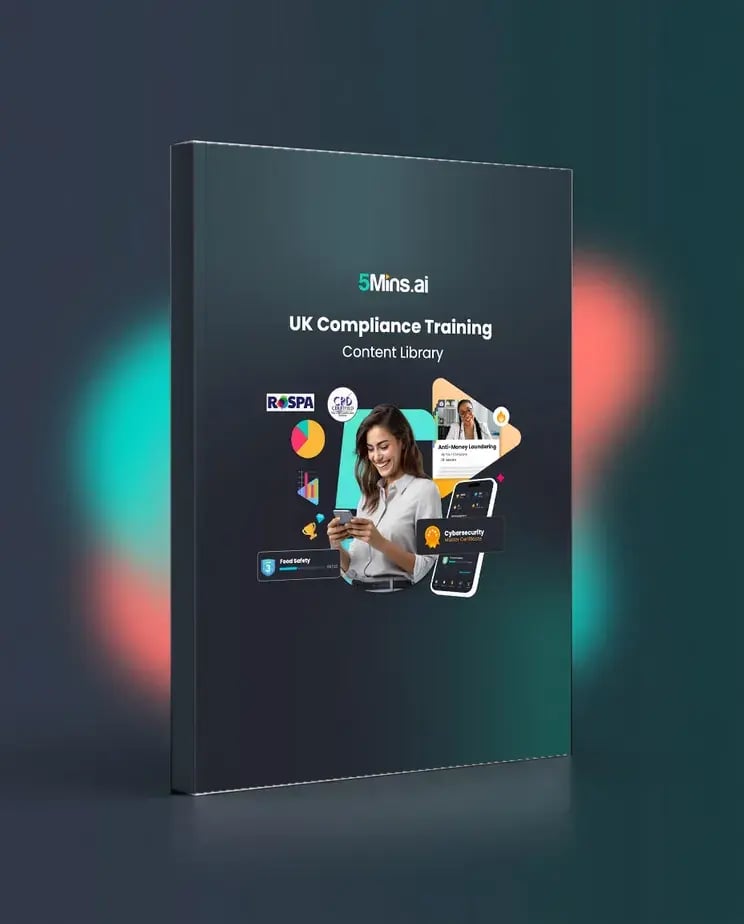
Free PDF catalogues to share with your compliance lead, your managers or your board.

Health & Social Care Compliance Catalogue cover
Health & social care

Health & Social Care Compliance Catalogue

Compliance training for health and social care teams, helping you meet regulatory standards and keep staff, patients and the people you support safe.

UK Compliance Catalogue cover
UK compliance

UK Compliance Catalogue

Built for UK organizations, covering GDPR, RIDDOR, Martyn's Law, employment law and the regulations your team needs day to day.

Global Compliance Catalogue cover
Compliance

Global Compliance Catalogue

Stay compliant across every market you operate in, with regulatory training covering GDPR, data protection, workplace safety and more.

Browse all course catalogues

Your questions answered

Questions about Dementia Awareness training

How long is the Dementia Awareness course?

It's made up of 6 microlessons, each under 5 minutes. Learners can finish it in one sitting or spread it over a few days, and 5Mins sends reminders until it is done.

Is there a certificate?

Yes. Learners get a certificate of completion once they finish every microlesson and complete the situational tests. The record is stored in 5Mins for audits.

What is the difference between dementia and delirium?

Dementia usually develops gradually and gets worse over time. Delirium comes on suddenly, often with infection or illness, and needs urgent attention. The first microlesson explains how to tell them apart.

Why is behavior described as communication?

People with dementia may not be able to say they are in pain, scared or bored, so changes in behavior can be how they tell you. The third microlesson shows how to respond.

How often should staff take dementia training?

Cover it during induction and refresh it regularly. In 5Mins you can set the course to repeat, for example every 12 months.

Can I try the Dementia Awareness course first?

Yes. Request a free sample lesson and book a short demo with our team. After your demo, we'll share sample lessons with you so you can see the format for yourself.

Get started

Give your people compliance training they'll actually enjoy

Assign Dementia Awareness and 5,000+ other micro courses in minutes, or turn your own policies into microlessons with AI Studio.

Start free trial