


Contents
- 1What a compliance course library actually gets you
- 2What custom compliance training actually costs you
- 3Course library vs. custom training vs. AI-generated: side by side
- 4When generic content is enough
- 5When you need company-specific training
- 6The hybrid model: how AI is closing the build-vs-buy gap
- 7How to decide: a quick framework for HR and compliance teams
- 8The short version
- 9Course library vs. custom training FAQs
- 10Sources
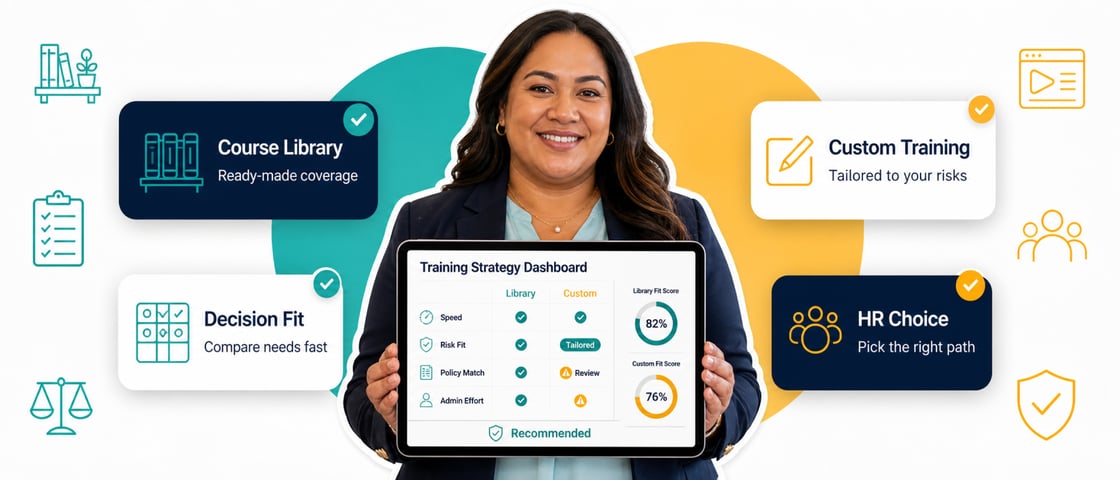
Most HR and compliance teams shouldn't choose between a compliance course library and custom training. Use both. License a library for topics that read the same at any employer, like harassment prevention or GDPR basics, and keep custom or AI-converted training for procedures, systems and jurisdictions that are specific to you. Libraries go live in days at a low per-seat cost. Custom modules cost $3,000 to $25,000 for 15 to 20 minutes of content1 and take weeks to months to build.
- Libraries win on speed and cost for generic risk. Harassment prevention, GDPR basics and cybersecurity awareness are covered in days, not months.
- Custom training earns its cost when the risk is yours alone. Your jurisdiction, your systems and your procedures justify a build. Content that would read the same anywhere doesn't.1
- Building is slow. Chapman Alliance found basic eLearning takes an average of 79 hours of production per finished hour, and custom modules typically run $3,000 to $25,000 each.1,2
- AI has changed the build side. 87% of L&D teams in Synthesia's survey were using AI, though only 57% actively and the rest in pilots.3
- A hybrid beats one lane. Candyspace's People Team reports useful content is in the library 80% of the time, so they only plan the rest.10
- The real question is whether the risk in front of you is generic or specific to your organization. Test every topic before you sign a contract.
A vendor demo just showed you hundreds of ready-made compliance courses. Meanwhile your risk team wants training built from your own policies, not content licensed by a hundred other companies. Both requests are reasonable. You have a budget review in two weeks.
Custom compliance training runs $3,000 to $25,000 per 15-to-20-minute module.1 A library subscription usually costs a fraction of that per employee, per year. That gap is why this decision stalls in committee. This guide compares a compliance course library with custom training and AI-generated courses, shows when each one earns its cost, and gives you a framework to decide.
What a compliance course library actually gets you
A compliance course library is pre-built content you license rather than commission. Providers cover the topics that look the same at almost any employer: harassment prevention, GDPR essentials, anti-money laundering fundamentals, fire safety, competition law. You pick the courses and assign them. The content arrives written and tested.
The advantages are real. You're compliant in days, not months. Publishers handle regulatory refreshes, so nobody on your team has to track every amendment to data protection guidance or workplace violence law. 5Mins, for example, keeps its compliance content up to date as regulations change, across 500+ accredited compliance courses. And libraries are the quickest route to online delivery, which 92% of organizations now use for at least some mandatory compliance training.4
Financial integrity (AML, KYC, fraud), cybersecurity and data protection, workplace conduct and DEI, health and safety, sustainability and ESG, and trade compliance. That covers most of a typical audit checklist without a separate vendor for each topic.
The limits show up fast, though. You're licensing the content, not owning it, so if you switch vendors the courses go with them. You can lightly customize a library course (your logo, your pass mark, a reordered module sequence), but you can't fix a scenario that doesn't match how your teams work. When a course feels built for nobody in particular, people notice. Generic examples and unfamiliar scenarios are a common reason engagement lags behind training built around real workflows.5
Libraries are the right call when the regulation is the same for every employer in your industry, the topic doesn't touch your internal systems, and speed matters more than depth.
What custom compliance training actually costs you
Custom training is commissioned. A team, internal or an agency, builds a course around your procedures, obligations and risk profile. That's the whole value proposition: content that would be wrong if you handed it to a different company. It's also the whole cost driver.
Chapman Alliance's survey of 249 organizations, one of the most cited benchmarks in instructional design, puts basic (Level 1) eLearning at an average of 79 hours of development per finished hour. Interactive (Level 2) content averages 184 hours.2,11 The data dates from 2010, so treat it as a ratio rather than a current price list. Custom compliance modules typically run $3,000 to $25,000 for 15 to 20 minutes of finished content,1 and a multi-course compliance program can clear $300,000 before translation or LMS integration enter the budget.6
What does that buy you? Scenarios drawn from your real procedures. A record that shows a regulator not just that training happened, but that it covered the exact obligation in question. Brandon Hall Group research, as cited by Wagons Learning, reports organizations using customized content see 42% higher employee engagement and 38% better knowledge retention than with generic courses.7 That's the return custom training is supposed to deliver, but only when the risk it covers is specific to your organization.
Spend on custom when a mistake carries consequences tied to your jurisdiction, role structure or procedures. Don't spend it on content that would read the same at any employer.
Course library vs. custom training vs. AI-generated: side by side
No single approach wins on every factor. Here's how the three compare on what HR and compliance teams actually get judged on.
| Factor | Course library | Custom training | AI-generated (from your documents) |
|---|---|---|---|
| Speed to launch | Days | Weeks to months per module | Hours to days, plus expert review |
| Typical cost | Per-seat license fee, low relative to a custom build | $3,000-$25,000 per 15-20 minute module1 | Usually part of a platform subscription |
| Who owns the content | Vendor (license expires) | Your organization | Your organization |
| Reflects your internal procedures | No | Yes | Yes, if built from your policies and SOPs |
| Accuracy for your jurisdiction | Generic, covers common standards | Built to your specific regulations | Depends on the source documents |
| When a policy changes | Vendor-controlled, automatic for law changes | Change order or in-house rebuild | Re-run the conversion, then review |
| Best for | Harassment prevention, GDPR basics, cybersecurity awareness | Machine-specific safety, proprietary systems, jurisdiction-heavy AML | Turning existing SOPs and handbooks into training fast |
When generic content is enough
Run a simple test before you commission anything. Read the off-the-shelf course as if you were the auditor. If everything in it is true for your organization and nothing important is missing, a library course is fine. General data privacy awareness, standard harassment prevention and baseline cybersecurity hygiene usually pass, because the regulation and the risk are the same whoever delivers the training.
Budget discipline matters here. Spending thousands to custom-build a course that a library subscription already covers is plain waste.
When you need company-specific training
The moment a course touches your internal systems, your procedures or a jurisdiction with unusual local rules, the answer flips. A financial services firm's AML training has to reference its actual transaction monitoring system, not a generic instruction to "flag suspicious activity." A manufacturer's machine safety training has to match the equipment on its floor, not a stock photo of a press nobody there has used.
Two factors carry the most weight. The first is whether the regulation itself is jurisdiction-specific, such as Quebec's Bill 96 French-language rules or California's workplace violence prevention mandates.8 The second is whether the risk depends on a procedure or system unique to you. A pharmaceutical company's Good Manufacturing Practice training, for example, should walk through its own batch records and deviation-reporting workflow. A generic GMP overview won't hold up if an inspector asks an employee to explain the real process. If either factor is true, a library course leaves a gap that shows up the first time an auditor or an incident tests it.
The hybrid model: how AI is closing the build-vs-buy gap
Here's what has changed in the past two years: you no longer have to pick between cheap and generic or accurate and slow. In Synthesia's 2026 survey of 421 L&D professionals, 87% were already using AI, with 57% using it actively and 30% running early pilots. Content and quiz drafting came second among use cases at 60%, behind voice and text-to-speech at 63%.3 Synthesia notes its sample probably over-represents early adopters, so read 87% as a ceiling for the wider profession, not an average.
Still, the direction is clear. Platforms built for this can take a policy handbook or an updated SOP and turn it into short lessons, with a human reviewer checking accuracy before anything ships. In 5Mins, AI Course Creator in AI Studio turns a long document into a full multi-lesson course, and Video Creator turns most documents into a video in about 10 minutes. Your documents are never used to train AI models. That closes most of the gap between "custom" and "fast." Collingwood, an insurance firm, has built 100+ courses in-house and estimates about a day saved per compliance course (an HR estimate).
The TalentLMS 2026 report, as summarized by elearningtrendz, warns that AI-generated content without governance can be fast but generic, or worse, inaccurate.9 Keep a subject matter expert in the approval loop before anything reaches employees. Apply the same discipline you would to a human-built course.
How to decide: a quick framework for HR and compliance teams
Skip the all-or-nothing debate. Treat it as a portfolio decision, not a single vendor contract.
List every mandatory training topic you run
From harassment prevention to role-specific safety procedures, get the full inventory in one place before you decide anything.
Run each one through the specificity test
Does it reference your systems, your procedures or a jurisdiction with unusual rules? If not, license it. If so, build it or convert it.
Reserve your build budget for what needs it
Candyspace, a digital agency with 50-100 employees, now finds useful content in the 5Mins library 80% of the time. Its People Team used to spend at least three to four days a month planning and creating content, and now spends a couple of hours.10 Compliance training time is down 58%.
That's where most teams end up: a library for topics that are the same everywhere, and custom or AI-converted content for the ones that aren't. Read the full Candyspace story, see the compliance training solution, or book a demo to see how a pre-built library sits alongside AI-converted policy training.
The short version
Ask, topic by topic, whether the risk is generic or yours. License the generic ones this quarter and spend your budget and expert time on the handful that need your name on them. Build those with an expert reviewing every output, whether a person or AI did the drafting.
Course library vs. custom training FAQs
Is a compliance course library enough to stay compliant?
For generic, universal topics, usually yes. Most libraries include completion tracking, certificates and automatic content updates that meet standard requirements. It stops being enough when a regulator or an incident tests a scenario specific to your procedures that the generic course never covered.
How much does custom compliance training cost?
Custom compliance modules typically run $3,000 to $25,000 for 15 to 20 minutes of finished content, depending on interactivity and production quality.1 A full multi-course program can exceed $300,000 once translation, LMS integration and multiple review cycles are included.6
Can AI convert our existing policies into compliance training?
Yes. Tools built for this can turn policies, SOPs and long documents into structured lessons in hours instead of the weeks a manual build takes, as long as a subject matter expert reviews the output before it goes live.
What's the difference between customizing an off-the-shelf course and building a custom one?
Customization changes the surface of a fixed course: your logo, your examples, your pass mark. Custom design starts from your actual requirements and can fix scenarios or omissions that customization can't touch.
How long does it take to build a custom compliance course from scratch?
Chapman Alliance's benchmark is an average of 79 hours of development per finished hour of basic eLearning and 184 hours for interactive content, from a 2010 survey.2,11 In practice, custom compliance builds take anywhere from two weeks to several months, depending on complexity.
Should we use a course library, custom training, or both?
Most organizations end up using both. License a library for topics that are identical at any employer, and reserve custom or AI-converted training for the procedures, systems and jurisdictions that are specific to you.
Sources
- Compliance Training Solutions: Custom vs. Off-the-Shelf, Neovation eLearning, June 2026, neovationelearning.com
- Time Estimates for Elearning Development, Christy Tucker / Experiencing eLearning, citing Chapman Alliance research, December 2025, christytuckerlearning.com
- AI in Learning & Development Report 2026, Synthesia, synthesia.io
- 2025 Training Industry Report, Training Industry, cited via LearnExperts, December 2025, learnexperts.ai
- Custom vs. Off-the-Shelf eLearning: Why Tailored Training Wins Every Time, Udutu, February 2025, udutu.com
- Custom eLearning Development: What It Costs and What Impacts Pricing, AllenComm, April 2026, allencomm.com
- Microlearning: A Game-Changer for Corporate Training in 2026, Wagons Learning, citing Brandon Hall Group research, March 2026, wagonslearning.com
- Off-the-shelf vs. custom compliance training: Your 2026 decision guide, Absorb LMS, December 2025, absorblms.com
- The State of AI in Corporate Learning 2026, elearningtrendz, citing the TalentLMS 2026 report, elearningtrendz.com
- Candyspace customer story, 5Mins, 5mins.ai
- How long does it take to create learning? Chapman Alliance, September 2010 (249 organizations), slideshare.net
This article gives general information. It isn't legal advice, and regulatory requirements vary by jurisdiction and organization, so speak to qualified counsel about your circumstances.

Saurav Chopra
Founder & CEO, 5Mins
Saurav is a serial HR tech entrepreneur on a mission to solve workplace challenges with technology. He previously co-founded Perkbox, the global employee experience platform now serving 5,000+ employers and 3M+ employees, before exiting to Great Hill Partners. His latest venture, 5Mins AI - the "TikTok of workplace learning" - combines generative AI, microlearning, gamification and peer learning to deliver a highly engaging learning experience for HR and compliance teams. Saurav holds an MBA from London Business School and an engineering degree from IIT Delhi, and is the recipient of the Barclays Scale Up Entrepreneur of the Year award.
More articles by Saurav
 James Francis
 Madlena (Maddie) Pozlevic
 Saurav Chopra