


Contents
- 1What is SCORM, and what does it actually track?
- 2What is xAPI, and when is it worth the effort?
- 3SCORM vs xAPI vs native platform tracking: side by side
- 4What compliance teams actually need to track
- 5Where native microlearning tracking fits in
- 6A decision guide for non-technical buyers
- 7SCORM, xAPI and tracking FAQs
- 8Sources
SCORM tracks completion, score and time inside one LMS. xAPI tracks learning anywhere, but only if you run a Learning Record Store and have a data plan. SCORM 1.2 still accounts for 56% of global eLearning content, so it isn't going away. For most compliance teams the standard matters less than the output: timestamped completions, scores, certificates, policy versions, renewal dates, overdue reports and an export you can hand to an auditor.
- SCORM is a packaging standard with basic reporting. It reports completion, pass or fail, score and time, and only while the learner is in a live LMS session.
- SCORM 1.2 still covers 56% of global eLearning content. Every LMS supports it, which is why compliance libraries default to it.
- xAPI tracks learning on mobile, in simulations and offline, but it needs an LRS, a budget and a reporting plan first.
- Auditors ask for evidence, not standards. Seven data points cover most requests, and only two of them come from SCORM itself.
- Platforms that track natively skip the packaging question for content built inside them. Every quiz answer, completion and renewal is tracked without a SCORM wrapper or an LRS. Standards only matter when you import or export.
Somewhere in your LMS procurement notes there's a line that says "must support SCORM and xAPI." Ask why and the honest answer is usually "the last vendor mentioned it" or "the instructional designer put it there."
Meanwhile the questions your auditor will ask have nothing to do with either acronym. Who completed the anti-bribery training? When? Which version of the policy did they see? Can you export the proof?
This guide explains SCORM, xAPI and native platform tracking in plain English. Then it flips the question. Start with the seven data points an audit asks for, and work backwards to the technology.
What is SCORM, and what does it actually track?
SCORM (Sharable Content Object Reference Model) is a set of rules from 2001 that lets a course built in one tool run inside any LMS. Think of it as a standard plug. An Articulate or Captivate course exports as a SCORM zip file, your LMS imports it, and the two can talk to each other.5
That conversation is narrow by design. A SCORM course can tell the LMS five things: completion status, pass or fail, a quiz score, time spent, and a bookmark showing where the learner stopped.1 For plenty of compliance training that's enough. It answers "did John Smith complete the fire safety module, and did he pass?" in a format auditors have accepted for two decades.6
The limits show up in practice, not in the brochure.
- It only works inside a live LMS browser session. Close the tab, lose the connection, or learn on a job site with poor signal, and SCORM goes dark.1
- It has a hard data ceiling. SCORM 1.2 caps its progress-saving field (suspend_data) at 4,096 characters. Long or complex courses can fail to save bookmarks without any warning. Learners report "losing progress" and completions don't record. SCORM 2004 raises the cap to 64,000 characters, which is one reason to ask which version your LMS supports.4
- It can't see anything outside the course. A workshop, a toolbox talk, a mobile refresher, a policy read in the handbook: all invisible to SCORM.6
You'll meet two versions. SCORM 1.2 has the broadest support. SCORM 2004 adds sequencing rules and the bigger data limit. If a vendor says "SCORM compliant," ask which version.5
What is xAPI, and when is it worth the effort?
xAPI (Experience API, formerly Tin Can) arrived in 2013 to track what SCORM can't. Instead of one course reporting to one LMS, any system can send a statement in an actor-verb-object format: "Jane completed Safety Drill Level 2," "Amir watched the AML video on mobile," "Priya passed the phishing simulation on her third attempt."1,5
Those statements flow into a Learning Record Store (LRS), a database that collects learning evidence from every source. That could be your LMS, a mobile app, a VR simulation, or an offline session that syncs when the connection returns.6 For compliance, that means event-level audit trails that don't depend on one vendor's logs. It also keeps your data portable if you switch platforms.4
The catch is cost and complexity. xAPI needs an LRS (built into some platforms, a separate purchase for others), technical skills to set up, and above all a reporting plan.8
Deploy xAPI without deciding which questions the data should answer, and you end up with thousands of granular statements per learner that can't answer a single compliance question. One analysis puts it bluntly: the system works technically while the analytics fail strategically.3
A quick word on cmi5. It's a newer specification that combines xAPI's rich tracking with SCORM-style rules for how an LMS launches and reads content. Keep it on your radar when buying new tools. Adoption in 2026 is still early, and it doesn't change the buying logic below.2,4
SCORM vs xAPI vs native platform tracking: side by side
| What matters to you | SCORM (1.2 / 2004) | xAPI + LRS | Native platform tracking |
|---|---|---|---|
| What it tracks | Completion, pass/fail, score, time, bookmark | Any learning event, anywhere (actor-verb-object) | Every lesson, quiz answer, streak and renewal in the platform |
| Works outside the LMS? | No, needs a live browser session | Yes, including mobile and offline with sync | Yes, if the platform has its own mobile apps |
| Infrastructure needed | None beyond the LMS | LRS plus technical setup and a data strategy | None, tracking is built in |
| Cost profile | Low, universally supported | Higher: LRS, tooling, skilled staff | Part of the platform subscription |
| Audit evidence | In-session proof: completed plus score | Event-level, portable audit trails | Timestamped completions, certificates, renewals, exports |
| Best for | Off-the-shelf course libraries, classic LMS compliance | Multi-system tracking, simulations, analytics programs | Frequent, mobile-first refreshers and policy rollouts |
What compliance teams actually need to track
Strip away the standards debate and an audit request comes down to seven data points.4 Whatever you buy, test whether it can produce all seven in under five minutes.
Completion status with timestamps
Not just "complete," but completed on which date and at what time. Timestamps settle deadline disputes.
Assessment evidence
The score, the pass threshold and ideally the number of attempts. "Passed with 85% on the second attempt" is defensible. "Watched the video" isn't.
Certificates
Generated automatically, tied to the individual and the course version, and retrievable years later.
Policy and course versions
When your anti-harassment policy changes, you need to prove who was trained on version 3 and who on version 2. SCORM's data model handles this worst, and auditors increasingly probe it.
Renewal and expiry dates
Annual refreshers, certification expiry and automated re-enrollment. A completion from 2023 doesn't cover a 2026 audit.
Overdue and exception reports
Who hasn't finished, who's close to a deadline, and which managers need to escalate. That's an operational report, not a standards feature.
Exportable audit logs
CSV or PDF evidence you can hand to an auditor or regulator without raising a support ticket with your vendor.
Look at what's missing from that list. Nothing requires xAPI, and only items 1 and 2 come natively from SCORM. Items 3 to 7 are LMS reporting features that sit on top of whichever standard delivers the content. So "do you support SCORM?" is the wrong first question in a demo. Ask "show me the overdue report and the audit export."
Where native microlearning tracking fits in
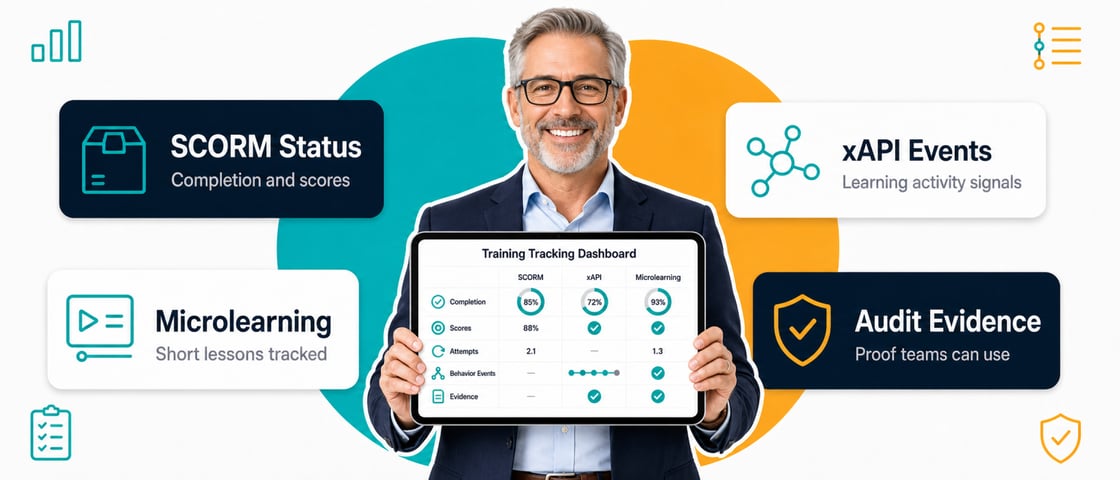
There's a third option the SCORM-versus-xAPI debate usually skips: don't package the content at all. When training is built and delivered inside a microlearning platform, tracking comes from the platform itself. It records every lesson, quiz answer, streak and renewal, with no standard bolted onto a zip file and no LRS to configure.
This matters most for the pattern SCORM handles worst: frequent, short, mobile-first refreshers. A monthly phishing drill built from microlessons of about 5 minutes generates cleaner completion data than one hour-long annual module, because people finish the format that fits their day. Bite-sized compliance training through 5Mins delivers 95%+ completion, against under 5% for legacy training. Learners watch in the browser or in the 5Mins iOS and Android apps. Managers get a Team Progress Email listing their team's overdue courses and courses due in the next 30 days, and the audit log exports as CSV.
Now the caveat. If your regulator mandates a specific accredited course that only ships as a SCORM file, or you've already invested in 500 SCORM courses, packaging standards still matter. Most compliance stacks in 2026 are hybrid: SCORM for accredited off-the-shelf modules, and native microlearning for refreshers, policy rollouts and anything mobile.7
A decision guide for non-technical buyers
SCORM is enough when your training is course-shaped, lives in one LMS, and your reporting needs are completion, score and certificate. That covers most annual mandatory training bought from a content library.7,8
xAPI earns its cost when you need to track learning across several systems, such as simulations, field training and coaching apps. You also need someone to own the LRS and define the reports before the data arrives.3,6
Neither is the point when your real problems are completion rates, chasing overdue learners, renewal automation and audit exports. Those are platform capabilities, not packaging standards. Ask every vendor to show the seven data points live.
One practical next step: take the list into your next vendor call and time each answer. A platform that makes you wait for a support ticket to produce an audit export will make you wait during an actual audit. That's the one moment you can least afford it.
SCORM, xAPI and tracking FAQs
Is SCORM or xAPI better for compliance training?
For standard LMS-delivered courses, SCORM is simpler, cheaper and universally supported, and auditors accept its completed-plus-score records.7,8 xAPI is better when you must evidence learning outside the LMS, such as field training, simulations or offline mobile sessions. Many organizations run both.
Do I need a Learning Record Store (LRS) to use xAPI?
Yes. xAPI statements need somewhere to go, and that's the LRS. Some platforms include one. Otherwise standalone options include SCORM Cloud, Watershed and Learning Locker.2 Budget for setup, integration and someone to own the reporting.
Is SCORM outdated in 2026?
No. SCORM 1.2 still accounts for 56% of global eLearning content and remains the default for compliance course libraries because every LMS supports it.2 It's limited, not obsolete. The practical risk is version-specific, like the 4,096-character progress-save limit breaking bookmarks in long SCORM 1.2 courses.4
What compliance training data should my LMS track for audits?
Seven things: timestamped completion status, assessment scores with pass thresholds, certificates, the policy or course version each learner saw, renewal and expiry dates, overdue and exception reports, and exportable audit logs. Test all seven in the vendor demo, not after purchase.
Can microlearning content be tracked without SCORM or xAPI?
Yes. Content built inside a microlearning platform is tracked by the platform itself: completions, quiz answers, renewals and device data, so no packaging standard or LRS is needed. Standards only come into play when you import external content or export learning records to another system.
What is cmi5 and should I care?
cmi5 combines xAPI's rich tracking with SCORM-style rules for how an LMS launches and interprets content, which makes records more comparable across vendors.4 It's worth asking about in new purchases, but adoption is still early in 2026, so don't let it block a decision.2
Sources
- xAPI vs SCORM: Choosing the Right eLearning Standard, iSpring Solutions, January 2026. View source
- SCORM vs xAPI: Which eLearning Standard Does Your LMS Need in 2026?, edzLMS, May 2026. View source
- SCORM vs xAPI: Key Differences & LMS Guide, LMSPedia, May 2026. View source
- xAPI vs SCORM for Compliance Training, Selleo, February 2026. View source
- SCORM vs xAPI Explained: Guide to eLearning Standards, CommLab India, May 2026. View source
- SCORM vs xAPI vs AICC: Choosing the Right Standard, Gyrus, March 2026. View source
- SCORM vs xAPI: Which Standard to Use in 2026?, Kompyl, May 2026. View source
- SCORM vs. xAPI vs. cmi5: Comparing eLearning Standards, CommLab India, December 2025. View source
This article is for general information. Statistics reflect published industry research as of July 2026 and were reviewed on 8 November 2026. Check your regulator's guidance for jurisdiction-specific record-keeping requirements.

Saurav Chopra
Founder & CEO, 5Mins
Saurav is a serial HR tech entrepreneur on a mission to solve workplace challenges with technology. He previously co-founded Perkbox, the global employee experience platform now serving 5,000+ employers and 3M+ employees, before exiting to Great Hill Partners. His latest venture, 5Mins AI - the "TikTok of workplace learning" - combines generative AI, microlearning, gamification and peer learning to deliver a highly engaging learning experience for HR and compliance teams. Saurav holds an MBA from London Business School and an engineering degree from IIT Delhi, and is the recipient of the Barclays Scale Up Entrepreneur of the Year award.
More articles by Saurav
 Saurav Chopra
 Madlena (Maddie) Pozlevic

 James Francis