.png?width=112&height=28&name=Logo%20(1).png)

 9 minute read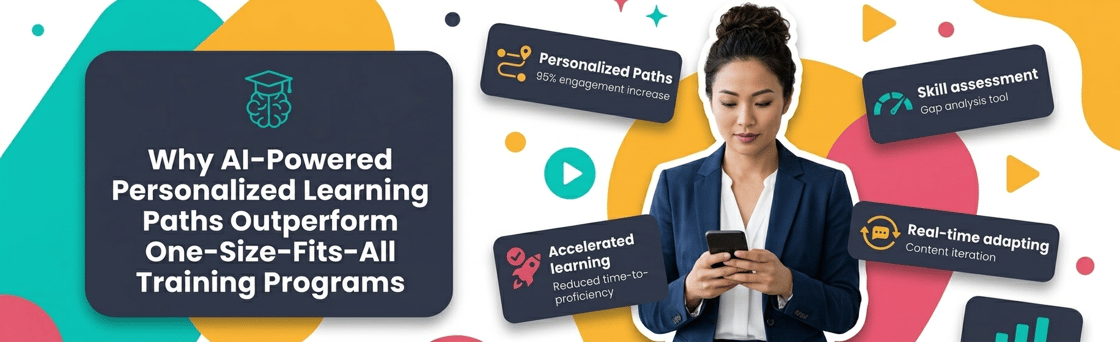
Your company spent thousands on a training program. The completion rate came back at 18%. Three months later, the same compliance incident it was meant to prevent has happened anyway.
The problem usually isn't the content. It's the delivery. Generic, one-size-fits-all training treats a new sales hire the same as a 10-year compliance veteran, a frontline hospitality worker the same as a remote software engineer. When training has no relevance to the individual receiving it, people stop paying attention - and the investment disappears.
AI-powered personalized learning paths change this equation. By adapting content, pace, and format to each individual learner, they consistently outperform generic programs on every metric that matters to business: completion rates, knowledge retention, time to competency, and employee retention. This article explains exactly how, and what the ROI data shows.

- 91% of employees want training that is personalized and relevant to their specific role - yet most organizations still deliver the same program to everyone.1
- Employees who receive personalized training are 3.5x more likely to report improved job performance (Gartner).2
- AI-powered onboarding reduces time to competency by up to 53% and improves new hire retention by 82%.3
- Companies leveraging AI-driven learning systems see 26% higher employee retention compared to those using traditional LMS platforms.4
- Only 23% of employees globally are engaged at work. Irrelevant training is one of the fastest ways to deepen disengagement - and relevant, personalized learning is one of the fastest ways to reverse it.6
- 5Mins.ai delivers AI-powered personalized learning paths with 95%+ completion rates, 60-80% reduction in training time, and 3-5x faster onboarding.15
The Real Cost of One-Size-Fits-All Training
Generic training programs carry a hidden cost that rarely shows up in L&D budgets: the cost of irrelevance. When employees sit through training that does not connect to their role, experience level, or daily responsibilities, they disengage - and disengaged employees cost the global economy $8.9 trillion in lost productivity annually, according to Gallup.6
The numbers are striking. Only 23% of employees worldwide are engaged at work. One of the most consistent causes of disengagement is training that feels like a box-ticking exercise rather than genuine development. A 2025 eLearning Industry report found that employees most commonly abandon training programs because the content feels irrelevant to their actual job.9
The ROI gap is measurable. Traditional e-learning completion rates sit below 20% for long-form programs. Companies continue to pour spend into training that the majority of employees never finish. When a training intervention is supposed to reduce compliance incidents or improve sales performance, a sub-20% completion rate means 80% of the workforce received no protection at all.
The structural problem is this: one-size-fits-all programs optimize for content delivery, not learning outcomes. They measure success by module launches, not behavior change. AI-powered personalized learning paths flip that model entirely.
What AI-Powered Personalized Learning Actually Means
Personalized learning is not just self-paced access to a content library. True AI-powered personalization adapts in real time based on each learner's role, prior knowledge, performance data, and behavior patterns.
There is an important distinction between adaptive learning and personalized learning. Adaptive learning adjusts the difficulty of content based on quiz performance - it's reactive. Personalized learning, driven by AI, goes further: it identifies skill gaps proactively, surfaces the right content at the right moment, adjusts the format and length based on how that individual learns best, and sequences the learning journey around their specific development goals.
In a workplace context, AI-powered learning paths typically work like this:
- The platform profiles each learner based on their role, team, seniority, prior training history, and skills gaps.
- The AI recommends a personalized sequence of content - prioritizing gaps, sequencing knowledge logically, and adapting based on what the learner completes and retains.
- Completion and assessment data feeds back into the algorithm continuously, refining future recommendations.
- Managers and L&D teams get real-time dashboards showing who has completed what, where knowledge gaps remain, and where compliance risks exist.
This is the difference between giving 500 employees the same 45-minute module and giving each employee the precise 5-to-10 minutes of content that closes their specific knowledge gap today.
The ROI Case: What the Data Shows
The performance gap between personalized and generic training is well documented. Here are the headline numbers:
| Metric | One-Size-Fits-All Training | AI-Powered Personalized Learning |
|---|---|---|
| Avg. completion rate | Under 20% | 80-95%+ |
| Knowledge retention (30 days) | 10-20% | Up to 70% |
| Time to competency | Baseline | Up to 53% faster |
| Employee retention impact | Minimal | +22-26% improvement |
| Content relevance to role | Generic | Role-specific, adaptive |
| Admin overhead | High (manual tracking) | Automated, real-time |
| Scalability | Linear cost increase | Scales without extra cost |
The retention data is particularly compelling for CFOs and HR Directors. According to Gartner, employees who receive personalized training are not just more effective - they are 2.5 times more likely to stay with their current employer.2 Given that replacing a single employee costs between 50-200% of their annual salary (SHRM), the ROI of personalized learning extends well beyond the L&D department.12
For L&D Managers, the completion rate data is the most immediately actionable. AI-generated content increases knowledge retention by up to 50% (IBM), while gamified, personalized experiences push completion rates to 90% compared to just 25% for non-gamified, generic equivalents.17 In compliance contexts, where training completion is both a legal requirement and a genuine risk management tool, this gap is the difference between protected and exposed.
The LinkedIn Workplace Learning Report (2026) captures the broader strategic direction: organizations making the most progress in learning are combining AI, career development, and measurable business outcomes. Personalized learning is the mechanism that connects all three.10
5 Ways AI Personalization Outperforms Generic Training Programs
1. Content relevance drives completion
Generic programs deliver the same content to a 22-year-old graduate intake and a 15-year company veteran. AI-powered paths filter out what each person already knows and serve only what is genuinely new and applicable to their role. When training connects to someone's daily work, completion becomes a natural outcome rather than a compliance checkbox.
91% of employees say they want training that is personalized and relevant to their day-to-day job (Continu, 2025).1 Platforms that deliver on this drive completion rates above 80%, compared to the sub-20% average for generic e-learning.
2. Pace adaptation reduces cognitive overload
One of the main reasons employees abandon training is cognitive overload. A 60-minute module forces every learner - regardless of prior knowledge - through the same information at the same speed. AI-powered platforms let employees move at their own pace, skip material they have already demonstrated competency in, and revisit sections where assessment data shows knowledge gaps.
58% of employees prefer self-paced learning, and self-paced programs consistently outperform scheduled group delivery on both completion and retention (SC Training, 2025).8
3. Role-specific pathways close the right skill gaps
A compliance officer and a sales manager might both need GDPR training - but the risks they face, the decisions they make, and the context that makes regulations meaningful are entirely different. Generic training cannot account for this. AI-powered learning paths build role-specific sequences from a shared content library, ensuring every learner gets the version of the training that is actually relevant to how they work.
49% of HR departments in the US already use AI to create personalized learning opportunities - and this number is accelerating rapidly (eLearning Industry, 2025).9
4. Real-time data replaces annual reviews
Generic training programs typically involve an annual training cycle and a completion report. AI-powered platforms provide continuous, real-time data: who completed what, when, where they dropped off, what they scored, and where knowledge gaps remain across teams, departments, and locations.
This data shifts L&D from reactive to proactive. Instead of discovering a skills gap after an incident, organizations can see it forming in the analytics and intervene before it becomes a problem. Businesses using AI-driven LMS platforms report a 30% reduction in time spent managing training programs, alongside a 45% increase in training program efficiency (Gartner, 2024).5
5. Personalization scales without extra cost
The commercial case for AI-powered personalization is strongest when you consider scale. Traditional customized training requires custom content development for each audience - expensive, time-consuming, and difficult to maintain. AI-powered platforms personalize from a shared library, meaning the cost of personalization stays flat as headcount grows.
The global personalized learning market is growing at 25.7% annually and is forecast to reach nearly $6 billion in 2025 (Business Research Company).11 Organizations that adopt AI-powered personalization now build a compounding advantage over competitors still delivering generic programs.
Personalized Learning Across Every Audience Type
One area where most competitors and commentators miss the mark: personalized learning is not just for desk-based knowledge workers. The ROI case is arguably strongest for frontline and deskless workers - the employees least well served by traditional training models.
Frontline and deskless workers
Retail staff, hospitality workers, field engineers, logistics teams - these employees cannot sit through a 45-minute desktop module between shifts. AI-powered mobile-first learning paths deliver 5-minute role-specific lessons at the right moment: a food safety refresher during a quiet period, a customer service scenario before a peak trading day. Completion rates for mobile-delivered microlearning regularly exceed 80%, compared to under 20% for desktop-first programs.
New hires and onboarding cohorts
AI-powered onboarding pathways reduce time to competency by up to 53% and improve new hire retention by 82% (Infeedo.ai, 2025).3 For high-turnover sectors, the productivity value of getting new hires to full effectiveness faster is often the single largest ROI driver from a personalized learning investment.
Leadership and management development
Leadership development is an area where one-size-fits-all training falls hardest. A new team leader and a senior executive need entirely different content, pacing, and framing. Managers who receive targeted training have 11% higher engagement scores than those who do not (Gallup), and teams led by trained managers show dramatically higher productivity and retention.14
Personalized learning paths serve each leadership tier with appropriate depth and relevance - building capability from the first management role through to C-suite development.
 How 5Mins.ai Delivers Personalized Learning at Scale
5Mins.ai is an AI-powered microlearning platform that delivers personalized learning paths through a TikTok-style, mobile-first experience. Instead of assigning the same training program to everyone, 5Mins uses AI to build individual learning pathways based on each employee's role, skill gaps, and goals.
Results 5Mins customers consistently achieve:
- 95%+ completion rates (vs under 5% for legacy LMS platforms)
- 60-80% reduction in training time
- 3-5x faster onboarding
- 50% better knowledge retention vs traditional methods
- 80%+ activation rates in the first week
With 20,000+ ready-made bite-sized lessons across compliance, leadership, Gen AI, and role-based training, teams can launch a fully personalized learning programme in days, not months - and without building a custom content library from scratch.
See it in action: fill in the form below to access the full course catalogue or book a personalized demo.
How to Move from Generic to Personalized Learning: A Practical Starting Point
Most organizations do not need to scrap their existing training investment to shift to personalized learning. The most effective transitions follow a phased approach:
Audit what you have
Map your current training assets against your employee population. Where are the biggest skill gaps? Which roles have the lowest completion rates? Which training has the highest drop-off? These are your starting priorities.
Choose a platform with AI-native personalization
Not all platforms that claim AI personalization deliver it. Look for real-time learning path adaptation, role-based content filtering, completion analytics at the individual level, and integration with your HRIS so the platform knows who each learner is from day one.
Start with high-stakes audiences
Compliance, onboarding, and sales training deliver the fastest measurable ROI from personalization. Launch with one audience, measure the results - completion rates, assessment scores, time to competency - and use that data to build the internal case for broader rollout.
Measure business outcomes, not just completions
Track what changes as a result of training: compliance incident rates, new hire ramp-up time, sales conversion rates, manager engagement scores. These are the numbers that justify L&D investment at board level.
If you are managing a tighter training budget alongside this transition, our guide on building a cost-effective microlearning programme covers the practical steps to delivering more training value with less spend.
Frequently Asked Questions
Personalized Learning FAQs
What is AI-powered personalized learning?
How does personalized learning improve employee retention?
What is the difference between adaptive learning and personalized learning?
What ROI can organizations expect from personalized learning platforms?
Can AI personalized learning work for frontline and deskless workers?
How do you measure the success of a personalized learning program?
The Bottom Line
Generic training programs are not failing because L&D teams are not trying hard enough. They are failing because the format itself cannot adapt to the people it is supposed to serve. One-size-fits-all training optimizes for delivery. Personalized learning optimizes for outcomes.
AI-powered personalized learning paths give every employee - whether a new frontline hire, a mid-level manager, or a senior executive - training that is relevant to their role, appropriately paced, and continuously refined based on how they actually learn. The business case is clear: higher completion rates, faster onboarding, better retention, and measurable ROI that justifies continued investment in people development.
5Mins.ai makes this accessible to any organization. With 20,000+ bite-sized lessons and AI-powered learning paths built around each individual employee, teams see results from week one - without the cost or complexity of building personalized training from scratch.
 Sources
- Corporate eLearning Statistics (2025), Continu - 91% of employees want personalized, role-relevant training; gamified content drives 90% completion rates vs 25% for non-gamified equivalents.
- Personalized Training Research, Gartner (via SuperAGI, 2025) - Employees who receive personalized training are 3.5x more likely to report improved job performance and 2.5x more likely to stay with their current employer.
- AI Onboarding Success Research, Infeedo.ai (via SuperAGI, 2025) - AI-powered onboarding reduces onboarding time by 53% and delivers 82% improvement in new hire retention rates.
- AI LMS Retention Study, Ruben, Arnaldo & Jose (2023), cited in The Learning OS (2024) - Companies using AI-driven LMS systems experience 26% higher employee retention vs traditional LMS.
- AI LMS Efficiency Research, Gartner (2024), cited in The Learning OS - 30% reduction in time managing training programs; 45% increase in training program efficiency after implementing AI-powered LMS.
- State of the Global Workplace (2025), Gallup - Only 23% of employees globally are engaged at work; disengaged employees cost the global economy $8.9 trillion annually.
- AI Knowledge Retention Research, IBM (via SuperAGI, 2025) - AI-generated content increases knowledge retention by up to 50%.
- Employee Training Statistics (2025), SC Training - 58% of employees prefer self-paced learning.
- Employee Training Statistics, Trends, And Data In 2025, eLearning Industry - 49% of US HR departments use AI to suggest or craft personalized learning opportunities.
- Workplace Learning Report (2026), LinkedIn - Organizations combining AI, career development, and measurable business outcomes make the most L&D progress.
- Personalized Learning Market Research, Business Research Company (2024) - Personalized learning market growing at 25.7% CAGR; forecast to reach nearly $6 billion in 2025.
- Employee Replacement Cost Data (2025), SHRM - Replacing a single employee costs 50-200% of their annual salary.
- AI and Adaptive Learning: Real-Time L&D Personalization, TechClass (2025) - Organizations using AI-driven L&D note a 22% improvement in employee retention rates.
- Manager Training Engagement Data, Gallup - Managers who receive training have 11% higher engagement scores than untrained peers.
- 5Mins.ai Customer Outcomes - 95%+ completion rates, 6-10x higher engagement, 60-80% reductions in training time, 3-5x faster onboarding, 80%+ first-week activation rates.
 This article is for informational purposes only and does not constitute legal, financial or professional advice. Statistics referenced are accurate as of publication and may change. Organizations should evaluate learning platforms against their own training requirements, regulatory obligations, and budget constraints before making purchasing decisions.
All content is researched and written by the 5Mins team.



Saurav Chopra







_transparent%20background.png)



.png)